
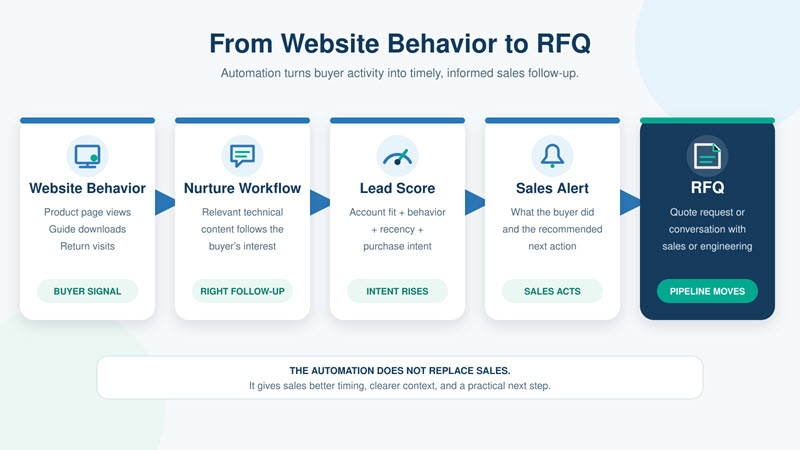
Industrial buyers rarely send a request for quote (RFQ) after one website visit. They read, compare, ask internal questions, disappear, come back, and involve other people before they are ready to talk.
A B2B marketing automation strategy gives that buying process structure. It helps manufacturers follow up based on what a buyer has shown interest in, not based on a generic newsletter calendar.
One recent study found 61% of B2B buyers prefer a rep-free buying experience, while 73% actively avoid suppliers that send irrelevant outreach. For technical buyers, the research window is even more important: the 2026 State of Marketing to Engineers research found that engineers spend 62% of the buying journey researching online.
That is the job of automation in industrial marketing: stay useful while the buyer is still researching, then alert sales when the account shows stronger intent.
Key Takeaways
- Manufacturing automation should adapt to buyer behavior, product interest, account fit, and buying stage.
- Engineers, procurement teams, distributors, and existing customers each need a distinct nurture path.
- Sales alerts should explain what the buyer did and recommend a clear next step.
- Lead scoring should account for fit, behavior, recency, and purchase intent.
- Measure performance through RFQs, sales-qualified leads, reactivated opportunities, and pipeline movement rather than email activity alone.
What B2B marketing automation means for manufacturers
B2B marketing automation is the use of customer relationship management (CRM) data, segmented lists, behavior triggers, email workflows, lead scoring, and sales notifications to move prospects through a longer buying process.
For manufacturers, it should not be treated as a bulk email tool.
It should connect the buyer’s behavior to the next useful step:
- A visitor downloads a tolerance guide, so they receive an application-focused follow-up.
- A distributor fills out a partner form, so the inquiry routes to the account owner.
- An existing customer views a related product page, so sales gets a cross-sell alert.
- A dormant opportunity returns to a high-intent page, so the rep gets a task.
Major B2B marketing automation tools are built around these kinds of actions. Marketing automation software uses CRM data to run workflows, segment contacts, score leads, send emails, and notify sales. Salesforce describes B2B marketing automation as automating segmentation, multi-channel outreach, lead scoring, and sales handoff across the funnel.
The tool matters. The strategy matters more.
Why long industrial sales cycles need structured follow-up
Manufacturing sales cycles stretch because the decision is rarely simple.
A buyer may need engineering review, production input, procurement approval, budget timing, vendor qualification, compliance checks, and management signoff. Gartner has also reported that buying groups can range from five to 16 people across as many as four functions, which means content has to help the group reach agreement, not just persuade one contact.
That creates four problems marketing automation can solve.
Buyers research before contacting sales
A technical researcher may visit a product page, download a guide, and compare suppliers long before submitting a request for quote (RFQ).
If your only follow-up is “Contact sales,” you are asking too much too soon.
A better path is:
- Send useful technical content.
- Offer a selection guide or application checklist.
- Show relevant proof.
- Invite a low-pressure consultation or RFQ when intent rises.
Evaluation can take months
Some industrial buyers are planning future projects. Others are replacing a failing component. Some are gathering options for next year’s budget.
Automation keeps the conversation alive without asking sales to manually remember every early-stage contact.
Multiple stakeholders enter at different times
An engineer may care about specs and compatibility. Procurement may care about supplier reliability, documentation, and commercial terms. An operations leader may care about downtime, lead times, or service support.
One email sequence will not serve all of them.
Not every qualified buyer is ready now
A lead can be qualified and still not be ready.
This is where many businesses lose pipeline. They treat “not now” as dead, then restart from zero when the same buyer comes back six months later.
A good automation program keeps that account warm with useful content and gives sales a signal when behavior changes.
What marketing automation should do before sales gets involved
A practical B2B marketing automation strategy should do five things.
1. Segment leads by fit and interest
Start with the fields that change the follow-up.
For manufacturers, useful segments often include:
- Product or service interest
- Industry or application
- Company type: OEM, distributor, end user, integrator, engineering firm
- Role: engineer, procurement, executive, operations, channel partner
- Buying stage: early research, comparison, RFQ-ready, customer, dormant opportunity
2. Trigger follow-up based on behavior
Behavior matters because buyers tell you what they care about before they ever speak to sales.
Useful triggers include:
- Viewed pricing, RFQ, or contact pages
- Downloaded a technical guide
- Revisited the site after 30, 60, or 90 days
- Clicked a comparison or selection checklist
- Opened several emails in a short window
- Visited a case study or application page
- Submitted a distributor, partner, or sample request
The trigger should match the next step. A person who reads a beginner article should not get the same email as a returning visitor who viewed the RFQ page twice.
3. Nurture technical and commercial stakeholders differently
Technical buyers need enough substance to validate fit. Commercial stakeholders need confidence that your company can support the purchase.
That means different content tracks.
Engineers may need:
- Application guides
- CAD, spec, or drawing request paths
- Compatibility notes
- Selection criteria
- Technical FAQs
Procurement and leadership may need:
- Supplier overview
- Quality and process proof
- Case-study-style examples
- Total cost of ownership points
- Implementation or support expectations
4. Alert sales when intent increases
Automation should not keep every lead inside marketing.
When a buyer takes a high-intent action, sales should know quickly. That may mean a task, email alert, CRM notification, Slack message, or account activity summary.
Examples of sales alerts:
- “Contact returned after 90 days and viewed RFQ page.”
- “Engineer downloaded selection checklist and case study.”
- “Existing customer viewed related product line twice this week.”
- “Distributor inquiry submitted; route to channel manager.”
The alert should tell sales what happened and what to do next.
5. Give sales context, not just a name
A CRM handoff that says “new lead” is weak.
Sales needs:
- Source campaign
- First conversion
- Last conversion
- Pages viewed
- Content downloaded
- Product interest
- Company type
- Lead score
- Lifecycle stage
- Notes from forms or prior conversations
Without that context, the rep starts cold even when the buyer has already shown intent.
B2B marketing automation examples for manufacturers
Here are four nurture paths that fit long industrial sales cycles.
| Nurture path | Trigger | Likely buyer | Follow-up content | Sales-alert threshold |
| Technical researcher | Downloads an application or specification guide | Engineer or project lead | Technical article, checklist, comparison worksheet | RFQ visit, repeat product views, or documentation request |
| Channel inquiry | Submits a partner form or views distributor content | Distributor principal or regional rep | Partner overview, line card, qualification questions | Immediate routing to channel owner |
| Customer cross-sell | Views a related product or application | Current customer contact | Application note and comparison guide | Multiple high-intent interactions |
| Dormant opportunity | Returns after an inactive or closed-lost period | Previous prospect | Updated technical content and review offer | Return to product, RFQ, or contact page |
CRM and sales handoff requirements
Marketing automation fails when the CRM is messy.
Before building complex workflows, define the handoff rules.
Lead scoring
Score both fit and behavior.
Fit signals:
- Industry
- Company size
- Account type
- Territory
- Product line match
- Customer vs. prospect
- Distributor vs. end user
Behavior signals:
- Product page views
- RFQ page visits
- Repeat visits
- Email clicks
- Guide downloads
- Case study views
- Form submissions
Do not let one click create a “hot lead.” A better score combines fit, recency, and intent.
Source tracking
Every lead should carry source data into the CRM.
Track:
- Original source
- Campaign
- First conversion
- Latest conversion
- Landing page
- Content offer
- Paid search term, when available
- Referring channel
This is how you connect automation to pipeline instead of reporting only opens and clicks.
Lifecycle stages
Define lifecycle stages before the workflows go live.
A simple manufacturing model may include:
- Subscriber
- Lead
- Marketing-qualified lead
- Sales-qualified lead
- Opportunity
- Customer
- Dormant opportunity
- Reactivated opportunity
Each stage needs an owner and a rule for movement.
Sales notes and feedback loops
Sales should be able to send feedback into the system.
Useful feedback options:
- Good fit, not ready
- Bad fit
- Distributor inquiry
- Existing customer
- Needs engineering review
- Pricing-only inquiry
- No response
- Recycled for nurture
That feedback improves segmentation, scoring, and future handoffs.
Metrics that matter
B2B email marketing automation should be measured by pipeline movement, not just email activity.
Track these first:
- Engagement by buying stage
- RFQ conversion rate
- Sales-qualified leads
- Pipeline influenced
- Reactivated opportunities
- Sales follow-up speed
- Opportunity source
- Content-assisted conversions
- Meetings or consultations booked
Open rates and click rates still matter. They show whether the content is getting attention.
But they do not prove the program is working.
For manufacturers, the better question is: did automation help the right accounts move closer to RFQ, consultation, sample request, distributor discussion, or sales-qualified opportunity?
B2B marketing automation best practices for industrial companies
Start smaller than you think.
A manufacturer does not need 40 workflows on day one. It needs a clean first path that sales trusts.
Build around one product line or buyer path first
Pick a high-value product line, application, or audience.
Build one nurture path from first conversion to sales handoff. Test it. Fix the CRM fields. Get sales feedback.
Then expand.
Write emails like a helpful sales engineer, not a newsletter
The best nurture emails are short and specific.
They say:
- Here is the guide you requested.
- Here is the application issue buyers usually miss.
- Here is a checklist your engineering and procurement teams can use.
- Here is when it makes sense to talk with us.
They do not say:
- “We are excited to share our latest update.”
- “In today’s fast-paced manufacturing environment…”
- “Our solutions are designed to meet your needs.”
Use automation to support sales, not replace it
Automation can identify timing. It can send useful content. It can route leads.
It cannot handle every technical nuance in a custom industrial sale.
The handoff still matters.
Keep the CRM clean
Bad data breaks automation quickly.
Common issues include:
- Duplicate contacts
- Missing company names
- No lifecycle stage
- Old owner assignments
- Inconsistent product interest fields
- No source tracking
- Leads routed to the wrong team
Fix these before adding more workflows.
Common pitfalls to avoid
Over-automating too early
Do not build a complicated system before you know the buyer paths.
Start with the obvious high-value paths:
- Technical download follow-up
- RFQ-intent alert
- Distributor inquiry routing
- Dormant opportunity reactivation
- Existing customer cross-sell
Sending generic newsletters
A newsletter can support awareness, but it is not a nurture strategy by itself.
A buyer comparing engineered components needs different content than a distributor evaluating your line card.
No sales ownership
If sales does not trust the lead score or understand the alerts, the system becomes noise.
Define what sales owns:
- Speed to follow up
- Notes entered into CRM
- Opportunity creation
- Disqualification reasons
- Recycle rules
- Feedback on lead quality
Poor CRM hygiene
Automation exposes bad data.
If the CRM cannot tell the difference between a student, a distributor, a customer, and an RFQ-ready buyer, the workflow will send the wrong message.
That is how automation becomes irrelevant outreach.
Build a better follow-up system for long-cycle industrial buyers
If your website is generating early-stage leads but too few RFQs, the gap may be follow-up, CRM alignment, and sales handoff.
We can help you build a marketing automation blueprint that connects content, CRM data, lead scoring, email workflows, and sales alerts around the way manufacturers actually sell.
Common Questions About B2B Marketing Automation for Manufacturers
What is a B2B marketing automation strategy?
A B2B marketing automation strategy is a plan for using CRM data, segmentation, behavior triggers, email workflows, lead scoring, and sales alerts to move prospects through a longer buying process.
Why does marketing automation matter for manufacturers?
It helps manufacturers stay visible while buyers research, compare options, involve stakeholders, and wait for the right timing. It also gives sales better context when a buyer becomes more active.
What are the best B2B marketing automation tools?
Common B2B marketing automation tools include platforms such as HubSpot and Salesforce Marketing Cloud Account Engagement. The best choice depends on CRM setup, sales process, data quality, budget, and internal ownership.
What should manufacturers automate first?
Start with one high-value path: technical content download follow-up, RFQ-intent alerts, distributor inquiry routing, dormant opportunity reactivation, or existing customer cross-sell.
How long should a nurture sequence be?
For industrial sales cycles, five emails is a practical starting point: educational article, application guide, comparison checklist, proof example, and RFQ or consultation CTA.
What metrics should marketing automation track?
Track RFQ conversion rate, sales-qualified leads, pipeline influenced, reactivated opportunities, engagement by buying stage, and sales follow-up speed. Email opens and clicks are useful, but they are not the final score.