Technical Storytelling Turns Complexity Into Buyer Confidence
Pipeline growth in high-ticket manufacturing marketing rarely increases the sales pipeline because of flashy campaigns. It moves when engineers, executives, procurement teams, and operations leaders can see what your product or service does, why it matters, and how it reduces risk.
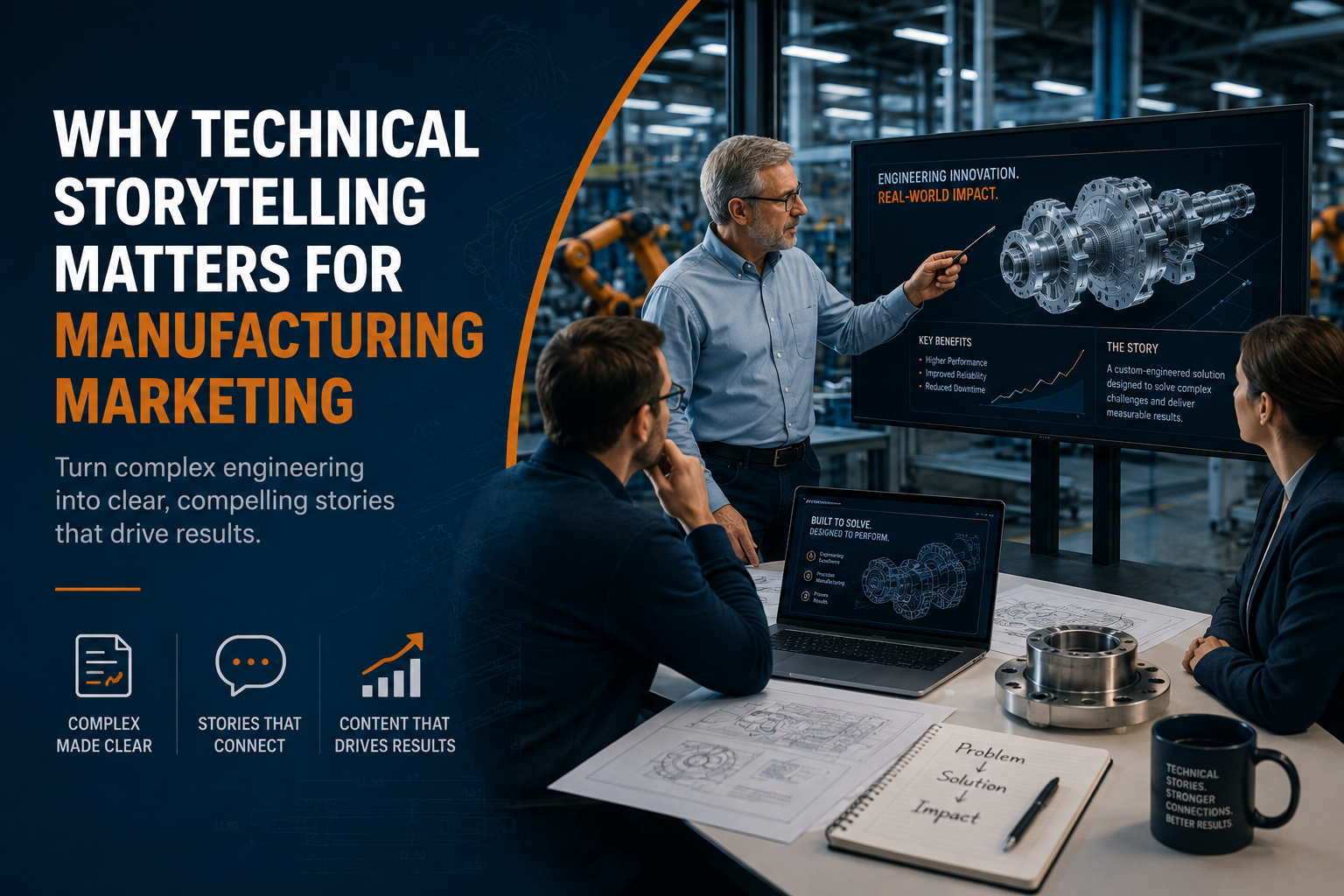
Technical storytelling helps manufacturers turn complex engineering, performance, process, and application knowledge into content that builds trust over time. It connects technical accuracy to operational value, so buyers understand the specification and the business reason to act.
Technical buyers often research heavily before contacting a vendor. There are reports that suggest technical buyers spend 62% of the buying process online before engaging with sales. They also found that engineering experts at vendor companies are among the most trusted content authors, with 66% of technical buyers rating them very or extremely trustworthy.
Takeaways
- Technical storytelling connects engineering details with operational needs and business outcomes.
- Strong manufacturing content speaks to the priorities of engineers, executives, procurement teams, and operations leaders.
- Manufacturers can find useful content topics by interviewing technical experts and tracking the questions that come up repeatedly in sales conversations.
- Application stories, technical explainers, selection guides, product comparisons, and diagrams help buyers assess complex products.
- Technical claims should be backed by specifications, test results, recognized standards, real-world examples, or documented outcomes.
What Is Technical Storytelling in High-Ticket Manufacturing Marketing??
Technical storytelling is creating content that explains complex industrial products, systems, processes, or applications in a way that gives technical evaluators enough detail and gives business decision-makers enough clarity.
It does not strip away the technical value. It organizes expertise so each buyer can answer the questions that matter to them:
- What does this product, component, machine, material, or process do?
- Where does it fit in the operation?
- What problem does it solve?
- How does it affect cost, uptime, throughput, quality, safety, compliance, or risk?
- Why should this supplier be trusted?
- What proof supports the claim?
The story becomes stronger when the content also explains how the system supports cleaner output, fewer changeouts, lower maintenance requirements, reduced contamination risk, or more consistent processes.
That is where technical storytelling becomes a sales asset.
Why Spec Sheets Alone Are Not Enough
Specifications are essential, but they don’t carry the full buying argument.
A spec sheet may help an engineer determine whether a product is technically viable. It may not help a CFO understand lifecycle cost, a plant manager understand installation requirements, or procurement understand supplier risk.
Modern B2B buying usually involves several stakeholders. Forrester’s 2026 business buying research found that procurement professionals are decision-makers in 53% of business buying cycles and often engage from the start, evaluating features and functions along with price.
That is why technical content for manufacturers needs to build several types of confidence.
Engineers Need Technical Accuracy
Engineers want real detail. They look for dimensions, tolerances, materials, standards, performance ranges, compatibility, operating environments, failure modes, and constraints.
Broad marketing language can create doubt because it does not help them validate fit. Strong technical storytelling gives engineers enough depth to trust that the company understands the application.
Executives Need Business Impact
Executives may not need every engineering detail, but they do need to understand why the investment matters. Your content should connect features to outcomes such as:
- Reduced downtime
- Lower scrap or rework
- Improved throughput
- Better quality control
- Lower total cost of ownership
- Shorter implementation time
- Reduced operational risk
- Stronger compliance posture
A technical page does not need to become a finance presentation but it does need to make the operational value clear.
Procurement Needs Supplier Confidence
Procurement teams evaluate more than unit price. They need confidence in supplier stability, responsiveness, documentation, quality systems, delivery expectations, and risk reduction.
A strong product page, application guide, or case-study-style proof page can help procurement understand why your company belongs on the shortlist.
Operations Needs Implementation Confidence
Operations leaders care about how the solution will work in the real environment. They need to know what changes, what stays the same, how the solution is installed or integrated, what support is available, and what could disrupt production.
Answer the “what happens next?” questions before they become obstacles for sales.
Technical Storytelling Supports the Entire Buying Committee
High-ticket manufacturing involves technical validation, financial justification, supplier evaluation, and implementation planning.
Some B2B research suggests that buyers use an average of 10 interaction channels across the journey, with company websites among the most frequently used touchpoints. Your website content, sales enablement materials, application pages, videos, diagrams, comparison guides, and follow-up emails need to work together, not in silos.
Technical storytelling gives those assets a shared blueprint.
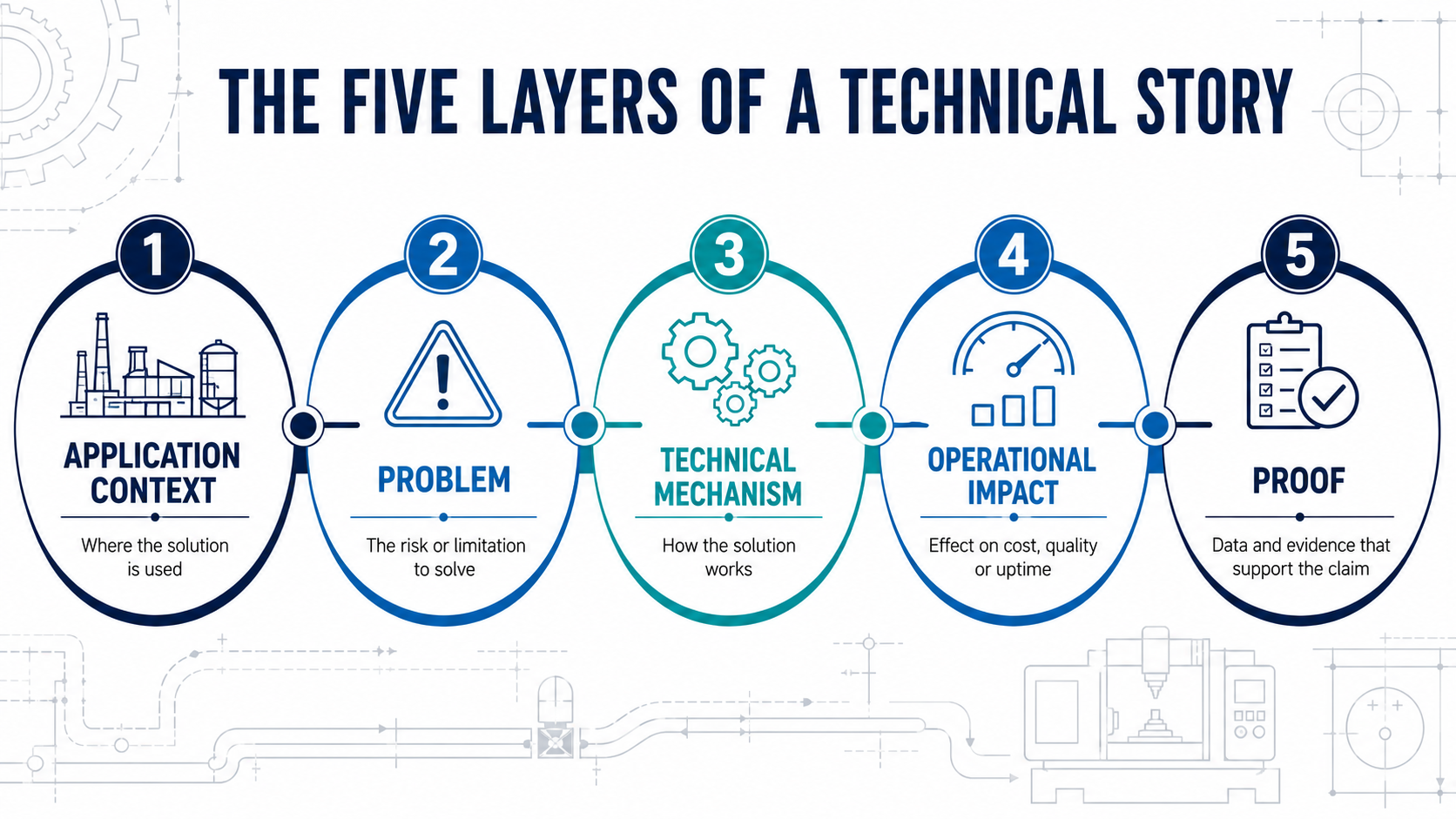
A good technical story usually includes five layers:
- Application context: Where the product or solution is used.
- Problem: The failure, inefficiency, risk, or limitation the buyer needs to solve.
- Technical mechanism: How the product works and why the design matters.
- Operational impact: How the solution affects uptime, cost, quality, throughput, safety, compliance, or risk.
- Proof: Data, examples, test results, case studies, diagrams, certifications, or process documentation that support the claim.
When these layers are missing, buyers have to connect the dots themselves. In a complex industrial sale, that creates friction.
How to Turn Technical Knowledge Into Content
Most manufacturers already have the raw material for strong technical storytelling. It lives in engineering conversations, sales calls, service notes, application reviews, training documents, request for quotes (RFQ) responses, and “tribal” knowledge.
The opportunity is to capture it, structure it, and turn it into content that supports the buyer journey.
1. Your Writer Should Interview the People Who Know the Product or Service
Start with the people who understand the product, application, and customer problems best. Your writer should interview:
- Product engineers
- Sales engineers
- Application engineers
- Field service teams
- Customer support teams
- Quality managers
- Estimators
- Technical sales leaders
Your writer should ask questions such as:
- What do buyers misunderstand about this product?
- What application conditions affect performance?
- What questions come up before an RFQ?
- What objections slow down the sale?
- What technical details help buyers feel confident?
- What proof do buyers ask for repeatedly?
- What separates a poor-fit customer from a strong-fit customer?
These conversations often reveal the most useful content topics because they come directly from buyer friction.
2. Mine Sales Questions and Objections
Your sales team already knows what buyers need to believe before they move forward. Turn recurring questions into content.
For example:
- “How do I know which model is right for my application?” becomes a selection guide.
- “How does this compare to the alternative material?” becomes a comparison article.
- “What information do you need for a quote?” becomes an RFQ checklist.
- “Will this work with our existing process?” becomes an application page.
- “What are the maintenance requirements?” becomes a technical FAQ.
This approach also improves sales enablement because the sales team can send useful content during active conversations.
3. Use Application Stories
Application stories show how a solution works in context. They do not need to be full case studies every time. A short application story can explain:
- The customer environment
- The operating challenge
- The technical requirement
- The product or process used
- The outcome or expected operational benefit
- The reason the solution was selected
This is especially useful when confidentiality prevents naming customers. A manufacturer can still describe the application category, constraints, decision criteria, and technical reasoning without revealing proprietary details.
4. Add Process Diagrams and Visual Explanations
For complex industrial products, a diagram can often clarify what paragraphs cannot. Useful visuals include:
- Process flow diagrams
- Before-and-after workflow diagrams
- Selection trees
- Installation diagrams
- Component breakdowns
- Failure-point illustrations
- Material compatibility charts
- Tolerance or performance range visuals
These assets help engineers validate fit and help non-technical stakeholders understand the operational story.
5. Build FAQs, Comparison Guides, and Buyer Guides
Technical buyers often search with practical, problem-based questions. Google’s Search Central guidance states that search systems prioritize helpful, reliable content created for people rather than content created mainly to manipulate rankings.
For manufacturers, the best SEO content is the content that answers real buying questions with precision.
Strong formats include:
- “How to choose…” guides
- “What is…” explainers
- “X vs. Y” comparisons
- “Common causes of…” troubleshooting articles
- “Design considerations for…” technical guides
- “Questions to ask before requesting a quote” checklists
- “How to reduce…” problem/solution articles
Write for the buyer first, then optimize the content for search.
Content Formats That Work for Complex Manufacturing Products
Different content formats support different stages of the manufacturing buyer journey. The strongest content strategy uses multiple formats that work together.
| Content Format | Best Use | Buyer Confidence It Builds |
| Application pages | Show where and how a product is used | Fit, relevance, industry experience |
| Problem/solution articles | Address pain points such as downtime, contamination, scrap, or bottlenecks | Operational urgency and solution value |
| Technical explainers | Clarify how a product, material, process, or technology works | Engineering confidence |
| Selection guides | Help buyers compare models, materials, specifications, or configurations | Decision clarity |
| Engineering calculators or checklists | Support sizing, quoting, planning, or evaluation | Practical utility and lead conversion |
| Case-study-style proof pages | Show evidence, process, and results | Supplier credibility and risk reduction |
| Technical FAQs | Answer recurring sales and engineering questions | Reduced friction before contact |
| Comparison guides | Explain tradeoffs between options | Evaluation confidence |
The right format depends on the complexity of the sale. A standard component may need a strong product page and selection guide. A custom automation solution may need application pages, process diagrams, engineering checklists, case studies, and sales enablement content.
How to Turn a Spec or Feature Into a Technical Story
A feature by itself: “Our system uses corrosion-resistant stainless steel construction.”
A stronger technical story:
“In washdown, chemical processing, or high-humidity production environments, corrosion can shorten equipment life and increase sanitation or maintenance concerns. Our stainless steel construction is designed to support long-term durability in harsh operating conditions while helping maintenance teams reduce replacement frequency and protect process reliability.”
The feature is still there. Now the buyer understands why it matters.
| Basic Feature Copy | Stronger Technical Story |
| “High-speed operation” | “Designed for high-throughput production environments where cycle time directly affects line capacity.” |
| “Custom engineering available” | “Configured around application requirements such as footprint, load, speed, integration points, and operator workflow.” |
| “Low-maintenance design” | “Built to reduce service interruptions by limiting wear points and simplifying access for routine maintenance.” |
| “Meets industry standards” | “Supports compliance-driven environments where documentation, quality control, and supplier accountability are part of the buying decision.” |
Technical storytelling keeps the specification and adds context, consequence, and confidence.
Common Mistakes in Manufacturing Technical Content
Mistake 1: Dumbing Down the Content Too Much
Clarity is good. Oversimplification is not.
Industrial buyers can tell when content has been stripped of useful technical detail. If the page says “high quality,” “innovative,” or “best-in-class” without explaining the engineering, process, or proof behind the claim, it becomes noise.
Better approach: Keep the technical substance, but organize it with clear headings, summaries, visuals, and plain-language explanations.
Mistake 2: Writing Only for Google, Not Buyers
SEO matters, but ranking is useful only when the content helps the right buyer move closer to action. A page written only to capture keywords can attract traffic without generating RFQs, marketing qualified leads (MQLs), or sales conversations.
Better approach: Start with the buyer’s decision criteria, then use SEO to make the content discoverable.
Mistake 3: Hiding Technical Proof in PDFs
PDFs can be useful for downloadable spec sheets, brochures, and engineering documentation. But when all technical proof sits inside PDFs, buyers and search engines may miss important information that should be visible on the page.
Better approach: Place the most important technical explanations, application details, proof points, FAQs, and conversion paths directly on web pages. Offer the PDF as a supporting download, not the only source of substance.
Mistake 4: Overusing Brand Claims Without Evidence
Claims such as “trusted leader,” “superior quality,” and “unmatched performance” do not build confidence on their own. Buyers need credible evidence of your claims!
Better approach: Support claims with application examples, measurable outcomes, standards, testing information, customer stories, comparison points, or documented process details.
How We Build Technical Storytelling Into a Manufacturing Marketing Strategy
Technical storytelling works best as part of an integrated digital strategy, not as a one-off blog post.
Our process aligns with the “Solutions Lifecycle”.
Discovery
We identify your business goals, buyer personas, product categories, sales cycle, technical differentiators, and conversion opportunities. This includes reviewing existing content, PDFs, website structure, analytics, sales questions, and RFQ quality.
Strategy
We map content to the manufacturing buyer journey, including awareness, technical validation, supplier shortlisting, RFQ readiness, and sales follow-up. The roadmap connects SEO, content, conversion, and sales enablement.
Implementation
We turn technical knowledge into useful assets such as application pages, technical explainers, comparison guides, FAQs, case-study-style pages, lead magnets, and conversion-focused website content.
Measurement
We track performance around metrics that matter: MQLs, Sales qualified Leads (SQLs), RFQs, and conversion rates.
Optimization
We refine content based on search behavior, buyer engagement, sales objections, and conversion data. The result is a content foundation that becomes more useful over time.
Our manufacturing marketing services help manufacturers generate leads, increase visibility, and support sales through targeted digital programs.
Proof Point: Technical Content Supports Long-Cycle Manufacturing Sales
Our case study for a leading global manufacturer shows how a strategic digital marketing program supported a niche, high-cost equipment sale with long purchase cycles.
The campaign focused on visibility, keyword performance, and MQL generation. We created a threefold increase in targeted keyword rankings, a fivefold increase in total rankings, and approximately 100 Marketing Qualified Leads in the first year.
That is the value of turning technical expertise into a structured digital presence. The website becomes more than a brochure. It becomes a qualification, education, and trust-building tool for buyers who are still researching.
Content Checklist for Manufacturers
Use this checklist to evaluate whether your current content supports high-ticket sales:
- Does each product or service page explain the application context?
- Does the content connect features to cost, uptime, quality, throughput, compliance, or risk reduction?
- Are technical claims supported with proof?
- Are common sales objections answered on the website?
- Are engineers, executives, procurement, and operations each given the information they need?
- Are important technical details visible on web pages, not only in PDFs?
- Are there clear RFQ, assessment, or contact paths?
- Are application stories or case-study-style examples included?
- Are diagrams, charts, checklists, or calculators used where they would improve clarity?
- Is content measured by qualified leads and conversions, not just traffic?
Build Trust Before the Sales Call
In high-ticket manufacturing sales, buyers need confidence before they reach out. Technical storytelling builds that confidence by making your expertise visible, useful, and relevant to each member of the buying committee.
Manufacturers that win complex sales are often the ones that explain value clearly, support their claims, and make it easier for buyers to move from research to RFQ.
Build a Technical Content Blueprint for Better Manufacturing Leads
Your technical knowledge is already one of your strongest sales assets. The next step is turning it into content that supports visibility, credibility, and qualified lead generation.
Schedule a Discovery Call with WSI E Results to identify where technical storytelling can strengthen your website, SEO, RFQ paths, and sales enablement strategy.
If you’re just curious about your search results compared to others, start with a Website Competitor Analysis. It’s free to see how clearly your technical value appears compared with other manufacturers in your market. We’ll send the completed analysis to you in an email! No obligation to speak with us, but if you’re interested, you can schedule one.
Frequently Asked Questions About Technical Storytelling for Manufacturers
What is technical storytelling in manufacturing marketing?
Technical storytelling is the practice of explaining complex products, processes, and applications in a way that connects engineering detail to business value. It helps buyers understand what a solution does, why it matters, and why the supplier can be trusted.
Why is technical storytelling important for high-ticket manufacturing sales?
High-ticket manufacturing sales involve risk, technical validation, long buying cycles, and multiple stakeholders. Technical storytelling helps engineers, executives, procurement teams, and operations leaders evaluate the solution with more confidence before contacting sales.
How is technical storytelling different from regular content marketing?
Regular content marketing may focus broadly on awareness or traffic. Technical storytelling focuses on translating engineering and application expertise into content that supports buying decisions, RFQs, MQLs, and sales conversations.
What content formats work best for technical manufacturing products?
Application pages, technical explainers, selection guides, comparison guides, engineering checklists, calculators, FAQs, and case-study-style proof pages work especially well for complex products.
Should manufacturers still use spec sheets?
Yes. Spec sheets are important, especially for engineers. They should be supported by web pages that explain application fit, operational value, implementation considerations, and proof.
How can manufacturers get technical information out of internal teams?
Interview subject matter experts (SMEs), sales engineers, application engineers, service teams, and customer support teams. Mine sales calls, RFQ questions, objections, training documents, and customer conversations for recurring themes.