
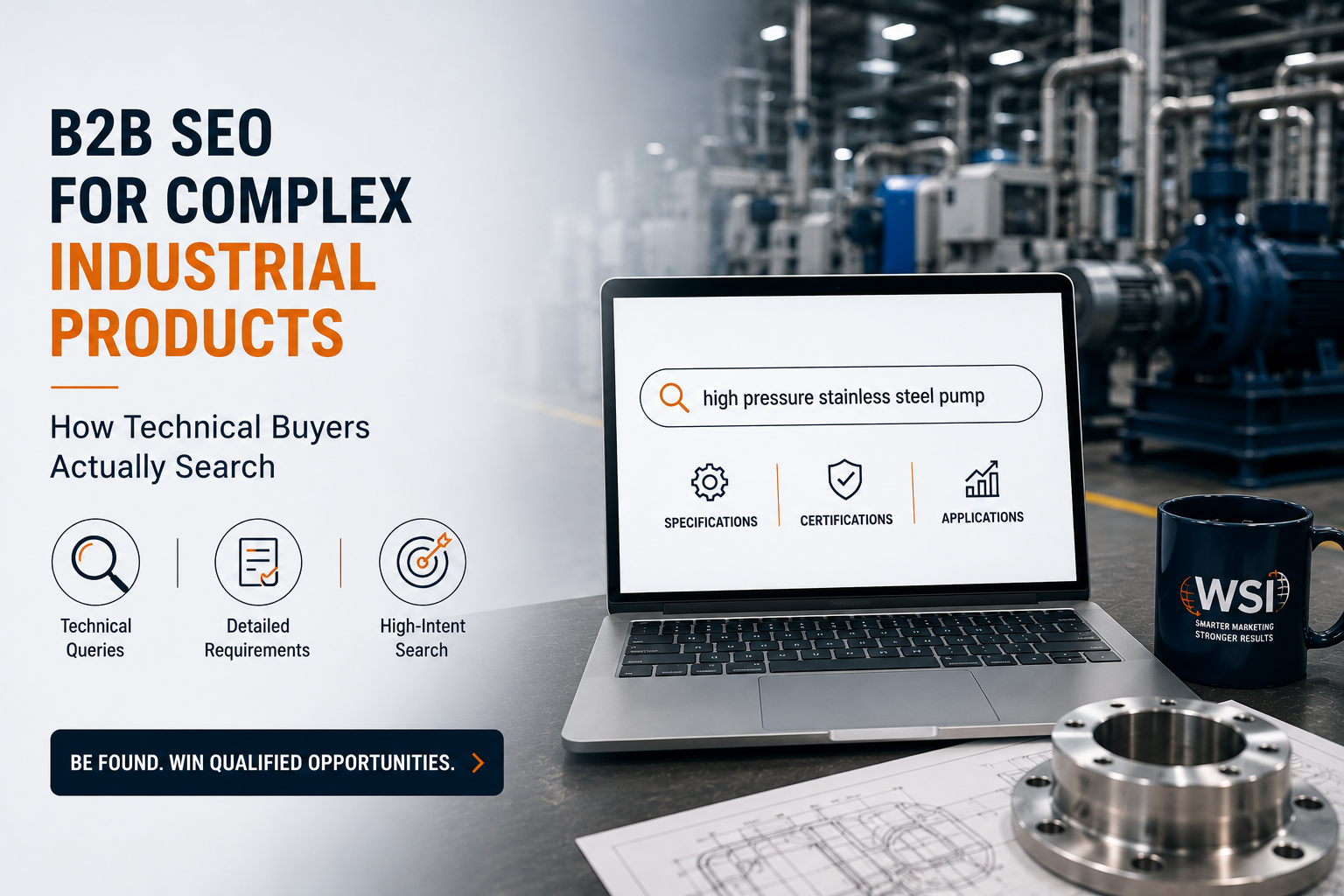
Technical buyers rarely search using neat marketing terms. They search by part type, material, application, problem, process, standard, drawing requirement, supplier need and even specific part numbers .
B2B SEO for manufacturers must reflect that behavior. An effective strategy focuses on helping engineers, procurement teams, operations leaders, and buying committees find the right page when they need to solve a problem, compare suppliers, or prepare a request for quote (RFQ).
Key Points:
- Technical buyers search by product, application, material, problem, specification, supplier criteria, and readiness to request a quote.
- Before increasing blog production, improve the pages that describe your products, capabilities, and applications.
- Set keyword priorities based on buyer intent and revenue potential, rather than search volume alone.
- Technical evidence, relevant internal links, and calls to action matched to each buying stage can help move prospects toward an RFQ.
- Track qualified leads, RFQs, assisted conversions, and sales results alongside rankings.
Why Manufacturing SEO Is Different
Most SEO advice is written for simple products, local services, or high-volume consumer searches. Complex industrial products require a different approach.
Someone searching for “custom rubber gasket supplier” may already have a drawing, a failed part, a compliance requirement, and a deadline. They may need EPDM, Viton, an FDA-grade material, low-temperature performance, or a supplier capable of short-run production.
That query may have limited search volume, but it can still represent a valuable sales opportunity.
Google’s SEO guidance starts with a practical principle: create content for users and make pages easy to find and understand. For manufacturers, this means using the language technical buyers use to describe their needs, rather than relying on internal marketing terminology.
B2B buyers also conduct more independent research than many sales teams realize. Gartner reports that 75% of B2B buyers prefer a sales experience without direct interaction with a representative. It also warns that fully self-service purchases can lead to more regret when buyers do not receive enough guidance.
Manufacturing websites should answer enough technical questions to build confidence before a buyer calls sales or submits a form.
WSI’s SEO work for manufacturers reflects this buying process. Industrial audiences may include engineers, procurement managers, operations leaders, supply chain teams, and other decision-makers who evaluate specifications, supplier fit, and technical evidence before taking action.
How Technical Buyers Search
Industrial buyers don’t begin and end with one perfect keyword . Their searches often develop in stages.
A buyer may start with a product category, narrow the search by application, compare materials, and then look for a qualified supplier. A search path might include:
- “custom machined aluminum housing”
- “aluminum housing for thermal management”
- “CNC aluminum enclosure tight tolerance”
- “6061 vs 7075 aluminum housing”
- “ISO 9001 CNC machining supplier”
- “request quote custom aluminum machining”
Each query signals a different need.
The first may indicate early research. A comparison search suggests technical evaluation. A supplier or RFQ query often signals stronger purchase intent.
A useful B2B SEO content strategy supports each stage instead of directing every visitor to the same product page.
Understanding how technical buyers search is a starting point. Manufacturers also need to assess whether their website supports buyers at each stage of the process. The WSI Technical Search Coverage Matrix offers a practical way to find content gaps and identify weak points on the path to an RFQ.
| Buyer signal | Diagnostic question | Content needed |
| Product or capability | Can buyers find the exact product, process, or manufacturing capability they need? | Product or capability page |
| Application | Can buyers connect that offering to their equipment, industry, or operating need? | Application or industry page |
| Technical validation | Can buyers verify materials, tolerances, specifications, performance, and applicable standards? | Technical or specification content |
| Supplier qualification | Can buyers evaluate certifications, capacity, quality systems, locations, and overall fit? | Supplier qualification or company content |
| Purchase intent | Can qualified buyers easily identify the appropriate next step? | RFQ page, drawing upload, sample request, or consultation CTA |
A gap in any row can disrupt the buyer’s research. A manufacturer may rank for a product term and still lose the opportunity if the site fails to explain the application, provide technical evidence, show supplier fit, or offer a clear path to an RFQ. The matrix helps marketing and sales teams decide which page to create or improve next.
Keyword Categories for Complex Industrial Products
Industrial keyword research is more useful when terms are grouped according to buyer intent. The goal is to create a practical content map, rather than a large keyword list with no clear purpose.
| Keyword category | What buyers search | Recommended page type |
| Product terms | Part names, equipment names, and product categories | Product or capability page |
| Application terms | Use cases, operating conditions, and installation context | Application page |
| Problem terms | Failure modes, production issues, and performance limits | Technical article or troubleshooting guide |
| Material or process terms | Materials, coatings, tolerances, and fabrication methods | Specification explainer |
| Industry terms | Aerospace, medical devices, food processing, packaging, and automation | Industry page |
| Comparison terms | Material A vs. material B or process A vs. process B | Comparison page |
| Supplier and RFQ terms | “Supplier,” “manufacturer,” “custom,” “quote,” location terms, and certifications | Conversion-focused landing page |
Many SEO programs for B2B companies focus heavily on broad educational searches while leaving high-intent technical terms uncovered.
Manufacturers do not need dozens of generic articles about manufacturing innovation. They need pages that answer the questions buyers ask before choosing a supplier.
Product and Capability Pages Form the SEO Foundation
For complex industrial products, product and capability pages often matter more than blog posts.
These pages should explain:
- What the product, part, process, or capability is
- Typical applications
- Available materials, tolerances, sizes, finishes, or performance ranges
- Industries served
- Compliance and quality standards
- Engineering support
- Customization options
- Information buyers should include in an RFQ
Google recommends creating helpful, reliable, people-first content rather than pages designed mainly to influence rankings.
For manufacturers, this means adding real technical substance. A page with a product or service name, a few vague benefits, and a contact button does little to support a complex buying decision.
A stronger page gives buyers enough information to continue evaluating the supplier.
Application Pages Match the Language Buyers Use
A technical buyer may understand the application without knowing the exact product name. Application pages capture searches that do not fit naturally on product pages.
Examples include:
- “gaskets for high-temperature sealing”
- “automation components for washdown environments”
- “metal stampings for battery enclosures”
- “industrial filtration for abrasive fluids”
- “custom kitting for aftermarket parts programs”
Application pages connect a buyer’s operating need with the relevant product or capability.
They also give sales teams useful context. A visit to an application page may reveal the buyer’s industry, environment, performance requirement, or process problem.
Technical FAQs Help Buyers Qualify Suppliers
Technical FAQs should answer genuine buying questions, not fill space.
Useful topics include:
- What information should be included in an RFQ?
- Which materials are suitable for the operating environment?
- What tolerances can the supplier hold?
- Which certifications are available?
- What is the typical lead-time range?
- Can the product be customized for OEM applications?
- Which drawings or file formats are required?
Buyer Guides Support Technical Evaluation
High-cost industrial purchases often require technical validation before procurement becomes involved. Buyer guides can support that research.
A useful guide might explain:
- How to choose the right material
- Which specifications affect performance
- Which tradeoffs matter for a particular application
- What to ask a supplier before requesting a quote
- How domestic and offshore sourcing differ
- How to reduce risk in a custom manufacturing project
Buyer guides should connect to the rest of the site. Link them to product pages, application pages, RFQ forms, case studies, and relevant sales resources.
Internal links give buyers a clear path through the evaluation process. They also help search engines understand how related pages fit together. Google’s SEO Starter Guide recommends organizing content so users can find and explore it easily.
Comparison Pages Help Buyers Build a Shortlist
Technical buyers often compare materials, processes, and supplier models before contacting sales.
Common comparison searches include:
- “powder coating vs anodizing”
- “urethane vs rubber rollers”
- “laser cutting vs waterjet cutting”
- “stainless steel 304 vs 316”
- “custom manufacturer vs distributor”
- “domestic supplier vs overseas supplier”
Comparison pages should be specific and balanced. Treating one option as the obvious winner in every situation can weaken credibility.
A useful comparison page should:
- Define both options.
- Explain where each one works well.
- Describe the tradeoffs.
- List the questions a buyer should ask.
- Link to the relevant product, application, or RFQ page.
This format helps buyers evaluate their options while keeping the next step visible.
SEO and AI Answer Visibility Overlap
AI search has changed how some buyers collect information, but the underlying requirements remain closely tied to SEO.
Google’s guidance on generative AI features states that established SEO practices still apply. Manufacturers should focus on making technical information clear, specific, and easy to interpret.
Pages that perform well in search and AI-generated answers often include:
- Direct definitions
- Brief answers near the beginning of each section
- Specific product and application language
- Descriptive headings
- Useful FAQs
- Original technical expertise
- Evidence such as specifications, certifications, process details, and case studies
- Internal links between related pages
Google has also introduced Search Console reporting for generative AI search experiences, including AI Overviews and AI Mode. This gives manufacturers another way to track whether their technical content appears in AI-assisted search.
AI visibility should not be treated as a separate tactic. The information that helps an engineer understand a specification also gives search engines and AI systems clearer source material.
What to Measure in B2B SEO
Rankings matter, but they do not show the full value of an industrial SEO program.
For complex products, measurement should focus on whether organic search brings qualified buyers closer to a sales conversation.
Useful metrics include:
- Qualified organic leads
- RFQ submissions
- Assisted conversions
- Organic traffic from target industries
- Rankings for high-intent technical terms
- Engagement on product, application, and specification pages
- Form starts and completions
- Calls from organic landing pages
- Repeat visits from target accounts, when that data is available
The strongest reporting connects this data with CRM outcomes. A ranking has some value. A ranking that contributes to an RFQ from a target industry has much more.
Common Mistakes in Industrial B2B SEO
A common mistake is chasing search volume without considering whether the searcher is a qualified buyer.
Broad keywords may attract students, job seekers, DIY researchers, or buyers outside the company’s service area. More specific terms may generate less traffic but lead to better sales conversations.
Other common mistakes include:
- Ignoring technical long-tail terms because reported search volume is low
- Publishing generic articles that do not connect to products or capabilities
- Using marketing language instead of the terms engineers and procurement teams use
- Leaving product pages thin while investing heavily in blog volume
- Failing to connect educational content with RFQ paths
- Treating SEO as a one-time project
- Avoiding meaningful tradeoffs in comparison content
- Skipping application pages for major industries or use cases
Publishing more content will not correct a weak site structure. Manufacturers need a content plan built around technical buying behavior.
A Practical B2B SEO Workflow for Manufacturers
A manufacturer-focused SEO program should follow a clear sequence.
1. Start With Products, Capabilities, and Margins
Identify the products, services, and applications that matter most to the business. SEO priorities should support revenue goals rather than keyword opportunities alone.
2. Build a Technical Keyword Map
Group keywords by product, application, material, process, problem, industry, comparison, and RFQ intent.
Use terminology from:
- Sales calls
- Quote requests
- Drawings
- Product catalogs
- Distributor conversations
- Customer service questions
These sources often contain the language buyers use more accurately than a standard keyword tool.
3. Audit the Current Page Structure
Look for missing pages, thin content, duplication, weak internal links, and blog posts that lead nowhere.
The site should help buyers move from research to technical validation and then to contact.
4. Improve Core Pages First
Prioritize product pages, capability pages, application pages, and supplier pages aimed at RFQ searches.
Blog posts can support these pages, but they should not replace the pages most likely to generate inquiries.
5. Add Technical Evidence
Include relevant specifications, material options, compliance information, process details, tolerances, industry examples, downloadable guides, and case studies.
6. Connect SEO With Conversion Paths
Every high-intent page should offer a clear next step, such as:
- Request a quote
- Schedule a call
- Download a guide
- Compare capabilities
- Request an assessment
The call to action should match the buyer’s stage in the evaluation process.
7. Measure Outcomes That Matter to Sales
Report on qualified leads, RFQs, assisted conversions, and progress across priority technical terms.
WSI’s manufacturing SEO service tracks keyword rankings, organic traffic, conversion rates, and ongoing performance for industrial clients.
SEO in Long-Cycle Industrial Sales
WSI’s global manufacturer case study describes an SEO-led digital marketing program for a niche industrial company selling high-cost equipment through a long sales cycle.
According to the case study, the campaign tripled targeted keyword rankings, increased total rankings fivefold, and generated about 100 marketing-qualified leads during the first year.
This is the practical purpose of SEO for B2B manufacturers. The objective is to reach buyers who have a technical need, fit the company’s capabilities, and have a reason to begin a sales conversation.
Where AI-Driven SEO Fits
AI-driven SEO can make research and planning more efficient, but it should not replace technical judgment.
AI can assist with:
- Grouping technical keywords by intent
- Finding gaps across product and application pages
- Turning sales questions into draft FAQs
- Comparing competitor page structures
- Finding internal-linking opportunities
- Summarizing Search Console query patterns
- Drafting schema recommendations for review
Human review remains necessary. A model may organize terms correctly at a surface level while missing an important difference in material, process, specification, or buyer intent.
Engineers, product managers, salespeople, and experienced industrial marketers should verify the technical meaning before content is published.
For manufacturers, AI is most useful as a research and organization tool. The company’s subject-matter expertise still drives the content.
Build Your SEO Plan Around Buyer Behavior
When an industrial website receives traffic but produces too few qualified RFQs, visibility may be only part of the problem. The site’s pages may not match how technical buyers research products, evaluate suppliers, and make contact.
A Free Website Competitor Analysis can show where competitors are gaining visibility, which technical terms they cover, and where the site may be missing high-intent searches. This is a low risk but valuable report. We email the report straight to your inbox, if you want to discuss the report, you can schedule a call. We’d love to speak with about gaining more of the market share from your competitors.
FAQs About B2B SEO for Manufacturers
What is b2b seo for manufacturers?
B2B SEO for manufacturers is the process of improving product, application, technical, and supplier-focused pages so industrial buyers can find the company through search. It focuses on qualified leads, RFQs, technical validation, and sales support instead of broad traffic alone.
Why is manufacturing SEO different from regular SEO?
Manufacturing SEO has to account for technical search behavior. Buyers search by part, material, process, application, specification, compliance need, and supplier requirement. The content has to be accurate enough for engineers and clear enough for procurement and executives.
What are the best b2b seo keywords for complex products?
The best b2b seo keywords usually include product terms, application terms, material or process terms, problem terms, comparison terms, industry terms, and RFQ terms such as “custom,” “supplier,” “manufacturer,” and “quote.”
Should manufacturers create blog posts or product pages first?
Product, capability, and application pages should usually come first because they connect directly to buyer intent and RFQs. Blog posts are useful when they support those pages through technical explanations, comparisons, FAQs, and buyer guides.
How does SEO support AI answer visibility?
Clear definitions, structured answers, technical FAQs, original expertise, schema where appropriate, and strong internal linking make content easier for search and AI systems to understand. Google’s guidance says foundational SEO best practices still apply to generative AI search experiences.
What should manufacturers measure from SEO?
Manufacturers should measure qualified organic leads, RFQs, assisted conversions, rankings for high-intent technical terms, engagement from target industries, and performance of product and application pages. Search Console and GA4 help connect visibility, traffic, and key events.
SEO terms used
Primary search term: b2b seo
Secondary terms included:
- b2b seo strategy
- seo for b2b companies
- b2b seo keywords
- b2b seo content strategy
- ai-driven seo strategies for b2b companies
- manufacturing SEO
- industrial SEO
- SEO for manufacturers
- technical SEO for manufacturers
- industrial keyword research
- product pages
- application pages
- RFQ optimization
- technical buyers
- engineers
- procurement teams
- high-intent keywords
- long-tail technical keywords
- AI answer visibility
- Search Console
- GA4 key events
- assisted conversions