Industrial buyers don’t “convert” because you published more content, they convert when your website and content reduce technical risk, operational risk, and supplier risk across the buying committee. A manufacturing content strategy that drives real buying progress is built around three stakeholder lenses, operations, procurement, and c-suite and the specific proof each needs before an RFQ—or a sales conversation—makes sense.
Content Marketing Institute’s manufacturing research shows why this is urgent: most manufacturing marketers rate their strategy as only moderately effective (67%), and many say it isn’t tied to the customer journey (47%), isn’t data-driven (46%), or lacks clear goals (40%).
Why this matters now
Your buyers are already doing self-service research, often across multiple channels, long before they raise their hand. If your content doesn’t help them spec, justify, and de-risk the decision, you’ll see the common symptoms:
- Engineers request “a quote” without enough info – slow, back-and-forth cycles
- Ops & C-Suite can’t find risk answers -lead times, quality, service, uptime
- Procurement defaults to “three bids” because supplier confidence isn’t clear
- Sales gets leads, but not the right ones, and not at the right stage
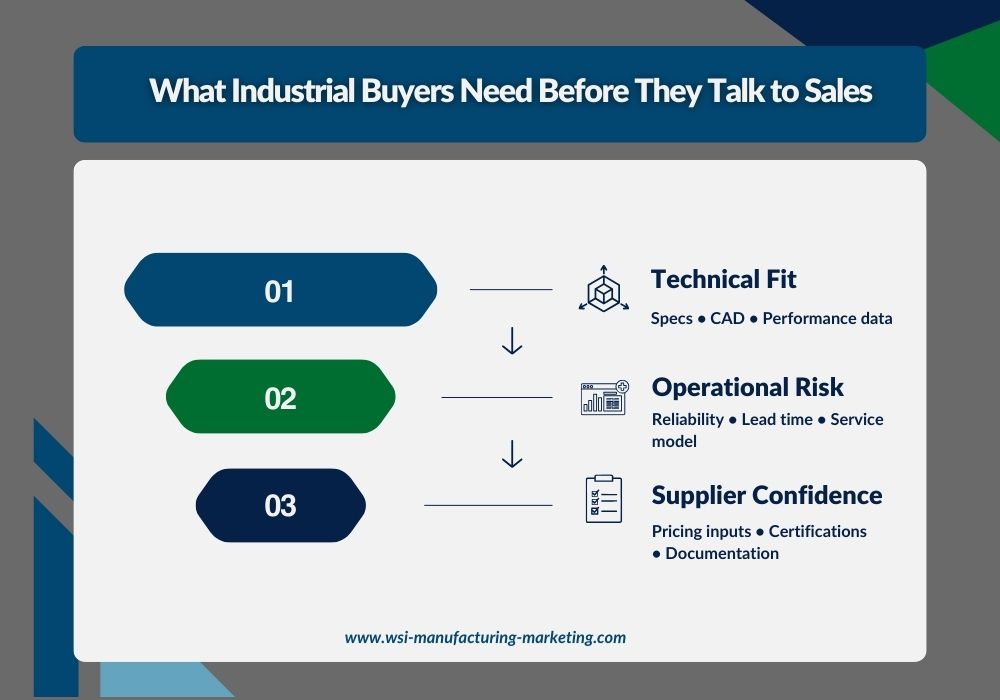
The 3 stakeholder lenses and what each must believe
1) Engineer lens: Fit
Engineers want confidence that your solution works in their application and constraints.
They look for:
- Specs, tolerances, materials, performance ranges
- CAD/models, drawings, wiring/interface details
- Standards and compliance (as applicable)
- Selection guidance and “how to specify” instructions
- Failure modes, limitations, and tradeoffs (yes, include them)
2) Operations & C-Suite lens: Risk
Ops cares about delivery, reliability, uptime, and implementation risk.
They look for:
- Lead times and what drives variability
- Quality controls and inspection capabilities
- Service model (install, calibration, PM, field service)
- Reliability proof (durability, cycle tests, performance curves)
- Documentation that supports onboarding and maintenance
3) Procurement lens: Cost and supplier confidence
Procurement needs commercial clarity and supplier risk reduction.
They look for:
- Quote inputs and what drives pricing (even if pricing is quote-based)
- Total cost of ownership (TCO) signals and ROI rationale
- Certifications, QA process, traceability, and supplier documentation
- Terms basics (warranty, service response, delivery expectations)
- Evidence you can supply consistently (capacity, locations, support model)
Content types that move manufacturing deals forward
These are the formats industrial teams consistently rely on to progress from research to validation then RFQ:
- Application pages – industry, use case, constraints, and proof
- Spec explainers – plain-English summaries and technical depth
- CAD/tech libraries – models, drawings, datasheets, and manuals
- Case studies/customer stories – outcomes, conditions, and scope
- Comparison guides – your approach vs. alternatives and selection criteria
- Compliance/quality pages – certifications, process, traceability, and QA
CMI’s manufacturing research also reinforces what’s working in the category: 89% of manufacturing teams commonly use short articles or posts and videos next with, 85%, and 74% rate video as most effective . Case studies and customer stories also rank highly among effective formats.
Build a content map that’s actually manufacturable
A content strategy becomes execution when you map it from business focus, stakeholder questions, content formats, and CTAs.
Content map framework
- Ideal Customer Profile (ICP) segment – industry, application, environment, and buying context
- Top jobs-to-be-done – what they’re trying to accomplish
- Questions by stakeholder – engineer, ops procurement and C-Suite
- Best formats – application page, spec explainer, CAD library, etc.
- CTA path – engineer-first vs procurement-first
Before/after content map sample (simplified)
Before – common “random acts” pattern
- “News” posts, trade show recaps, generic capability pages
- One CTA: “Contact us”
- No segmentation by application or stakeholder questions
After – stakeholder-driven map
- ICP segment: Food & beverage processing OEMs
- Job-to-be-done: Reduce unplanned downtime from seal failures
- Engineer questions: chemical compatibility? temp/pressure range? surface finish requirements?
- Ops questions: lead time? PM schedule? failure indicators?
- Procurement questions: TCO vs. alternatives? certifications? supplier documentation?
- Formats: application page, materials/spec explainer, selection guide, case study, compliance page
- CTA paths: “Download compatibility chart” or “Request CAD” or “Talk to an engineer” are engineer-first CTA. “Request quote inputs checklist” is a procurement-first CTA
Two CTA paths: engineer-first vs procurement-first
Your CTAs should match intent. “Request a quote” too early often increases friction.
Engineer-first CTA path
Looks like this fit → validation → handoff
- Download spec/selection guide (or compatibility chart)
- Request CAD / datasheet bundle
- Ask an engineer (short form with application fields)
- RFQ (only after self-qualification)
Procurement-first CTA path
Looks like this supplier confidence → pricing clarity → RFQ
- Supplier packet (certs, QA overview, traceability, warranty/service)
- Quote inputs checklist (what’s needed for accurate pricing)
- Budgetary consult / scope confirmation
- RFQ (properly qualified)
CMI’s manufacturing research shows a major hurdle is creating content that prompts a desired action . In practice, CTA paths like these are one of the fastest ways to fix that, because the “action” matches the stakeholder’s next decision.
Trust accelerators for manufacturing websites
If you want content to accelerate buying, your site needs visible “trust infrastructure”:
Proof
- Case studies with conditions and measurable outcomes
- Customer logos & markets served (where allowed)
- Test data summaries, performance curves, validation notes
Certifications and compliance
- ISO or other certifications, industry compliance, documentation access
- Material traceability and quality documentation (as relevant)
Process and QA
- Inspection and testing capabilities
- Documented approvals workflow, PPAP/FAI readiness (when applicable)
- How you handle nonconformance and corrective actions
Operational confidence
- Lead time ranges and what drives that variability
- Capacity, locations, service coverage, support SLAs
- Clear warranty and service model
Distribution plan: SEO first, then LinkedIn/email, then paid retargeting
A practical order of operations:
- SEO-first foundation
Build application and spec pages that capture high-intent search and route to the right CTAs. - Amplify with LinkedIn and through email
Use LinkedIn for credibility and to recruit the right stakeholders to your deeper assets. Use email for nurture and reactivation. - Paid retargeting to accelerate known interest
Retarget spec/CAD/compliance page visitors with one strong next-step asset.
How to measure content beyond pageviews
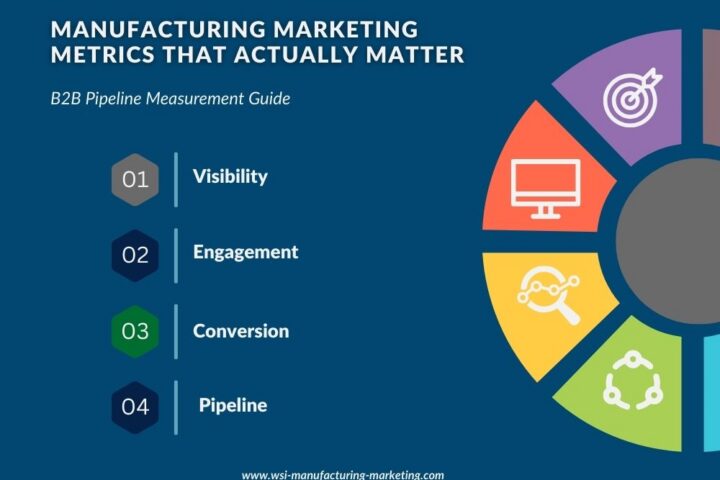
Manufacturing teams often get stuck on vanity metrics, then leadership questions ROI. CMI’s manufacturing research notes many struggle with ROI attribution and tying performance to business goals.
Use a measurement stack that reflects buying progress:
Buying-progress metrics (recommended)
- Assisted conversions – content touched before RFQ, demo, or consult
- RFQ starts and completions by content path
- Spec sheet / CAD / compliance packet downloads
- Return visits to key application/spec pages
- Speed-to-lead and follow-up completion after high-intent actions
- Opportunity influence – contacts from target accounts consuming content
Operational measurement requirement (non-negotiable)
- Event tracking for downloads and CTA clicks
- CRM fields that capture application + stakeholder intent
- Lifecycle definitions (MQL/SQL/RFQ) and routing rules so content doesn’t “die” in the inbox
Proof points and benchmark insights: What manufacturing teams are seeing
A few manufacturing-specific benchmarks worth referencing internally as you build buy-in:
- Many manufacturing marketers say their strategy is only moderately effective, often because it isn’t tied to the customer journey or isn’t data-driven.
- Creating content that drives action (and measuring it) remains a key challenge.
- Generative AI adoption is common, but integration is limited, a signal that process and governance matter as much as tools
Common failure modes and the fixes
- Don’t write content for “everyone”. Do build ICP-specific application clusters with stakeholder CTAs
- Don’t write great content with weak conversion paths. Do create engineer-first and procurement-first CTA routes
- No SME workflows. Instead set monthly SME blocks and standardized review templates
- Marketing creates, sales ignores. Embed content in sales sequences and stage playbooks
- Don’t stop measurement at traffic counts. Do track assisted RFQs, downloads, and opportunity influence
If you want content that moves stakeholders toward an RFQ, start with a clear blueprint: what must exist, what’s missing, and what to build next.