Long B2B sales cycles don’t need “more marketing” ; they need a digital strategy that functions like an execution plan: clear revenue objectives, defined channel roles, stage-based messaging, and a follow-up system that turns research into RFQs. Buyers are increasingly trying to self-educate and avoid irrelevant outreach, so your channel mix has to help them progress without friction.
Start with objectives tied to revenue reality
Manufacturing revenue goals rarely map cleanly to “leads.” Your strategy should start with outcomes the business actually feels:
Revenue-tied objectives
- Pipeline created or influenced (opportunities, not clicks)
- RFQs or quote requests (by product line / application)
- Distributor or rep inquiries (when they’re part of the model)
- Engineering consult requests (high-intent, pre-RFQ conversations)
- Reactivation of dormant accounts (existing customer expansion)
Then define how you’ll measure movement.
Is it:
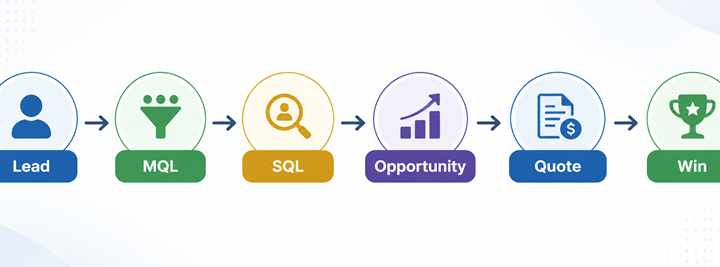
- MQL to SQL to RFQ conversion rate
- Speed-to-lead (time to first response)
- Sales accepted lead rate
- Opportunity creation rate from key intents (application, part number, spec queries)
What “digital strategy” means for manufacturing
Digital strategy is not a list of tactics. It’s a blueprint that answers:
- Who are we trying to win?
- What buying stages and stakeholders must we influence?
- Which channel plays which role ?
- What must exist on the site, in content, and in CRM to convert and route demand?
- How we measure and optimize
Channel roles in manufacturing GTM
B2B buyers use many touchpoints and expect to move between them. McKinsey describes the “rule of thirds” as in-person, remote or self-serve and notes buyers use an average of 10 interaction channels, which makes orchestration the advantage.
Below is a manufacturing role definition for each channel.
SEO for demand capture: high-intent discovery
SEO’s job in long sales cycles: capture demand when buyers search for solutions, specs, standards, and use cases, then lead them into the right next step.
What SEO should prioritize for manufacturers:
- Application and problem searches :“reduce scrap in…”, “high-temp gasket for…”
- Spec and compliance searches: materials, certifications, standards
- “Make/buy/replace” searches: alternatives, cross-references, retrofit
- Industry-specific intent: OEM, MRO, facility maintenance, process engineering
What should the SEO execution plan include
- Pillar and cluster architecture by product family and application
- Technical on-page requirements: crawlable specs summaries, schema, internal links
- “Next step” conversion paths aligned to stage
Content for trust and specification confidence: The “proof layer”
Content marketing for manufacturers isn’t “blogging.” It’s technical enablement that reduces risk for the buyer.
Content should answer:
- “Will this work in my environment?”
- “What are the constraints, tolerances, and failure modes?”
- “How do I specify it correctly?”
- “What proof do you have? Do I have test data, compliance or case examples?”
Trust-building content types that move deals
- Application notes and selection guides
- Spec & standards explainers, with plain-language summaries
- CAD or spec sheet landing pages built to convert
- FAQ libraries that remove friction of lead times, materials, and compatibilities
- Case studies with measurable outcomes
Paid media for priority accounts and retargeting
Paid Search is not a replacement for SEO content. In long cycles, its role is priority acceleration:
- Put your best technical assets in front of priority segments now
- Retarget engaged visitors to keep your brand “in the shortlist”
- Support product launches or capacity-driven pushes
Where paid works best in manufacturing:
- Retargeting site visitors who hit spec sheet, CAD drawing or compliance pages
- LinkedIn targeting by job function (engineering, operations, procurement)
- Search ads for high-intent terms you can’t win organically yet
- Account-based campaigns for defined OEM and distributor targets
Rule: Paid should never outpace your conversion paths. If the landing page doesn’t build confidence and route the lead correctly, paid becomes expensive traffic.
Email for nurture AND reactivation
Email is your follow-up system, not your newsletter.
Email should do three things:
- Nurture buying committees through evaluation
- Enable sales with timely, relevant assets
- Reactivate dormant leads or accounts with value, not just “checking in” messages
LinkedIn for credibility and leading buyers to content
LinkedIn’s job is to build credibility and reach, then drive the right people into your deeper assets, like SEO content, application pages, and landing pages.
Use LinkedIn to:
- Publish client-facing insights
- Promote new guides, selection tools, webinars, and proof points
- Amplify sales enablement content sales teams can actually share
The rule of intent: match channel to buying stage as well as stakeholder
Buyers want to self-serve, but they also avoid irrelevant outreach. Gartner found 61% prefer a rep-free buying experience, and 73% actively avoid suppliers who send irrelevant outreach.
That’s why the “rule of intent” matters:
Intent = (Stage) + (Stakeholder) + (Urgency)
Your channel mix works when each touchpoint clearly answers, “What should I do next?”
Example channel-to-stage map for manufacturing
| Buying stage | Primary stakeholder | What they need | Best channels | Best “next step” CTA |
|---|---|---|---|---|
| Awareness | Ops/engineering | problem framing | SEO + LinkedIn | application guide download |
| Consideration | Engineer | fit + constraints | SEO + content + retargeting | selection guide / spec sheet |
| Validation | Engineer + procurement | proof + compliance | content + email + sales enablement | CAD request / compliance pack |
| Selection/RFQ | Procurement + leadership | commercial clarity | email + paid + direct outreach | RFQ / “talk to an engineer” |
| Post-sale expansion | Ops + maintenance | outcomes + service | email + LinkedIn | PM/service plan / upgrade path |
A practical retargeting + nurture structure
Retargeting (7–21 days)
- Segment audiences by behavior:
- Spec sheet or CAD viewers
- Compliance and certification viewers
- Pricing and quote page visitors
- Industry and application page visitors
- Rotate 2–3 assets max:
- selection guide
- application note
- proof point (case example or test summary)
Nurture email sequence (example for 30–45 days)
- Day 0: deliver requested asset and “how to use it”
- Day 3: selection checklist or common spec mistakes
- Day 7: application example include constraints or limitations
- Day 14: proof point; a case study or test data
- Day 21: “talk to an engineer” offer with a clear agenda
- Day 35: reactivation email with new resource, not “just checking in”
Sample 90-day rollout plan (week-by-week)
This is a “manufacturable” rollout: build the foundation first, then scale.
Weeks 1–2: Discovery and alignment (foundation)
- Confirm revenue objectives (RFQs, distributor inquiries, pipeline)
- Define ICP and priority segments (industries, applications, deal size)
- Audit: website conversion paths, CRM fields, lead routing, content gaps
- Pick 10–20 target topics or search terms that map to real buying intent
Weeks 3–4: Conversion paths and measurement (make it measurable)
- Create or fix core landing paths:
- RFQ, CAD request, spec sheet download, distributor inquiry
- Add tracking for forms, downloads and key page events
- Define lifecycle stages and SLAs (MQL definition, speed-to-lead)
- Build initial reporting dashboard (channel, stage and outcome)
Weeks 5–6: SEO quick wins and content spine (demand capture)
- Optimize top products and application pages
- Publish 2–3 “spine” assets:
- one selection guide
- one application note
- one proof page
- Launch technical FAQ blocks on priority pages
Weeks 7–8: Paid and LinkedIn activation (priority acceleration)
- Launch retargeting tied to the “spine” assets
- Launch 1–2 LinkedIn campaigns by job function or industry
- Build a single “priority account” campaign with a tight list and a buttoned up message
Weeks 9–10: Email nurture and sales enablement (follow-up system)
- Build nurture email sequences by segment
- Create sales enablement bundle:
- one-pager, FAQ sheet, case proof, objection handling
- Train sales on follow-up motions and routing rules
Weeks 11–12: Optimization sprint
- Review performance by intent stage:
- where do visitors drop?
- what converts to RFQ?
- Improve form quality
- Double down on top-performing topics and audiences
Governance: who owns what
Long-cycle performance comes from cadence and ownership, not heroics.
Ownership (simple RACI)
- Marketing (Owner): SEO, content, paid, LinkedIn, site UX, analytics
- Sales (Owner): follow-up SLAs, opportunity creation, CRM hygiene, feedback loop
- Engineering (Owner): technical validation content, spec accuracy, FAQs
- Operations & Service (Contributor): lead times, service model, delivery constraints
Review cadence
- Weekly: execution, speed-to-lead, and campaign health
- Biweekly: content performance, conversion rates, and pipeline touchpoints
- Monthly: MQL to SQL to RFQ to win performance and influenced pipeline
- Quarterly: strategy recalibration (what to scale, what to stop)
KPIs that matter
- Leading: impressions, rankings, CTR on high-intent queries
- Mid: conversion rate by page type, form completion quality, nurture engagement
- Lagging: RFQs, opp creation, win rate for marketing-influenced deals
Common failure modes
1) Random acts of marketing
Fix: assign channel roles and stage-based goals; build the blueprint first.
2) Weak conversion paths
Fix: create clear CTAs by intent, not generic “Contact Us.”
3) No follow-up system
Fix: define SLAs, automate nurture, and close the loop in CRM.
4) Content that’s promotional instead of useful
Fix: prioritize specification confidence like guides, FAQs, proof, and constraints.
5) Paid traffic without landing-page readiness
Fix: build the spine assets AND landing paths before scaling spend.
Proof points and “data types” to use in your strategy
Use research to justify the shift and operational data to optimize it.
- Buyers prefer self-service and avoid irrelevant outreach. Use this to justify better intent matching and fewer “blasts”.
- Buyers expect an omnichannel mix, use this to justify orchestration, not channel silos.
- Buyers report high dissatisfaction with providers at the end of the purchase process, use this to justify clarity, enablement, and friction reduction.
Talk to us about a strategy-first roadmap and execution support
If you’re tired of “activity” that doesn’t translate to RFQs and pipeline, we’ll help you build a strategy-first channel mix roadmap, then execute it with measurable outcomes.