If you’re a manufacturer, OEM, or industrial distributor, the right SEO partner is not the agency that ranks highest on a generic list. It is the one built to solve your actual constraint, whether that is technical content, catalog architecture, RFQ conversion, or full-funnel execution. This guide gives you a practical way to compare agency models so you can review proposals with fewer blind spots and more confidence.
Start with the problem you need solved
Bucket A: Industrial inbound and technical content engine
Best for: companies that need credible, engineer-respected content at scale, such as application notes, selection guides, and failure-mode content that support long sales cycles and buying committees.
What good looks like
- an SME-driven content process that turns engineer interviews into publishable assets
- an editorial system that repurposes one topic into blog content, PDFs, sales sheets, and nurture emails
- a clear connection between content and RFQ generation, not just traffic growth
Questions to ask
- “Show your engineer interview outline and a real example of the final content.”
- “How do you maintain technical accuracy without dragging the approval process out?”
- “How do you repurpose one topic into sales enablement and email nurture?”
Bucket B: Industrial SEO with an RFQ pipeline focus
Best for: teams that already have content expertise, or can produce it, but need SEO built around specifier language and measurable quote outcomes.
What good looks like
- keyword research based on standards, specs, part numbers, and tolerances
- a capability and application page strategy built around conversion-ready money pages
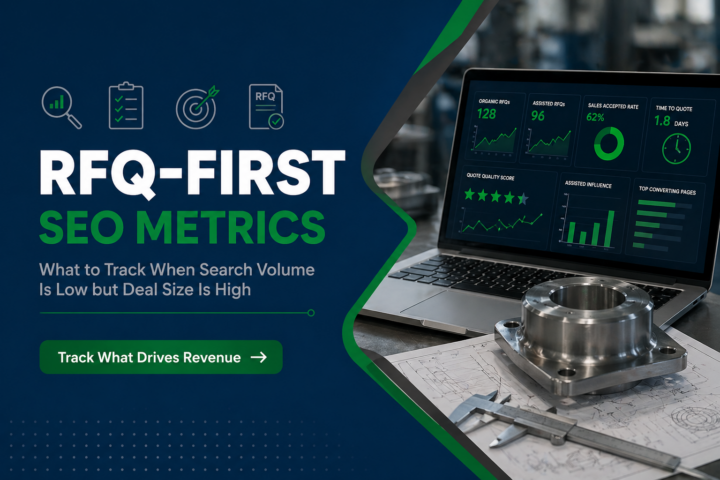
- reporting tied to RFQs, assisted influence, and quote quality
Questions to ask
- “How do you build keyword targets from standards, grades, and part numbers instead of relying only on keyword tools?”
- “How do you decide whether a topic belongs on a capability page, application page, or FAQ?”
- “How do you report assisted conversions and connect SEO to RFQs and quotes?”
Bucket C: Manufacturing website and SEO together
Best for: companies whose main bottleneck is the site itself, where information architecture, templates, internal linking, conversion UX, and technical SEO need to be solved together.
What good looks like
- SEO-safe architecture and templates designed for deep industrial catalogs
- RFQ flows built for technical buyers, including file upload, response expectations, and trust signals
- redesign and migration governance that protects rankings through redirect mapping and QA
Questions to ask
- “What does an SEO-safe redesign look like in your process before launch, during launch, and after launch?”
- “How do you prevent index bloat from filters, variants, and parameter URLs?”
- “How do you improve RFQ conversion rates without adding friction?”
Bucket D: Technical or international SEO specialists
Best for: businesses with complex catalogs, multiple markets, or enough technical debt that site architecture and governance determine results.
What good looks like
- strong control of faceted navigation, duplication, and crawl efficiency
- international SEO governance, including hreflang, localization, and regional targeting
- deep technical audits with implementation guidance that internal teams can actually use
Questions to ask
- “Which facets should become curated landing pages, and which should be noindexed, canonicalized, or blocked?”
- “How do you monitor crawl stats and index coverage month to month?”
- “What is your migration playbook, and how do you reduce ranking loss?”
Bucket E: Executive thought leadership and authority building
Best for: companies whose growth depends on stronger credibility, category authority, and executive visibility in premium, long-cycle deals.
What good looks like
- executive point-of-view development tied to real pipeline themes
- a content system that spans LinkedIn, articles, podcasts, and webinars
- close alignment with sales enablement and recurring buyer objections
Questions to ask
- “How does thought leadership connect to measurable outcomes such as RFQs or influenced pipeline?”
- “What is your governance process for accuracy, compliance, and approvals?”
- “How do you turn one executive point of view into a multi-format content system?”
What to ask any agency
No matter which bucket seems like the best fit, these questions help you see whether the agency understands industrial buying reality or is falling back on a generic B2B pitch.
Process and deliverables
- “Walk me through your first 90 days. What actually gets shipped?”
- “What does your technical SEO audit include for catalog-heavy sites?”
- “How do you build a keyword map from specifier language?”
SME handling
- “How do you get engineer input without wasting their time?”
- “Who owns accuracy review, and how do you keep timelines moving?”
Reporting and RFQ outcomes
- “What do you track besides rankings and traffic?”
- “How do you measure assisted conversions and quote quality?”
- “How do you connect marketing activity to CRM outcomes?”
CRO and sales enablement
- “How do you reduce RFQ friction around forms, file uploads, routing, and response expectations?”
- “How do you equip sales with content that helps active opportunities move forward?”
Pricing and contract structures to expect
Most industrial SEO engagements fall into one of three structures:
- Project-based: technical audits, keyword maps, IA planning, or migration planning
- Ongoing retainer: technical SEO, content, optimization, and reporting
- Hybrid: an initial build phase followed by governance and ongoing optimization
What usually increases scope and cost:
- large catalogs with faceted navigation and duplication risk
- multi-location or international SEO requirements
- technical content production that depends heavily on SME input and review cycles
- CRO work on RFQ flows, including forms, uploads, trust elements, and speed
A simple decision tree
If your rankings are flat and the catalog is messy, Bucket D or Bucket C is usually the right place to start.
If you get traffic but not RFQs, prioritize Bucket B with strong CRO capability.
If your team has expertise but cannot scale engineer-trusted content, Bucket A is usually the better fit.
If you are entering new languages or regions, Bucket D matters more.
If premium positioning and executive credibility are the constraint, Bucket E can work well layered onto A, B, or C.
Verify fit before you buy
Keep the decision grounded.
- Ask for case studies that match your situation, including catalog depth, spec-driven demand, and long sales cycles.
- Use reference calls to test process quality, governance, and reporting honesty.
- Treat third-party review platforms such as Clutch as one input, not the decision-maker.
- A paid workshop or mini-audit often reveals more than a polished proposal because you can see how the team thinks.
Why WSI E Results fits manufacturing reality
WSI E Results is part of a global network, which means the bench is broader than a small local agency can usually offer. That includes access to AI teams, strategists, technical specialists, and design support, so programs can scale without becoming generic.
More importantly, the work is built around the manufacturing buyer journey:
- strategy first, not disconnected tactics
- technical SEO, technical content, and conversion working together
- measurement tied to RFQs, quote quality, and pipeline influence
Not sure which bucket fits?
If you’re deciding between technical SEO, technical content, and a full-funnel approach, the first step is figuring out the real bottleneck.
Schedule an AI Discovery Call or request a Free Website Competitor Analysis to identify:
- where technical SEO is holding back niche rankings
- where content gaps are limiting spec-driven visibility
- where RFQ friction is hurting quote volume and lead quality