
Industrial buyers still make decisions the same way they always have: they need technical confidence, commercial clarity, and a low-risk path to purchase. The 4 Ps still work in manufacturing, but only when you translate them into modern, digital go-to-market (GTM) requirements that support a single decision maker, procurement department or maybe even a full buying committee.
If your website design, content, and CRM don’t reflect your real Product, Price, Purchase Place and Promotion decisions, you’ll see the real pipeline failure: low-quality leads, stalled RFQs, channel conflict, and “marketing activity” that doesn’t create a pipeline.
Why the 4 Ps still apply (even when the channels are digital)
Manufacturing marketing isn’t about “campaigns.” It’s about reducing friction in a long, multi-stakeholder buying process while staying aligned between sales, marketing, operations, and channel partners.
The 4 Ps are still the cleanest way to pressure-test your GTM foundation because they force the questions industrial teams often skip:
- Product: What exactly are we selling and how do we prove it fits the buyer’s?
- Price: How do we signal value when pricing is quote-based or variable?
- Place: How do buyers actually buy from us and how do we avoid channel conflict?
- Promotion: How do we create demand and enable sales across a long cycle?
The modern shift is this: each “P” must show up clearly online in your product pages, content, conversion paths, and lead routing.
What are the 4 Ps of Marketing in manufacturing terms?
The 4 Ps are a framework for building a market-ready offer:
- Product: Your solution, specs, configurations, documentation, and service model, your “proof”
- Price: How you price, quote, position value, and support total cost ownership (TCO) justification
- Place: How you sell and fulfill (direct, reps, distributors, ecommerce/portals, hybrid)
- Promotion: How you create visibility, credibility, and demand across the buyer journey
In B2B manufacturing, the “Ps” are less about packaging and more about technical validation and buying confidence.
P1: Product in manufacturing; configurability, specs, documentation, service model, lead times
For manufacturers, “Product” is rarely a simple SKU. It’s often:
- configurable
- engineered-to-order (ETO) or make-to-order (MTO)
- tied to compliance and documentation
- dependent on lead times and service capacity
Modern “Product” GTM decisions you need to make explicit
- What can be configured vs. standard?
- What must be validated: materials, tolerances, environment, certifications?
- What’s the service model: installation, calibration, PM, field service, training?
- What are realistic lead times and what drives variability?
- What proof is required: test data, case examples, application notes?
Build your site for buyers
If you want more qualified RFQs, your product or content pages should support evaluation, not just awareness:
Core technical assets
- CAD models or request flow
- Downloadable Spec sheets, datasheets and a crawlable summary
- Technical drawings, dimensional info, tolerances
- Materials, finishes, operating ranges
- Compatibility, integrations, interface standards
- Compliance proof or company certifications like ISO, CE, UL, RoHS/REACH or whatever applies to your specific industry
Application confidence
- Use cases by industry or application
- FAQs that address fit, performance, maintenance, limitations
- Selection guides or configuration logic
- Performance curves, test results, or typical results
- Quality or process signals like traceability and inspection capabilities
Commercial and operational clarity
- Lead time guidance; clearly state ranges and the variable that affects the lead time
- Minimum order quantities (if relevant)
- Service model and warranty
- “Request a quote” and “Talk to an engineer” CTAs with the right form fields
UX that supports self-qualification
- Clear naming conventions and filters
- Comparison capability, even it’s basic, who are you competing with for the market share
- Fast access to downloads. No dead ends! That creates buyer rage clicking
- Visible next steps: RFQ, sample request, distributor locator, rep contact)
P2: Price — quote-based pricing, total cost of ownership, and value signals
In manufacturing, “Price” is often:
- quote-based
- dependent on volume, configuration, material, lead time, or service scope
- shaped by competitive alternatives and switching costs
That doesn’t mean you can’t market it. It means your job is to market the pricing logic and value, not a single number.
How to modernize “Price” without publishing a price list
- Clarify what drives the quote: volume, configuration, tolerances, materials, certifications, delivery requirements
- Use value-based pricing signals: performance, uptime, scrap reduction, throughput, risk reduction, compliance
- Enable TCO comparisons: operating costs, maintenance, longevity, downtime risk, energy use, labor reduction
- Offer budgetary pathways: “starting at,” typical project ranges, or packaged service tiers
- Reduce quote friction: make RFQ forms smarter only ask what’s needed
Digital requirements that support quote-based pricing
- RFQ forms that capture pricing-critical inputs
- CRM fields aligned to those inputs
- Content that supports justification of the purchase
P3: Place — direct sales vs. reps vs. distributors vs. ecommerce/portals
“Place” is where manufacturing GTM either scales or breaks.
Your channel strategy determines:
- who owns the relationship
- how fast buyers get answers
- how margin is protected
- how marketing routes leads
- how conflict is avoided
Place decision tree (direct vs. distribution vs. hybrid)
Use this to pressure-test your channel model:
- Is the product technically complex or application-specific?
- Yes, then direct or engineer-led selling is often required, or a highly trained rep network
- No, then distribution or ecommerce can scale
- Is post-sale service critical to retention or performance?
- Yes, then direct or hybrid with service control
- No, then distribution can work well
- Do buyers require fast availability and easy reordering?
- Yes, then distributors or portals shine
- No, then direct quoting may be fine
- Is your differentiation value-based (performance, compliance, uptime)?
- Yes, then direct or hybrid supports value selling
- No, then commodity pressure may push you toward wider channels
- Do you have channel partners you must protect?
- Yes, then hybrid strategy with clear lead rules and channel-ready content
- No, then you can lean direct more aggressively
Common “Place” reality check
If your site says “Request a Quote” everywhere, but your market expects distributor purchasing, or vice versa, you’re creating buyer frustration and friction.
Digital “Place” requirements
- Clear paths: Buy direct, Find a distributor, Contact a rep, Request engineering consult
- Lead routing logic in CRM by territory, product line, and channel rules
- Channel partner enablement: co-branded assets, spec sheets, application content, FAQs
P4: Promotion: How to integrate trade shows with SEO, content, LinkedIn and email
In manufacturing, promotion works when it’s integrated, not when it’s scattered across tactics.
A modern promotion mix usually includes:
- trade shows and events- high-intent conversations
- SEO and technical content– always-on discovery
- LinkedIn- visibility with credibility and applied account based targeting
- email nurturing (moving committees through the cycle)
- sales enablement content (helping sales answer “why you?”)
A promotion mix by sales cycle length example
| Sales cycle | What buyers need most | Best-fit promotion mix |
|---|---|---|
| Short (weeks) | fast specs, availability, and confidence | SEO for product queries, strong product pages, quick-turn email follow-up, retargeting |
| Mid (1–3 months) | validation, comparison and stakeholder alignment | SEO and application content, case studies, webinars, LinkedIn thought leadership, structured nurture |
| Long (3–12+ months) | risk reduction and internal justification | deep technical content, ROI or TCO tools, account-based LinkedIn, event strategy, sales enablement library, multi-touch nurturing |
Promotion must match Product and “Place” or it fails
- If Product isn’t clear, promotion generates unqualified leads.
- If Place isn’t aligned, promotion creates conflict.
- If Price or value signals aren’t supported, deals stall in procurement.
Practical worksheet: 4Ps and digital requirements
Use this as a working checklist with marketing, sales, and ops.
Product
Website must include
- product/configuration clarity, spec summaries, downloads, compliance info
- Application and use-case pages
- clear CTAs, “Talk to an engineer,” “Request CAD,” “RFQ”
Content must include
- selection guides, application notes, FAQs, troubleshooting
- proof assets: case examples, test data summaries, quality signals
CRM must include
- fields for configuration and application inputs
- routing rules: product line, territory, urgency, channel
- SLA expectations for speed-to-lead
Price
Website must include
- value signals: performance, uptime, compliance or service
- what drives pricing and what info is needed for a quote
- RFQ forms that capture pricing-critical details
Content must include
- TCO explainers, ROI narratives, cost-of-failure risk content
- “how to specify” guidance that prevents re-quote loops
CRM must include
- quote-stage tracking and reason codes for stalls
- attribution fields: which content resulting in the opportunity
Place
Website must include
- distinct purchase paths: direct purchase, rep/distributor or portal
- distributor locator or rep finder (when applicable)
- clear “who to contact for what” logic
Content must include
- channel-ready spec assets and application content
- partner enablement kits (if you support distributors)
CRM must include
- channel rules and lead ownership logic
- partner referral tracking
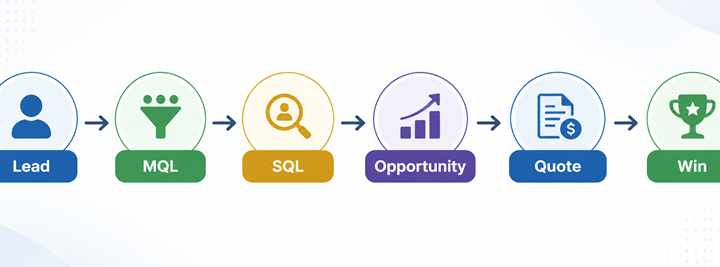
- reporting by channel performance (MQL to SQL to RFQ to win)
Promotion
Website must include
- landing pages aligned to intent: industry, application, and/or product family
- conversion points mapped to buyer stage
- analytics and event tracking for measurable optimization
Content must include
- SEO pillar and cluster content by application and/or industry
- sales enablement library: one-pagers, comparison sheets, FAQs
- nurture email sequences by segment and stage
CRM must include
- lifecycle stages
- automated nurturing and tasking for sales follow-up
- closed-loop reporting: pipeline impact, not vanity metrics
Common pitfalls and how to fix them
1) “Promotion” without Product clarity
Symptom: traffic rises, lead quality drops
Fix: upgrade product/application pages first; build content around selection and validation.
2) “Place” conflicts with channel partners
Symptom: distributors complain, leads get misrouted, sales slows down
Fix: define channel rules, reflect them on the site, and enforce routing in CRM.
3) Quote-based pricing becomes a black box
Symptom: buyers hesitate to engage; RFQs lack detail; quotes take too long
Fix: publish pricing drivers, add value-based signals, and improve RFQ inputs.
4) Tactics aren’t tied to measurement
Symptom: lots of activity, unclear ROI
Fix: define KPIs that map to revenue: qualified leads, MQLs, SQLs, RFQs, conversion and pipeline influence.
Proof points, examples, and the “data types” that matter
If you want the 4 Ps to drive measurable outcomes, track the signals that actually reflect manufacturing buying behavior:
- Product engagement: spec sheet/CAD downloads, comparison behavior, “talk to an engineer” submissions
- Price readiness: completion rate of quote-intake fields, time-to-quote, stall reasons
- Place effectiveness: lead routing accuracy, speed-to-lead by channel, partner-sourced pipeline
- Promotion impact: MQL to SQL to RFQ to win rate, influenced pipeline, keyword visibility for application intent, CTR on technical content
And when you need internal buy-in, use simple proof narratives:
- “We reduced RFQ back-and-forth by improving quote intake fields.”
- “We increased qualified opportunities by aligning product pages and SEO content to application intent.”
- “We prevented buyer and sales conflict by clarifying purchase paths and routing rules.”
CTA: See how your 4Ps show up online vs. competitors
If you want to make the 4 Ps actionable, start by seeing how clearly, or inconsistently, your competition appears across the digital footprint you want to leave.
Get a FREE Website Competitor Analysis to identify:
- gaps in product documentation and conversion paths
- pricing/value signals competitors are using
- channel clarity and potential conflicts for your buyers or theirs
- promotion performance opportunities: SEO content, LinkedIn and email