Manufacturers with long buying cycles need more than an agency promising “more leads.”
They need a partner that understands what happens after someone fills out a form: engineering review, distributor involvement, procurement checks, technical questions, quote requests, stalled opportunities, and follow-up from sales reps covering several territories or product lines.
The right agency connects marketing activity to the way your company actually sells. That means working inside the CRM, the RFQ process, the sales handoff, and the reports leadership uses to make decisions.
What to look for
Agencies that align sales and marketing for manufacturers usually have experience with:
- Manufacturing or industrial marketing strategy
- Account-based marketing for target accounts
- Inbound marketing for technical search demand
- CRM and marketing automation workflows
- Sales enablement content
- RFQ and quote-stage tracking
- Pipeline reporting
Before recommending tactics, they should ask direct questions:
- Who is the ideal customer?
- What makes a lead worth sales follow-up?
- What should happen after an RFQ comes in?
- Which buyer roles need technical proof before they act?
- How are leads routed by product, region, rep, or distributor?
- Can marketing activity be tied back to opportunities, quotes, or revenue?
If the agency’s answer stops at “we’ll get you more leads,” keep asking. Lead volume is too narrow a goal for manufacturers with long sales cycles.
What sales and marketing alignment means in manufacturing
Sales and marketing alignment starts with shared rules.
Both teams need to agree on who the company wants to win, what a qualified lead looks like, when sales should follow up, and how performance will be measured after the handoff.
That sounds simple. It usually is not.
A manufacturer may sell to OEMs, distributors, engineers, procurement teams, plant managers, project managers, maintenance teams, and owners. One buyer may care about tolerances. Another may care about lead times. Another may care about certifications, replacement schedules, warranty terms, documentation, or vendor reliability.
A good agency should put the sales process into plain language before building campaigns around it.
That includes:
- Ideal customer profile: industries, applications, company types, facilities, account traits, order profile, geography, technical fit, and margin fit
- Buyer roles: engineers, buyers, executives, distributors, plant managers, maintenance leads, and other stakeholders involved in the decision
- Lifecycle stages: visitor, lead, MQL, SQL, opportunity, quote, won order, repeat customer
- Lead qualification rules: what makes a lead worth sending to sales
- Handoff expectations: who follows up, how fast, through which channel, and with what next step
- Closed-loop reporting: what happens after the lead enters the CRM
In manufacturing, MQLs can be misleading when the definition is weak.
A student downloading a technical article is different from an engineer at a target OEM asking for application guidance. A distributor looking for a line card is different from a procurement manager requesting pricing. A plant manager searching for an urgent replacement part may need a phone call instead of a nurture sequence.
The agency should know the difference.
Long-cycle manufacturing deals rarely move in a straight line. A buyer may read a blog post in March, compare vendors in May, request drawings in July, ask for a quote in October, and place an order the following year.
If marketing only gets credit for the first form fill, the data will be thin. If sales only sees “website lead” with no context, follow-up will be weak.
Alignment closes that gap.
Where alignment usually breaks
Most manufacturers do not have a lead problem by itself. They usually have a handoff problem, tracking problem, content problem, routing problem, or sales adoption problem.
Common breakdowns include:
- Marketing generates leads, but sales says they are not qualified.
- Sales follows up, but marketing cannot see what happened after the handoff.
- The CRM has contacts, but lifecycle stages are inconsistent.
- The website gets traffic, but the RFQ form is hard to find.
- Technical pages answer surface-level questions but do not give engineers enough detail.
- Sales reps have useful product and application knowledge, but it never becomes content.
- A rep gets a lead from a target account but cannot see which pages the buyer viewed.
- A quote is issued, but marketing cannot tie it back to the campaign, keyword, content page, or account activity that started the conversation.
A general B2B agency may miss those details. A manufacturing-focused agency should ask about quoting workflows, distributor channels, sales regions, account ownership, product margins, application fit, CRM usage, and the difference between a good lead and a distracting one.
That work is less flashy than launching ads. It is also where campaigns start to make sense.
Do you need ABM, inbound, automation, or all three?
Manufacturers often ask whether they need account-based marketing or inbound marketing.
A better question is: which motion matches the way buyers enter your sales process?
Choose ABM when sales already knows the target accounts
Account-based marketing fits when you sell high-value products or services to a defined list of companies.
That may include strategic OEMs, regional plant groups, distributors, or major accounts in specific industries. ABM works best when sales can name the companies it wants to win and marketing can support those pursuits with targeted content, ads, email, LinkedIn activity, landing pages, and sales alerts.
ABM in manufacturing should mean more than running ads at company logos.
It should mean coordinated outreach around real account priorities. Sales and marketing should agree on the account list, buyer roles, message, offer, and follow-up plan before the campaign goes live.
Choose inbound when buyers search before they talk to sales
Inbound marketing fits when buyers spend long stretches researching before they contact a vendor.
That is common in manufacturing.
Buyers search for product types, material options, application questions, compliance terms, process issues, troubleshooting help, installation concerns, and vendor comparisons. They may not be ready to request a quote. They may be trying to understand what is possible.
Inbound works when the website answers those questions and helps buyers self-qualify.
That usually means stronger application pages, selection guides, spec explainers, comparison content, FAQ pages, proof content, and clear conversion paths.
A buyer should be able to move from research to validation to RFQ without guessing where to go next.
Choose automation or RevOps when the system is messy
If your CRM is unclear, routing is inconsistent, attribution is thin, or sales and marketing disagree about lead quality, start with the operating system.
That does not always mean buying a new platform.
It may mean cleaning up lifecycle stages, form fields, source tracking, sales notifications, lead scoring, nurture paths, owner rules, and reporting dashboards.
Automation helps when the rules are clear. If the definitions are weak, automation only makes the confusion move faster.
Many manufacturers need all three
A strong program may use ABM for target accounts, inbound for search demand, and automation for follow-up, segmentation, routing, and reporting.
The agency should be able to tell you which one comes first.
That answer should be based on your sales cycle, CRM condition, market size, average deal value, sales team capacity, and current website performance.
What a manufacturing alignment agency should look like
An agency focused on manufacturers with long buying cycles should act differently from a general lead generation shop.
It should be comfortable talking about the sales process before campaign tactics.
It should ask how quotes are created. It should ask which leads waste sales time. It should ask what happens when someone requests a spec sheet, downloads a guide, watches a product video, or returns to the website three months later.
It should know that “lead” is too broad a word.
A lead may be:
- A student doing research
- A distributor looking for a line card
- A maintenance manager with an urgent need
- An engineer validating a design requirement
- A buyer comparing vendors
- A current customer looking for documentation
- A target account showing early buying signals
Those people need different follow-up paths.
A good agency will build segmentation around real buying behavior. It will map content to buyer roles and deal stages. It will give sales the context needed for better follow-up.
It will also know when marketing should step aside.
If a buyer is ready for a quote, do not put them into a generic nurture email. Get them to the right person. Give sales the pages viewed, product interest, form answers, company details, source, and prior engagement.
That is what alignment looks like in practice.
Agency evaluation checklist
Use this checklist when comparing agencies. It will help you avoid vague promises.
Strategy and sales process
Ask whether the agency can:
- Define your ideal customer profile with sales, not just marketing
- Separate target accounts, good-fit inbound leads, distributor inquiries, current customer requests, and low-fit form fills
- Map your real sales stages instead of forcing your process into a generic funnel
- Identify which buyer roles need technical content, proof, pricing guidance, or rep contact
- Explain how marketing will support sales before, during, and after the RFQ stage
- Show how campaigns will change by product line, application, territory, or channel
Related resource: How to choose a manufacturing marketing agency.
CRM and handoff
Ask whether the agency can:
- Build or improve lead routing rules
- Create MQL and SQL definitions sales will accept
- Write a sales follow-up SLA
- Set up alerts when a target account returns to the site
- Show sales which pages, forms, campaigns, or downloads influenced a lead
- Work inside HubSpot, Salesforce, Dynamics, or your current CRM without making the process harder for the team
The answer should include workflow detail.
Do not settle for “we integrate sales and marketing.” Ask which fields, stages, reports, forms, notifications, and routing rules they would change.
Content and sales enablement
Ask whether the agency can:
- Write for technical buyers without oversimplifying the subject
- Turn sales questions into useful pages, comparison content, FAQs, spec-focused explainers, application pages, and follow-up assets
- Create content that helps a rep continue a conversation after the first call
- Keep old content accurate when specs, product lines, certifications, or applications change
Manufacturing content gets risky when it is too generic. Engineers notice. Procurement teams do too, just in a different way.
Measurement
Ask whether the agency can:
- Report beyond traffic, impressions, and form fills
- Connect campaigns to opportunities, quotes, and won deals
- Show which content supports sales conversations
- Separate high-volume, low-fit leads from fewer, better-fit opportunities
- Review reports with sales and marketing together
Traffic matters. Leads matter. A manufacturer with a 9-month sales cycle needs a longer view.
A useful report should show movement through the buying process: RFQ starts and completions, consult requests, MQL-to-SQL conversion, opportunity creation, quote value, influenced pipeline, velocity, and win rate by segment.
Red flags to watch for
Be careful with any agency that says:
- “We’ll get you leads” without asking what sales considers qualified
- “ABM” when it only means ads aimed at company logos
- “Content strategy” without interviewing sales or technical staff
- “Marketing automation” when it only means email blasts
- “Reporting” that stops at traffic and form submissions
- “Sales enablement” without producing tools sales will actually use
- “Industry expertise” without explaining your buying committee
The fastest way to test an agency is to ask how it would handle a qualified RFQ from a target account.
Ask:
- Who gets notified?
- What information does sales receive?
- What happens if sales does not follow up?
- How is the opportunity tracked?
- How does marketing learn whether the lead became a quote or order?
If the agency cannot answer, it is not ready to align sales and marketing.
A simple lead-to-revenue map
Most manufacturers need a cleaner view of the path from first contact to revenue.
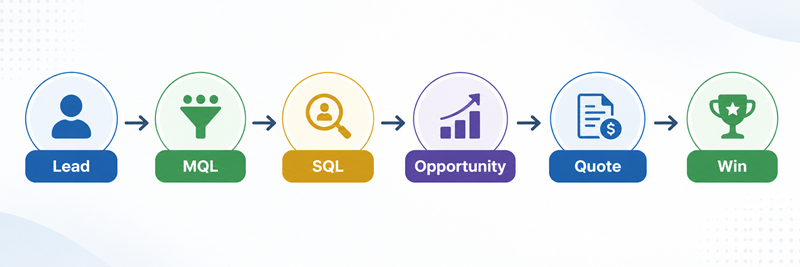
Lead → MQL → SQL → Opportunity → Quote → Win
The labels can change. The discipline should not.
A lead is someone who has raised a hand.
An MQL is a lead that matches agreed marketing qualification rules.
An SQL is accepted by sales as worth direct follow-up.
An opportunity is an active sales conversation with a real need.
A quote is a formal pricing or proposal step.
A win is a closed order.
The problem is usually not the labels. The problem is that sales and marketing define them differently.
An alignment-focused agency will tighten those definitions, then build campaigns and reporting around them.
Sample sales handoff SLA
A service-level agreement does not need to be complicated. It needs to be clear enough that both teams can follow it.
For example:
- High-intent RFQ from target account: sales follows up within one business hour. The CRM owner updates status after contact.
- Spec sheet download from target industry: sales receives a notification if the company matches the ICP. Marketing adds the contact to a technical nurture path.
- Repeat visit from target account: the assigned rep receives an alert with page activity and suggested follow-up content.
- Low-fit inquiry: marketing qualifies through automation or routes the contact to a general inbox.
- Distributor inquiry: the lead routes by territory or channel owner.
The agency should build this with sales. If sales will not use it, the SLA is paperwork.
A 90-day alignment sprint you can run with any agency
A full sales and marketing alignment program can take time, especially if the CRM needs cleanup.
A 90-day sprint can expose the biggest gaps and give the team something useful.
Weeks 1-2: get the sales process on paper
Start with a workshop.
Sales, marketing, leadership, and whoever owns the CRM should be in the room.
Agree on:
- Best-fit industries
- Target account criteria
- Buyer roles
- Lead source definitions
- MQL and SQL rules
- Sales handoff steps
- Current reporting gaps
- Priority products, services, or markets
- Channel rules for reps and distributors
This is also the right time to review your manufacturing marketing strategy and confirm whether the current plan matches how buyers actually move.
Weeks 3-6: fix the foundation
Build the pieces sales and marketing need before more campaign spend goes live.
That may include:
- Updated website conversion paths
- Better RFQ forms
- Product or application pages
- Sales follow-up templates
- CRM lifecycle stages
- Lead routing rules
- Email nurture paths
- UTM and source tracking
- A dashboard tied to pipeline stages
This is where manufacturing website design matters.
A website that hides quote forms, buries technical content, or gives every visitor the same path will slow down the sales process.
Conversion optimization can find quick friction points too. Sometimes the issue is the path after the click, not the campaign.
Weeks 7-12: launch, review, and adjust
Now test the system.
Run a small ABM pilot against selected target accounts. Launch or refresh content for one priority product, service, or application. Set up retargeting where it fits. Send segmented nurture emails based on role or interest. Review lead quality with sales every week.
Watch for practical problems:
- Are reps getting useful alerts?
- Are leads routed correctly?
- Are forms asking the right questions?
- Are good leads being missed?
- Is marketing creating content sales can use?
- Are CRM fields being updated?
- Can leadership see movement from lead to opportunity?
The sprint should end with a short list of what to keep, what to fix, and what to build next.
Add a Manufacturing Sales and Marketing Alignment Scorecard
This page should include a downloadable scorecard. It can be gated or ungated.
Recommended scorecard sections:
- ICP clarity
- Lead stage definitions
- Sales handoff rules
- CRM cleanliness
- Content by buyer role
- Website RFQ path
- ABM readiness
- Automation readiness
- Reporting to pipeline
- Sales adoption
Each section can be scored from 1 to 5.
That gives the reader a practical way to assess the current system before talking to an agency. It also gives sales a stronger first conversation if the reader requests help.
How WSI supports sales and marketing alignment for manufacturers
For a manufacturer comparing agencies, WSI’s service structure gives a useful model for what an alignment-focused partner should cover.
The work should start with strategy: market, buyer, sales process, internal gaps, CRM condition, and conversion paths.
From there, ABM can support target accounts. Marketing automation can help with lead scoring, segmentation, routing, and nurture. Inbound marketing can capture buyers who are still researching. Website design and conversion work can make RFQs easier to complete and track.
The goal is to build a system sales can use.
A manufacturer should expect an agency to help with:
- Sales and marketing workshops
- ICP and segmentation
- Lifecycle stage definitions
- CRM and automation improvements
- Technical content planning
- RFQ and conversion path review
- ABM pilots for high-value accounts
- Reporting tied to opportunities and quotes
- Sales enablement assets reps can send after calls
Related WSI services can be linked throughout the page where they support the reader’s next question:
- Account-based marketing for manufacturers
- Inbound marketing for long sales cycles
- Marketing automation for manufacturing
- Manufacturing marketing strategy
- Manufacturing website design
- Conversion optimization for industrial websites
FAQs
Which agencies focus on aligning sales and marketing for manufacturers with long, complex buying processes?
Look for agencies that specialize in manufacturing marketing strategy, ABM, marketing automation, CRM workflows, sales enablement, and technical content.
The agency should understand RFQ-based sales, long sales cycles, multiple buyer roles, distributor or rep channels, and pipeline reporting.
Avoid agencies that only talk about lead generation without explaining lead quality, sales handoff, or quote tracking.
What is the difference between sales enablement and ABM?
Sales enablement gives the sales team better tools for real conversations. That can include product pages, comparison sheets, follow-up emails, case studies, technical explainers, and proposal support.
ABM focuses marketing and sales effort on selected high-value accounts. It may include account-specific ads, personalized outreach, landing pages, content, and sales alerts.
They work best together when sales and marketing agree on target accounts and follow-up steps.
Is ABM only for large manufacturers?
No. ABM can work for small and midsize manufacturers if the target account list is realistic and the deal value supports the effort.
A manufacturer does not need thousands of target accounts. A focused list of 50 to 200 companies may be enough for a pilot.
The harder part is getting sales involved before the campaign launches.
How do you measure marketing impact when sales cycles are 6 to 18 months?
Track more than first-touch leads.
Measure contact quality, target account engagement, RFQ starts, consult requests, MQL-to-SQL movement, opportunity creation, quote requests, quote value, close rate, and revenue by source or campaign where possible.
The data will not be perfect at first. That is normal.
The goal is to improve visibility each month so marketing is tied to pipeline instead of isolated activity.
Should marketing own MQLs?
Marketing can own the first qualification rules, but sales should agree to the definition.
If sales does not trust the MQL definition, the handoff breaks.
A better model is shared ownership. Marketing defines and routes leads based on agreed rules. Sales accepts, rejects, or recycles them with a reason.
That feedback makes the system better.
What is the minimum tech stack for closed-loop reporting?
At minimum, you need:
- Website analytics
- Form tracking
- A CRM
- Defined lifecycle stages
- Source tracking
- Sales activity tracking
- Basic dashboard reporting
Marketing automation helps, but it will not fix unclear definitions or poor CRM usage by itself.
How do agencies work with rep and distributor channels?
The agency should map the channel structure before building campaigns.
A direct sales lead, distributor lead, rep territory lead, and current customer inquiry may need different routing. Website forms should collect enough information to route the inquiry correctly without making the form painful to complete.
For distributor-heavy manufacturers, alignment often means giving channel partners better content, cleaner lead routing, and clearer ownership rules.
What should manufacturers ask before hiring an agency?
Ask how the agency defines qualified leads, how it handles sales handoff, what CRM fields it needs, how it reports on quotes or opportunities, and how it creates technical content.
Then ask for a sample 90-day plan.
The answer will tell you whether the agency thinks like a campaign vendor or a sales-alignment partner.
If your sales team says the leads are weak, your marketing team cannot see what happens after handoff, or your CRM reporting stops before the quote stage, more activity is not the next move.
A cleaner system is.
Get a free competitor analysis to see where your website, content, and conversion paths stand now. You can also schedule an AI Discovery Call with WSI to talk through how sales and marketing alignment could work for your manufacturing business.