Visibility itself is burning up as AI reshapes the atmosphere around your business.
The fight for attention is no longer happening on search results alone—it’s happening inside ChatGPT, Perplexity, Claude, and every system your customers are already prompting for answers.
This is the moment most companies will freeze. They’ll cling to their Google rankings, pray their backlinks hold, and tell themselves: “We’ve done the work. We’re good.”
You’ve learned what it takes to build visibility outside AI: authority, trust, signals that Google and others can’t ignore. Good. Keep doing it. But that’s not enough.
There’s a second layer of work happening inside the walls of the Als themselves that you need to prepare for as well. While you’re tweaking page content, your competitors are embedding themselves inside the systems people now trust most. They’re not waiting to be discovered. They’re making sure they get repeated.
This isn’t magic. It’s not guesswork. It’s a set of strategic moves you can make today to secure a lasting presence inside tools like ChatGPT, Perplexity, and Claude.
Right now, someone is asking ChatGPT for advice in your space. The businesses that show up consistently? They didn’t get there by accident. They took direct action inside these platforms while everyone else was still debating whether AI mattered.
This isn’t theory. It’s happening. And the savvy businesses? Well, they’re already building their seat at the table while the door’s still open. The next frontier of SEO isn’t just on your website—it’s inside the Als deciding who gets seen.
Embed Yourself in AI’s Inner Circle
If Google were your front door, these AI platforms are your private backroom deals. The kind where the real decisions get made. Perplexity, Claude, ChatGPT—they’re not just skimming the open web anymore. They’re building their own curated ecosystems, and they reward the sources that live inside their walls. Perplexity Pages. Claude Artifacts. Al-native spaces built for answers, not just articles. Structured, credible, and frictionless to cite.
Perplexity is the clearest case study. It’s not a search engine—it’s an answer machine. It thrives on short, sharp, well-cited insights it can pull without hesitation. That’s why forward-thinking businesses aren’t waiting to be scrapped. They claim their stake zside the platform, building Perplexity Pages that act like VIP passes to the machine’s brain. And Perplexity doesn’t stop there. Its Discover feed dynamically assembles on-the-fly news pages from a blend of sources. The fresher and more structured your insights, the more likely you are to show up in that rolling feed—where authority is built in real time.
The same logic applies to Claude Artifacts and other Al-native formats. You’re not hoping an external bot stumbles across your site. You’re feeding the system your best answers in its preferred format—making it nearly impossible to ignore you.
This isn’t about flooding every platform with everything you know. It’s about claiming your corner—the topics that define your authority and should never be rewritten without your name attached. But what about when the AI isn’t pulling from inside its own walls? That’s when the game moves to your turf, and you need to control what it sees.
Curate What AI Sees: Be the Source, Not the Bystander
Here’s something most business owners don’t realize: all major platforms—Google, ChatGPT, Claude, Perplexity—use bots to crawl your site. Some, like Googlebot and Bingbot, were built to match content to searches and send you traffic. But the new bots aren’t here to match. They’re here to mine.
Bots like GPTBot and PerplexityBot scan your content to extract answers, train their models, and fuel future responses. Whether you get credited depends on your signals being strong enough. They summarize across multiple sites and surface general citations—often favoring more authoritative or structured domains, even if someone else said it first. That means you can do the work and still get skipped if your signals aren’t strong enough.
You’re not writing for search engines anymore. You’re writing for systems that remember, remix, and respond. You can’t afford to be passive. Because when AI learns from you without crediting you, you lose twice—once when your work is used, and again when someone else gets the recognition. So don’t hide from AI. Direct it. Show these systems exactly what you want them to see: your sharpest proof, your most explicit claims, the content that positions you as the go-to expert. Make it easy to parse, easy to cite, and impossible to ignore.
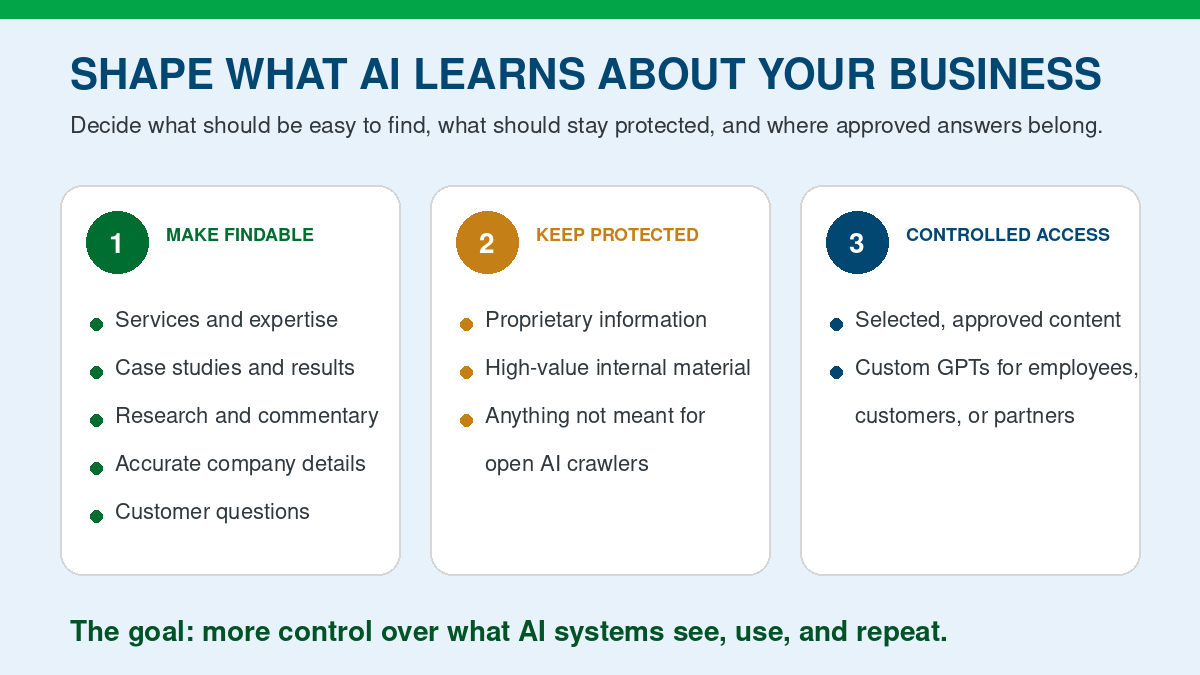
And when something is too valuable to give away? Protect it. Block AI bots from scraping your proprietary research, internal frameworks, or download-only resources. Gate what needs guarding. Draw the line—strategically.
But be honest about the tradeoff. If AI can’t train on it, it won’t cite it. If it can’t see you, it can’t share you. And if your competitor lets it in? They become the source. Which is precisely why the next shift matters even more.
Traditionally, websites were built for people to read and for search engines to index. But while traditional systems just read your site, they don’t offer much more. AI interacts with it. And a new standard is emerging to make that possible.
It’s called NLWeb, and major platforms like Shopify, TripAdvisor, and Eventbrite are already adopting it. Think of it like turning your website into a live database that AI systems can query directly.
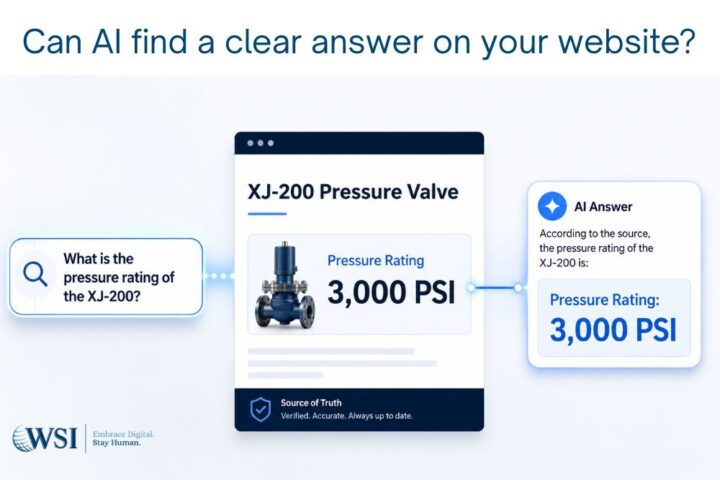
With NLWeb in place, your content becomes more than a page. It becomes a trusted source that AI agents can pull from in real time, eliminating the need for guessing or scraping. You eliminate confusion. You reduce hallucinations. You become the answer.
This isn’t a technical tweak. It’s a strategic change in how the internet works. Because in the Al-powered web, good content alone doesn’t win. If your site isn’t structured for machines to use, it won’t matter how brilliant your insights are. AI won’t choose you. It will choose someone else.
If you think that’s just about the public web, you’re missing the most controllable layer of all: the version of your business people interact with directly.
Own Your Story Before AI Rewrites It
Your buyers, your team, even your partners, they’re already asking ChatGPT questions about you. But the public version doesn’t care if it gets your story half-right. It pulls whatever scraps it finds, even if they’re outdated or twisted by a competitor’s spin.
A Custom GPT is your safety net for the truth. It’s not a search tactic—it’s a trust tactic.
A Custom GPT isa version of ChatGPT that you train yourself. You feed it only the trusted content you choose: your FAQs, your case studies, your playbooks, your truth. Then you share it with the people who need it most: your reps, your team, your franchisees, your biggest clients. So instead of guessing, they get it right.
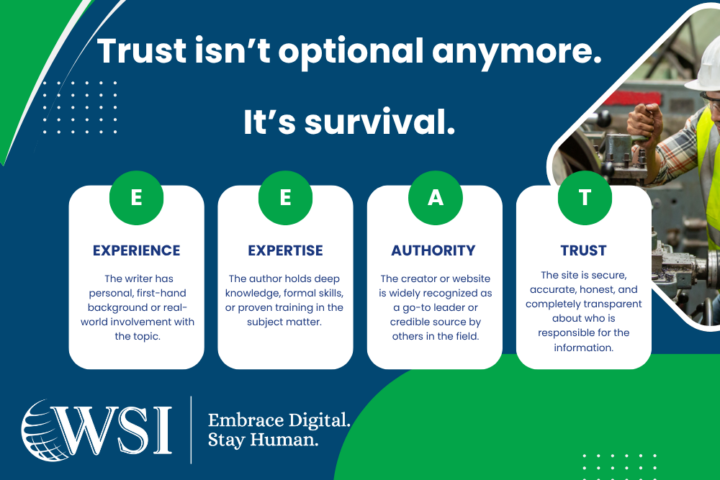
And they do something else too: they reinforce your broader E-E-A-T—your expertise, experience, authority, and trust signals. By sharing your Custom GPT on your site or with key clients, you demonstrate that you’re the real source.
Creating Custom GPTs doesn’t feed the public AI model (not yet anyway). It won’t make ChatGPT mention you more in random queries. But it does keep your truth locked tight where it matters: with the people who need to trust you most.
Companies are already ahead on this: consultants feed their Custom GPT with keynote scripts and frameworks, enabling their team to provide consistent advice. SaaS companies lock onboarding and pricing details inside to prevent customers from getting wrong answers. Franchise networks provide local reps with brand guidelines and compliance rules. The accounting firm is training its Custom GPT on tax code updates and client scenarios, ensuring that every partner provides consistent advice during the busy season. The real estate team is loading theirs with neighborhood data and market trends, so agents always have detailed comparisons and local insights at their fingertips.
Our research shows that those using their own trained versions of Chat- GPT keep their answers consistent, reduce the risk of AI getting things wrong, and build stronger trust with their teams, clients, and partners.
For companies with deep expertise, complex messaging, or multiple reps who answer tough questions every day, a Custom GPT is the simplest line of defense you can put in place right now.
You can’t stop Al from reading the rest of the web. But you can make sure when your people ask for an answer, they hear it from you—the way it was meant to be heard.
And if the game changes. If the next version of ChatGPT starts pulling from custom-trained sources, you’ll already be ready. Because if there’s one thing I know after watching search reinvent itself for decades, it’s this: Staying agile never hurts. Acting too late always does. Structure or Stay Invisible:
Welcome to Agent-Oriented Optimization
There’s a significant movement happening underneath all this. One most business owners haven’t even heard of yet. But it’s already shaping who shows up in AI answers, and who disappears entirely.
It’s called Agent-Oriented Optimization (AOO)—and it’s quickly becoming the new standard for visibility in Al-driven discovery.
In the traditional search era, the goal was to get indexed and ranked by Google. In the AI search era, the goal is to be understood and acted on by machines. These aren’t search engines anymore—they’re AI platforms and increasingly, AI agents that search and act on behalf of humans.
Agents don’t click. They complete tasks. They pull the answers, make the comparisons, even place the order—without ever visiting your website like a human would.
Think Perplexity’s Comet, ChatGPT’s shopping tools, Manus, GenSpark, and whatever Google and Microsoft are about to embed into Chrome and Edge. These aren’t “browsing” your site like a human. They’re pulling the facts they need straight from the source. Things like your pricing, availability, service list, or product details, and skipping anything they can’t easily understand.
This is especially critical for retailers. The rise of agentic commerce—where AI agents can find, compare, and even purchase products without human clicks—is already underway. Perplexity has launched a shopping agent. Shopify is powering OpenAlI’s in-app checkout. The businesses that will win are those whose product data is structured, current, and machine-readable.
That’s where a new standard called Model Context Protocol (MCP) comes in. Think of it like HTTPS for the AI era. It’s what lets these agents interface directly with your business systems. Without it, they might still find bits and pieces, but not in a way they can easily trust or act on. And in this new environment, “hard to use” equals invisible. Google is already layering on protocols like AP2 (Agentic Payments Protocol) and A2A (Agent-to-Agent), which allow agents to not only find and interpret your data, but also transact and pay on your behalf. And OpenAI has introduced the Agentic Commerce Protocol (ACP) to power “Instant Checkout” inside ChatGPT—an open standard built with Stripe that lets users go from prompt to purchase in seconds.
That’s the core of AOO. If your content and systems aren’t structured to interact with Al agents easily, you risk exclusion entirely. And as agents take over more of the choosing, that kind of exclusion will be fatal. This shift is especially urgent for product-based and service-based businesses—anyone who relies on live data, dynamic pricing, or transactional interactions. If your information isn’t structured, connected, and machine-readable, the Al agent moves on. No friction. No remorse.
So yes, keep building trust signals. Keep earning mentions. But if you want AI to recommend you, you have to be usable. Not just readable.
This is Agent-Oriented Optimization. It’s nota tactic buta threshold. One that’s already separating the businesses that show up from the ones that don’t.
What’s Next: When AI Stops Answering and Starts Acting
Here’s the thing: the worst these systems will ever be is right now. They’re getting sharper. Faster. More autonomous. Tomorrow’s AI isn’t just answering queries—it’s making decisions.
Platforms like Perplexity and ChatGPT are testing AI agents that don’t just pull facts—they complete tasks. They browse, compare, buy, and book on your behalf. And they don’t care about click-throughs or pretty websites. They only care about data they can understand and act on.
That means your business needs to show up in formats machines can use: clean, structured, real-time data that feeds into the systems doing the choosing. If you sell products, watch what’s happening with structured product feeds. If you provide services, consider how agents might vet providers tomorrow. This isn’t about visibility alone anymore. It’s about being usable by machines that are doing the work for your customers.
So yes—do what you can today. Build trust. Feed the right signals. But don’t get comfortable. AI doesn’t wait. It evolves. And so must you.
In Summary: Key Takeaways
Most businesses are obsessing over what they can do on their website or what they can tweak for Google, and that’s where they stop. But the truth is: all signs point to visibility depending as much on what happens inside AI systems like ChatGPT, Perplexity, and Claude as it does outside them. The details are still unfolding, but the trajectory is clear.
If there’s one thing I know about search, it’s this: it never hurts to lead. It always hurts to wait. So, think of these takeaways as your starting point for staying ahead:
- Al-ready isn’t just about content. It’s about structure. You have to feed AI clean, clear, connected data it can understand and act on.
- Don’t just show up. Be usable. Agent-Oriented Optimization means making your site actionable agents, not just readable to people.
- Claim your seat inside AI ecosystems. Build presence in AI-native formats like Perplexity Pages and Claude Artifacts while the door is still open.
- Decide what to share—and what to guard. Train AI on your best, most brand-defining proof. Protect what gives you a competitive edge.
- Own your version of the truth. A Custom GPT ensures your team, clients, and partners hear your story straight—no hallucinations, no guesswork.
This window is still open, but not for long. AI is learning fast. Agents are evolving. And the businesses that integrate themselves into AI platforms and present themselves in a structured, direct, and credible manner will be the ones it references.
Up Next: Next, I’ll show you how to build your Adaptive SEO mindset—your operating system for survival. This is where your authority, structure, cross-channel content, and Al-ready signals all come together.