Your competitor just landed three AI citations this month. You published twice as much content.
Guess who’s winning?
While you’ve been perfecting blog schedules and chasing backlinks, they’ve been feeding the machine that decides who gets remembered. Their name shows up when ChatGPT answers questions about your industry. Their insights get quoted in Perplexity summaries. Their company becomes the default answer. You? You’re still waiting for clicks that aren’t coming.
This isn’t just talk anymore—it’s measurable in your shrinking traffic and recycled keyword lists. The asteroid is visible on the horizon, growing larger as most people just standing there—eyes wide, necks craned—marveling at what’s about to hit.
Standing still won’t protect you. Standing still is extinction. This is where Adaptive SEO comes in—not as another checklist to dust off quarterly, but as your instinct to move. Your radar for staying visible when the rules of discovery shift under your feet.
Because you know what happens when you stay static: your site becomes fuel for the machine; scraped, summarized, and served up in someone else’s answer. AI doesn’t care about your perfect meta descriptions. It cares if you’re worth remembering—if your voice, your data, your business name show up in the places it trusts to build its worldview.
So, the question now isn’t “Do you see the asteroid?” You do. The only question left is: “Will you move fast enough to matter when it lands?”
What Adaptive SEO Really Means
Adaptive SEO isn’t a new tactic to bolt onto your marketing plan. It’s your survival mindset in a world where AI now decides who gets found, who gets cited, and who gets forgotten.
We believed agility was so critical to SEO that years ago, we made it official—registering WSI AdaptiveSEO® as our own. Back then, it was about staying ahead of algorithm updates. Today, it’s about staying alive in a search landscape where machines write the rules and decide the winners. It’s a mindset that understands this simple truth: search engine optimization isn’t your focus anymore—you’re training the very systems that rewrite your answers, shape your reputation, and compress the funnel before your customer ever sees your site.
Static SEO says: Rank for keywords, and the clicks will come.
Adaptive SEO says: Be discoverable everywhere trust-building happens.
Think of Adaptive SEO as your radar system—continuously scanning the horizon for the next shift. Learning and recalibrating before change becomes a crisis. It’s the difference between being summarized once and being cited consistently when AI needs expertise in your category. That survival framework rests on five core principles that keep you visible, regardless of how the search landscape shifts. Principles of WSI AdaptiveSEO®
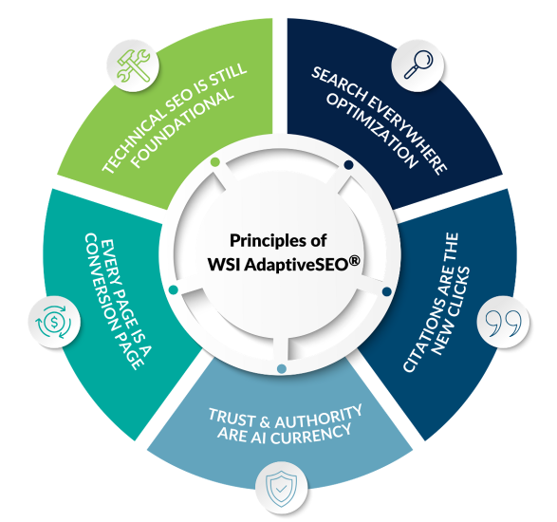
Principle #1: Search EverywhereOptimization
Still think SEO begins and ends with Google? That’s not a strategy. That’s suicide.
Your customers don’t just search on a single search engine anymore—and neither do the AI systems rewriting the answers.
They pull from Reddit threads, YouTube transcripts, podcast show notes, press mentions, TikTok captions, LinkedIn posts, Facebook updates, and even that community post you forgot you wrote three years ago. If your voice is absent from these conversations, you’re invisible in the very ecosystems that feed AI responses.
Search Everywhere Optimization means your authority travels. It’s the shift from “optimize for blue links” to “be discoverable wherever the conversation happens.” When you’re quoted in a podcast, tagged in an industry forum, or mentioned in a trusted article—that’s a signal AI can learn from. These references teach the next wave of large language models who you are and why you’re worth mentioning.
So, stop thinking of SEO as just your website. Your website is your home base, but your business needs outposts in every place AI and people look for answers.
The businesses that adapt don’t wait for clicks. They plant their ideas where they’ll be seen and then double down when they hit.
- A LinkedIn post that gains traction becomes a podcast talking point. A podcast becomes a YouTube clip.
- A clip becomes a quotable stat in the news.
Each mention is another thread AI uses to build its answer, with your name attached. The old search question was: “Are we ranking for that term?”
The new survival question is: “Are we showing up everywhere our audience—and Al—goes looking for answers, and turning that into results we want?”
Because “everywhere” isn’t random—it’s targeted.
And if you’re not everywhere that matters? You’re nowhere.
Principle #2: Citations Are the New Clicks
In the old SEO world, the click was the goal. Generate traffic, track con- versions, optimize the funnel.
But AI often eliminates the click entirely. Your best content becomes fuel; summarized and served up inside someone else’s answer, with your attribution potentially lost in the process. Spoiler: that click isn’t the point anymore. The mention becomes more valuable than the visit.
When AI systems decide how to answer a question, they pull from sources they trust. If your name, research, or insight shows up in those sources, you expand your chances—the number of ways you can be pulled into an answer. You’re not guaranteed to appear, but you’ve made it far more likely that you will. This is where your competitors are either sleeping or sprinting.
The static businesses cling to blog schedules and chase backlinks like it’s still 2015. The adaptive ones build authority assets that AI is more likely to pull from—original data no one else has, expert commentary in trusted publications, quotes in podcasts and webinars, memorable soundbites that
AI can easily extract and re-use.
This is more than “digital PR.” It’s survival PR.
It’s about planting your flag in credible, high-signal places so the next wave of AI platforms is more likely to pull you into the conversation.
So, ask yourself: if your biggest competitor got quoted in TechCrunch, invited onto two top podcasts, and cited by three industry blogs this quarter, while you pushed out another generic “10 tips” blog post. Who do you think has the better shot at being surfaced when AI builds an answer? Clicks built yesterday’s traffic. Citations increase your odds of tomorrow’s relevance.
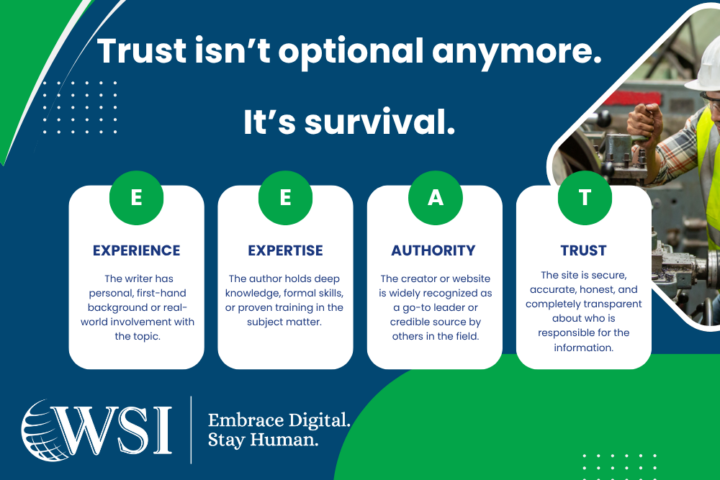
Principle #3: Trust & Authority Are AI
Currency AI goes beyond merely analyzing your content. It profiles your credibility.
When ChatGPT decides which expert to quote or Perplexity chooses which source to cite, it’s not evaluating trust from scratch. It’s echoing the signals it inherits from the systems that already rank and recommend content—Google search, Bing search, news outlets, and other trusted sources it pulls from.
Most businesses get this backwards. They think authority is something you declare on your About Page. In reality, it’s something you prove in the open web—over and over—until the systems feeding AI have no choice but to prioritize you.
Trust and authority aren’t a box you check once. They’re a heartbeat. If you don’t keep feeding them, they fade.
Your job isn’t to convince AI you’re an expert. It’s to become so obviously credible in the places that matter industry publications that quote your insights, podcasts that feature your perspective, research that cites your data, and communities where your voice carries weight.
Every mention expands your likelihood of being pulled into tomorrow’s answers. And size doesn’t set the limit—consistency and presence do. You don’t need national reach, just the right visibility in the right places. If you go quiet, you don’t just slip down the rankings; you slip out of the conversation entirely.
The static mindset treats authority like a credential you earn once. The adaptive mindset recognizes that authority is something you continually have to build.
Because AI doesn’t care what you say about yourself, it cares what the rest of the internet says about you and whether that’s enough to make you worth retrieving.
Principle #4: Every Page Is a Conversion Page
Where you used to have time to nurture, convince, and guide someone through three or four pages of your site, now that entire journey happens before they even arrive. AI answers, compares, and filters. The curious tire-kickers disappear. The visitors you do get are changing. They’re not necessarily browsing. They’re looking to make a decision.
Earlier, we talked about the homepage becoming a high-intent conversion pag ip ae point. That’s still true. But AI is also sending those same high-intent visitors to other pages. Which means…every page has to work like a homepage.
And while our data shows homepage visits are climbing again—thanks to Al-driven searches and branded lookups—it’s not the only page in play. In many cases, AI sends people straight to a subpage: a product detail, a blog article, a pricing page.
The truth is, whatever page they land on must work like your homepage: a compressed marketing funnel that delivers your most substantial proof, clearest offer, and tightest trust signals—fast.
One lazy headline, one bloated paragraph, one “Learn More” button buried in the scroll, and that belief evaporates. Because that precious click didn’t come easy. It came through the machines that could have erased you and chose not to.
So, welcome people who are eager to act—because they are becoming increasingly ready to do so.
The static mindset says: “Our homepage is who we are.”
The adaptive mindset says: “Any page they land on closes the deal.”
Traffic for traffic’s sake died the day AI started compressing the funnel. The only clicks that matter now are the ones you know how to con- vert—wherever they land.
Principle #5: Technical SEO Is Still Foundational
You can build all the authority you want, but if Al can’t read your content, none of it matters.
Most businesses treat technical SEO like a launch chore. They run an audit, fix a few errors, and move on. They assume site speed, structure, and crawlability will take care of themselves.
They don’t.
Your site’s technical foundation determines whether AI systems can access, understand, and trust your content. Clean, fast, and well-organized information gets prioritized. Bloated, confusing sites get skipped.
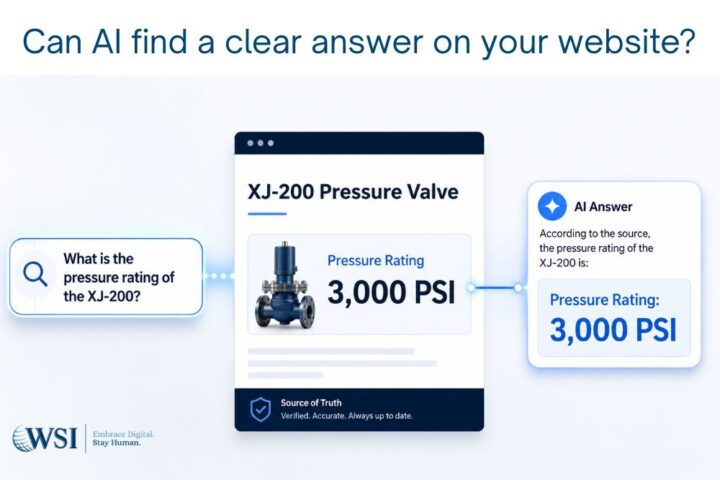
The bar is rising. As we covered in Chapter 5, the next frontier is “callability”; websites’ AI agents can pull answers from directly. That’s where protocols like NLWeb and MCP come in—the new plumbing of the AI era. They’re what let AI agents pull the right details from your site instantly and accurately, whether it’s pricing, availability, or product specs.
Picture an AI agent as a personal shopper. If everything in your store is labeled, easy to find, and priced clearly, they can grab what they need and recommend you instantly. But if the inventory’s locked away or missing tags, they move on without hesitation. NLWeb, MCP, and structured data make your “store” instantly usable for AI.
When it comes to technical SEO, the static mindset says it’s a one-time checklist. The adaptive mindset recognizes it’s your ongoing ticket in, serving as the baseline that enables the rest of your survival strategy to work.
You don’t have to be perfect. But you do have to be accessible, interpretable, and now, callable. Because AI systems like ChatGPT, Perplexity, and Claude can’t amplify what they can’t read or understand. Make it easy for them.
Adaptive SEO Is a Continuous Loop
Set-and-forget strategies have never worked in search marketing—and they’re even more dangerous now.
Change happens in weeks, not years. Platform evolves, AI models update, and user behaviour shifts constantly. What works today could be irrelevant next month.
Adaptive SEO operates as a continuous feedback loop: publish, test, learn, adjust, repeat. It’s the only way you stay visible when everything else is changing faster than you can predict.
The businesses that thrive don’t cling to static playbooks. They build feedback into every piece of content. They see every page, every podcast clip, every snippet as an experiment. What earns citations gets amplified.
What falls flat gets fixed or replaced. Nothing stays frozen.
This is the real survival mindset: stay in motion.
The moment you stop learning, you stop adapting, and you hand your spot to someone who won’t make that mistake.
Static businesses get reduced to a quick line in someone else’s AI answer—stripped of context, credit, and clicks.
Adaptive ones get cited, shared, and remembered in ways that drive sales, leads, and influence.
Pattern Breaker: Who Survives, Who Vanishes
Picture two tax prep firms in any mid-sized city in America.
The first firm has a beautiful website built five years ago. Clean design, solid local SEO, decent Google reviews. They rank well for “tax preparation [city name]” and get steady business during tax season. Their blog publishes the same “Top 10 Tax Deductions” post every January, with updated dates.
The second firm is smaller but thinks differently. Their lead accountant writes new LinkedIn posts breaking down new tax law changes in plain English. She is frequently quoted in the local business journal, appears on regional podcasts discussing small business finances, and is featured when regulations shift. When the local news needs an expert commentary on policy tax changes, they call her first.
Their websites look similar. Their services cost the same. But when people ask Perplexity, “who’s the most trusted tax advisor in [city]” or ChatGPT, “what should small businesses know about the new tax rules,” guess whose name appears in the answer? The first firm is still waiting for last year’s SEO strategy to pay off. The second firm is booked solid because AI learned who the real expert is.
This pattern repeats across industries: one business stands still, hoping yesterday’s signals will carry them forward. The other feeds the loop by sharing insights, earning mentions, and staying visible where AI looks for authority.
This isn’t about tax prep or local services. It’s about understanding that AI transcends just crawling your website. It learns from everything the internet says about you.
The businesses that keep that loop alive—publishing, testing, and earning citations in unexpected places— become too credible to ignore. The ones that freeze, watch AI write them out of the conversation entirely.
That’s the survival loop you’re building now: not perfect, not static, but always in motion.
In Summary: Key Takeaways
Most businesses are still clinging to old SEO habits. They tweak a keyword here, add a blog post there, and hope that’s enough to stay visible while everything around them changes.
But survival now depends on movement, not maintenance. Staying still is the real risk. Keep these takeaways front and center as you adapt:
- Checklists won’t save you. Movement will.
- Search happens everywhere now. You need to be present where people and AI seek answers.
- Get quoted or get forgotten. If you’re not mentioned, you’re not remembered.
- Trust signals fade if you don’t keep them alive. Prove your authority every time you show up.
- Strong technical basics make everything else possible. If your content can’t be found, nothing else matters.
Adaptive SEO is a loop. Publish, learn, adjust, repeat.
Most businesses will stand still and wait for help that’s not coming. The ones that keep moving are the ones that will still matter when the smoke clears.
Up Next: You know now that survival means staying in motion. But this new search ecosystem is too complex to tackle alone. In the next chapter, you’ll see why trying to handle SEO solo, especially in an Al-powered world, is the fastest way to get buried, and what to do instead.