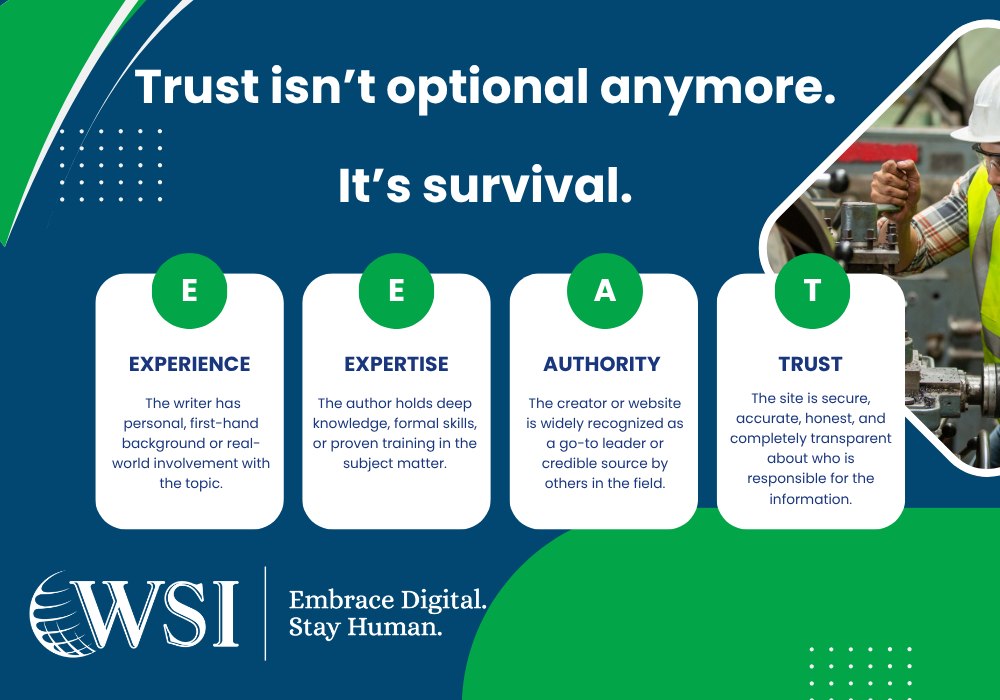
Trust isn’t optional anymore. It’s survival.
Al is rewriting the rules of who gets found and who quietly vanishes. You might think that your website, your blog, and your Google ranking buy you credibility. They don’t. Not anymore. AI doesn’t trust you because you have a website. It trusts you because the world does.
And that kind of recognition isn’t just for big corporations—small and mid-sized businesses can earn it too by consistently demonstrating their expertise in the right places.
Every search query is now an audition. AI scans billions of signals— reviews, mentions, interviews, media coverage—to determine whose voice is credible enough to cite. And the truth is: most businesses look like ghosts: no real signals, no proof they’re real, no reason to believe them.
When you don’t show that proof, AI overlooks you. Your name never makes it into the conversation.
That moment your business gets named—that citation—is the new marker of trust. Because now being seen is not about the click itself. It’s about being named as the source when it matters most.
Those mentions don’t appear out of nowhere. They come from authority. That’s what earns you the right to be mentioned. That’s the real currency of AI search.
And if you’re not building it—your real-world credibility, your trusted voice, your proof you belong in the room—you won’t have any currency at all. The businesses and individuals building authority now aren’t just preparing for the future; they’re writing it.
This chapter serves as your blueprint for becoming the brand that AI trusts and humans believe in.
The Authority Gap: Why Most Businesses Fail the AI Trust Test
If you’re still measuring your marketing by how many people click your links, you’re staring at the wrong scoreboard. Here’s what’s really happening: AI answers questions right on the search page now. It pulls from sources it trusts, leaving everyone else in the dark. Those clicks you used to chase. They’re evaporating.
But what really stings is what happens next: you’re left unnamed when it counts.
The good news? AI’s trust signals aren’t pay-to-play—they’re earned. A single-location retailer, a small local law office, or a boutique bed and breakfast can compete with industry giants if they intentionally build those signals.
Our research reveals a sobering reality: 61% of AI mentions come from editorial media, not company websites. 10 That means the conversation about your expertise is happening without you, unless you’re actively earning credible mentions, reviews, citations, and coverage beyond your own site.
As Google has made clear, trust doesn’t just live on your domain anymore. It’s built off-page—through what others say about you, not just what you say about yourself.
Behind every zero-click answer is a company that got named. And behind that name is real-world authority. So yes, clicks matter less now. But if you’re not the trusted source AI chooses to cite, you’re not just losing website traffic. You’re giving your competitors the chance to train AI to trust them instead.
This is the trap: when AI passes you over, your name fades from the conversation. With every search, you lose more trust signals, more citations, more chances for people—and AI—to remember you.
E-E-A-T Isn’t Just a Concept, It’s Your Survival Test
Experience, Expertise, Authoritativeness, Trustworthiness.
Those four letters— E-E-A-T—are no longer optional. They’re the bar AI uses to decide who belongs in the answer and who disappears.
It’s not a buzzword. It’s not a box to check off on your checklist. It’s your reputation, your proof, your insurance policy against becoming irrelevant.
You can’t just say you’re trustworthy. You have to prove it. In your content, people, credentials, media mentions, reviews, and brand consistency.
E-E-A-T isn’t just about your website anymore. You need to be trusted everywhere your audience is searching for answers.
That means proving your expertise on LinkedIn. Getting quoted in industry publications. Speaking at conferences. Building a reputation that extends far beyond your homepage.
Authority isn’t confined to your zip or postal code—it’s everywhere or nowhere. And authority doesn’t only mean national press. For small and mid-sized businesses, AI pulls from local signals just as much as global ones—Chambers of Commerce, city business journals, industry associations, community directories, and your Google Business Profile.
Local citations and partnerships aren’t just good hygiene; they’re trust signals AI uses to verify who you are and whether you belong in the answer.
Size doesn’t necessarily decide who clears the bar— visibility and proof do. A business with ten employees can still become the go-to expert in its niche if it shows up in the right mix of digital and real-world conversations.
Why Video Matters More Than Ever
Video isn’t new to SEO. For years, marketers have known that YouTube results often outrank text, and that search engines value multimedia. But AI has changed the stakes. What used to be a ranking boost is now a trust builder. AI systems are increasingly referencing YouTube and short-form clips because they feel real, human, and verifiable.
And the data proves it. YouTube citations in Google AI Overviews have grown by 25% in just a few months.” Video is also 3.1x more likely than text to be cited for product information—especially instructional content and comparisons.
Think about it: a written article can tell me you know what you’re doing. A video can show me. Seeing a face, hearing a voice, watching a demonstration—it all builds credibility in ways a blog post never could. That’s Experience and Expertise in action, the first two letters of E-E-A-T, delivered straight to both users and AI systems.
And you don’t need studio lights to make it work. A dentist explaining whitening options. A lawyer breaking down a new regulation. A contractor walking through a renovation. Short, authoritative clips like these are exactly the kind of assets AI trusts and cites.
Video isn’t a nice-to-have. It’s one of the fastest ways to stack authority and one of the clearest paths to visibility inside AI answers.
Digital PR: The Trust Signal Most Businesses Ignore
If authority is your currency, then digital PR is your printing press.
You can write the smartest blog post in your industry, but if you’re the only one saying it, you’re not building authority. You’re just shouting into the void.
Digital PR is the most overlooked competitive advantage for most businesses. It’s how you break that echo chamber. It’s the guest podcast spot.
It’s the local news feature.
It’s the industry newsletter that quotes your take on what’s next.
It’s the YouTube video that explains, reviews, or demonstrates an idea so clearly that AI—and your audience—can’t ignore it.
Every time your name appears beyond your own content, you’re signaling authority AI can’t dismiss. Remember: most AI mentions come from editorial media, not your own content, so you need others talking about your expertise, not just you.
You’re not just reaching human eyeballs. You’re training AI to see you as a source.
And it’s not just about AI. It’s about real humans, too. When your name keeps popping up in trusted places, when your business becomes the name people see in their inbox, on their LinkedIn feed, on the conference stage—trust snowballs. And trust, once built, multiplies.
The smart companies get this right: they don’t sit around waiting for the phone to ring. They create the story—original data, bold opinions, helpful insights—and make it easy for the world to share it. None of this requires a huge PR department. Small businesses succeed in digital PR by prioritizing relevance and relationships over sheer volume.
Al-powered search engines like Google’s AI Overviews, ChatGPT, and Perplexity are designed to prioritize information from trusted and authoritative sources. No citations? No moat. And no moat means every new piece of content you publish just trains AI to trust someone else.
The truth is, your competitors are already doing this. While you’re optimizing blog posts for keywords that don’t matter anymore, they’re building relationships with journalists, getting quoted in trade publications, and establishing themselves as the go-to voice in your space.
Every day you wait is another day they get ahead.
The Authority Blueprint: 5 Signals AI Needs to Trust You
The average business owner talks about trust. But they don’t show it in ways the outside world—and AI—can verify. That’s not just a marketing miss. It’s a visibility death sentence.
Authority isn’t built in silos. It’s built by showing up everywhere, with consistency, clarity, and proof that the world agrees you belong. This is where the Authority Blueprint comes in. Because you can’t fake trust anymore. Not with AI. Not with customers. Not with the web watching your every move.
AI doesn’t reward intention. It rewards evidence. And these five signals? They’re not nice-to-haves. They’re the difference between being cited and being erased.
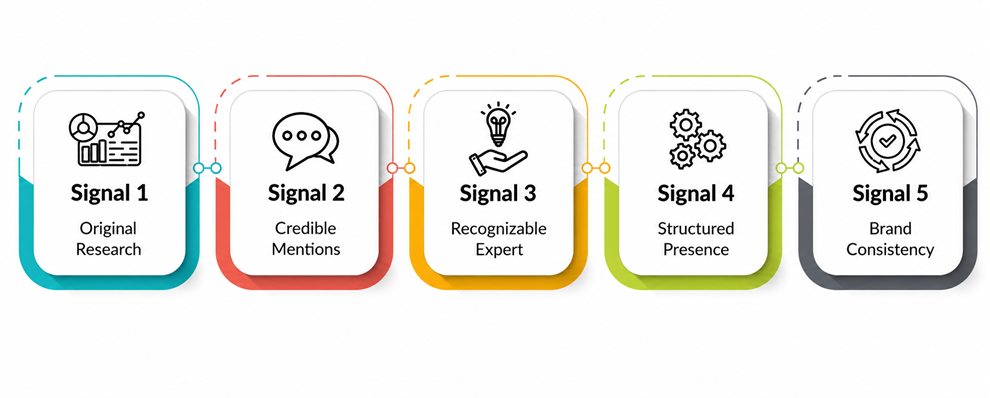
Signal 1: Prove You’ve Done the Work (Original Research)
Originality is your moat now. And most companies don’t have one.
Al is greedy for answers, but it’s not impressed by the same recycled blog post that ten thousand competitors have already published. AI has read every “Top 10 Tips” list out there. It doesn’t need yours, unless yours brings something new to the table. So what counts as real-world proof?
Not opinions. Not summaries. Not another listicle repeating what everyone already knows.
Real-world proof is your own research, customer studies you owned, data you gathered through experience, processes you tested, refined, and documented so well that others could replicate it—and trust that it works. AI platforms prioritize high-quality, authoritative content that offers genuine value and accuracy.
When your insights get cited by other sites, by journalists, by your industry peers—that’s when AI takes notice. That’s when you stop being background noise and start being the source.
Too many businesses think “content” means churning out yet another opinion piece. What the market—and AI—really wants is original substance. It wants to see that you didn’t just Google the topic and paraphrase it. You did the work. You have the scars to prove it.
And when you do, you don’t just win a click. You earn the right to be the answer.
But here’s the twist: doing the work isn’t enough. Not if no one’s talking about it.
Signal 2: Get Others to Say It for You (Credible Mentions)
If you’re the only one talking about you, you don’t exist. Not to AI, and not to customers.
AI cross-checks you against the wider world. If nobody reputable is mentioning you, quoting you, interviewing you, or referencing your work—you’re invisible.
Think of it like word-of-mouth for the AI era. AI wants to see your name pop up in respected places: trusted news sites, industry blogs, podcasts, webinars, and conference recaps. Those outside signals act like digital endorsements.
You ’ve just read why digital PR matters—and why it’s no longer optional. It’s not about bragging rights or vanity logos. It’s how your name enters the conversation: quoted, referenced, talked about in the places that shape public trust.
Trust starts long before someone visits your site. It starts the moment your name shows up in the wild—on a podcast, in a trade publication, mentioned by someone who matters.
And when AI sees your name in places like Forbes, TechCrunch, Bloomberg —or for many businesses, in industry publications, local media, Chambers of Commerce listings, or trusted community sites—it counts as a credibility signal.
Winners don’t wait for invites. They show up.
They pitch original insights to journalists.
They comment on industry trends.
They accept podcast invites.
They share stories worth repeating.
And when that happens, mentions pile up. And AI starts to trust that you’re worth citing again.
If you’re stuck pumping out blog posts and waiting for Google to do the rest, you’re in trouble. Authority in this new world is built outside your walls as much as inside them. No third-party proof? No trust. No trust? No inclusion.
No inclusion? You’re just teaching AI to choose your competitors instead.
Signal 3: Put a Face on the Expertise (Recognizable Expert)
People trust people. So does AI.
One of the fastest ways to lose trust is hiding behind a faceless “content.” Alisn’t stupid; it wants to know who’s answering. What’s their experience?
Are they an expert? Have they done this before?
This is where most organizations trip up. They publish good advice, but the author is listed as “Admin,” “Team,” or simply “Nobody.” To AI, that looks like filler. It wants a real name, real credentials, tangible proof that you have authority behind the words.
AI models prioritize content from established experts in a given field. This involves consistently publishing niche, in-depth articles that address specific audience needs, including detailed author bios that highlight qualifications and experience.
A recognizable expert could be your founder, a certified specialist on your team, or a respected industry voice you collaborate with. Their name, bio, credentials, and even where they’ve been quoted all strengthen your trust signals. Think about how you make decisions in the real world. You don’t take tax advice from someone who won’t put their name on it. Neither does AI.
So if you want to be cited, show your face. Tell your story. Highlight the experience behind the advice. Give people—and AI—a reason to believe you’re the one worth listening to.
When your content is anchored in real people with real expertise, you’re not just another echo online.
You’re the voice that is trusted.
Signal 4: Make Your Identity Unmistakable (Structured Presence)
If your identity is messy, your trust signals vanish. AI pieces together clues from everywhere: your website, your Google Business Profile, online directories, press mentions, and even company bios. It’s looking for patterns that say, “This is real, consistent, and worth trusting.”
Too many businesses think it’s enough to slap a logo on a few pages and call it done. But if your company name, descriptions, or contact details don’t match across the web, you’re confusing the very system you want to believe you’re credible.
Google’s AI Mode heavily relies on Google Business Profile (GBP) data, including business hours, services, and customer reviews, to populate its responses. An unoptimized Google Profile can lead to a business being overlooked, even if its website ranks well.
Having a structured presence means you’re making it easy for AI to verify who you are.
That starts with consistency. Your company details, like name, address, and services, need to match everywhere you appear, from your website to your Google Business Profile to every directory you’ve ever touched.
It means showing your people. Real author pages. Real bios. Not “Team” or “Admin” at the bottom of the page, but names, faces, and credentials that speak for themselves.
It means claiming your place in the knowledge graph—on Wikidata, Crunchbase, Google Business Profile—and making sure every entry tells the same story. And yes, even Wikipedia. These aren’t vanity listings; they’re the backbone of how AI verifies you’re real and quoteable.
And it means making your “About” and “Contact” pages unmissable. Not buried in the footer. Not vague. Clear, direct, human.
This isn’t about tactics. It’s about trust. If your digital presence is messy, AI won’t clean it up for you. It will just move on to someone who appears to have their act together.
Because when everything lines up, when your signals match and reinforce each other, you don’t just look trustworthy. You are.
Signal 5: Show Up the Same Everywhere (Brand Consistency)
Trust isn’t built by doing the right thing once. It’s built by doing it again and again, everywhere you show up.
Al is trained to spot patterns. It looks for a clear signal that you are who you say you are, and that the world agrees. That means your website, social profiles, reviews, and media mentions all need to tell the same story.
Passing that trust test means playing a bigger game. Search Everywhere Optimization.
If your signals are scattered—one thing on your website, something else on LinkedIn (especially if your profile is outdated or inactive), missing from Crunchbase or Wikidata—AI won’t connect the dots. You’re either a known entity across the whole digital ecosystem, or you’re just background noise.
Too many businesses blow this. Their website says they’re industry leaders, but their LinkedIn page hasn’t been updated in three years. They claim five-star service, yet they haven’t replied to a single customer review online. They put time into creating great thought leadership content, but then share it with the wrong headline or no author bio at all. To AI, that gap is a red flag—it trusts the consistent brand, not the one that can’t keep its own story straight.
And don’t forget: consistency isn’t just internal. It’s external. Digital PR (which we unpacked earlier) is what stitches your message across the ecosystem. It’s the pattern AI learns to trust because other people are carrying your story too.
Every inconsistency chips away at your trust score. AI notices the gaps. So do people.
This is why authority isn’t a campaign. It’s a discipline. You can’t earn one extraordinary mention and call it done. You need to show up the same way—credible, helpful, human—every place your name appears.
When AI sees that pattern, it recognises the same expertise, quality, and clear signals. It knows you’re not just another fly-by-night site. You’re a business worth trusting and mentioning.
But trust doesn’t just come from the places you control. It also shows up in the areas you don’t—the ones where people talk unprompted, and where AI quietly listens.
The Signal You Can’t Control—But Can Still Earn
You can build all the authority pages and trust signals you want. But if real people aren’t talking about you where real questions get asked, you’re still invisible when it matters most.
Proving your authority doesn’t happen in your polished channels alone. It happens in the wild—in the raw, unfiltered conversations that train AI too.
Al actively engages your website. It learns from the conversations people trust: the threads on Reddit, the answers on Quora, the debates that prove you’re relevant when the real questions come up.
Most businesses ignore these spaces. They think they’re too messy, too unpredictable, too risky. And they are you can’t control every comment or every thread. But while you sit back, your competitor’s name shows up in forums, reviews, and everyday answers—and those mentions stick. They don’t just build human trust. They shape what AI remembers.
This isn’t about blasting every comment section with spam about your products. It’s about showing up where your audience already talks and is asking questions and making your voice part of the discussion.
A business owner answering a niche question in a forum. A founder doing an honest Ask Me Anything (AMA) that proves they’ve actually done the work. A team member adding clarity to a heated debate with insight that cuts through the noise.
These are the signals AI loves: authentic, human, proof you know what you’re talking about.
As noted earlier, while 61% of AI citations come from editorial media, a surprising share of trust data also flows from the messy, human threads of Reddit debates, Quora answers, and niche forums. These raw conversations feed AI’s understanding just as much as a polished press release does.
OpenAI (the company behind ChatGPT) has a deal with Reddit that lets it pull Reddit conversations straight into ChatGPT in real time. So when people ask questions, ChatGPT can use current Reddit threads—not just old data—to help shape its answers. So, your site alone isn’t enough.
And yes, it’s a difficult reality. You can’t script it all. But you don’t have to do it perfectly on day one. Start small. Give this to one person you trust to represent your company: one thread, one answer, one moment of honesty at a time.
Because when AI scans the places where people ask the messy, unpredictable questions, you want your name there. Clear. Trusted. Impossibleto skip.
The Trust Test: A Reality Check
Let me tell you about a company I met last year: a brilliant local law firm. They’d spent years ranking well on Google, pulling in steady leads from blog posts about small business law. Solid. Reliable. But they hadn’t changed a thing over the last 5 years or so.
Then AI summaries started rolling out. Suddenly, the questions their articles used to answer: “How do I set up an LLC?” “What contracts do I need?” was answered directly in the search results. Clicks dropped by half in six months.
At first, they panicked. They thought they needed more blog posts. More keywords. But the real problem wasn’t volume. It was authority.
They had no original research. No local case studies. No media quotes. No lawyer bios with credentials front and center. In the eyes of AI, they were just one more generic source that could be replaced in a heartbeat.
So, they flipped the script. They published a small business legal trends report (their own data). The senior partner started giving commentary to local business outlets and podcasts. They updated every lawyer’s bio with credentials, case wins, and community work. They cleaned up their Google
Business Profile and cross-checked their listings on every local directory.
The result? They didn’t just recover. They became the firm Google’s AI Overviews, and ChatGPT started citing, not just for local queries but in broader small business conversations. Their organic clicks didn’t bounce back to old levels—they didn’t need to. The clients they got came in ready to sign, already convinced they were the trusted choice.
Same team. Same practice. The only difference? They stopped playing the old game—and made trust visible everywhere AI was looking.
The question isn’t whether you have expertise. It’s whether you can prove it in ways the world—and AI—can verify.
The Race for Survival Has Already Started
Here’s what keeps me up at night—and what should worry you too.
Every day you wait to build these authority signals is another day your competitors get ahead.
AI doesn’t create winners. It amplifies them.
And the businesses that already had recognition, credibility, and trust signals are seeing those advantages multiply in the AI era. Which means the longer you wait to earn your place in these systems, the harder it becomes to get in at all. This is the new reality: you are no longer optimizing content. You are training AI to trust you. To quote you. To summon your company in moments that matter.
And those AI systems don’t wait. They don’t crawl daily looking for updates. They decide based on what they already know. And if they don’t know you, you won’t be showing up.
Not in a click. Not in a summary. Not in a single, synthesized response.
In Summary: Key Takeaways
Before you move on, remember this: authority isn’t a buzzword—it’s the only thing standing between your business and a slow slide into invisibility. Al is already deciding which names stay in the conversation and which ones don’t. These takeaways are your wake-up call to prove you belong.
- Mentions are the new clicks. When AI skips the links, it still needs credible sources. If you’re not cited, you don’t exist.
- Authority is the new currency. E-E-A-T is how you show you’re worth trusting.
- Original proof beats empty posts. Bring real insights, unique data, and firsthand experience AI can’t get anywhere else.
- Digital PR is your survival moat. Earn credible mentions in places that matter by being quoted, being interviewed, and being seen.
- Trust is a pattern, not a stunt. Show up the same credible, helpful, human way in every place your name appears.
Up Next: You’ve built the signals AI needs to see, but you’re not done.
Building authority is just half the battle. In the next chapter, I’ll show you how innovative companies are taking direct action inside LLMs like Perplexity, ChatGPT, and Claude. And what happens when you let your competitors own that space instead?