Google doesn’t want your keywords. It wants your meaning.
Keyword-stuffing is dead (actually, it was dead a long time ago). Search engines aren’t engines anymore—they’re interpreters. And if you’re still optimizing your site like it’s 2012, your content isn’t just outdated. It’s invisible.
We’re in the middle of a seismic shift from keyword-matching to meaning-mapping.
Today’s Al-powered systems, such as Google AI Overviews, ChatGPT, and Perplexity, aren’t just parsing meaning. They’re also scanning for context, completeness, and recency. For many queries, especially fast-moving ones, freshness can outweigh even the cleanest content. If your information is clear but stale, you’re still invisible. Clarity is the shield. But here’s the twist: clarity alone won’t save you.
Visibility now depends on a blend of clarity of expression, topical depth, contextual fit, and timing. It’s not enough to simply provide a clear answer to the question. You need to answer it better, faster, and more recently than the rest.
The Keyword Collapse
Traditional SEO was simple: pick high-volume keywords, repeat them strategically throughout your content, add backlinks, and then hope for the best. It worked—until AI changed the blueprint.
Search engines no longer serve up content that matches keywords. They reference sources that answer questions. Our research shows Al-powered search compresses the funnel: users arrive on your site already informed and ready to act. They’ve browsed inside the AI interface. They land on your website not because of keywords, but because your content delivered clarity, authority, and relevance.
The bar has changed. It’s no longer enough to include the right terms. You have to demonstrate true understanding in real time.
Not keyword matching. Meaning mapping.
AI Doesn’t Match Words. It Maps Meaning.
Large language models (LLMs) like ChatGPT, Gemini, and Claude aren’t linear search engines. They use natural language processing (NLP) —the branch of AI that helps machines understand human language—and topic clustering to understand relationships between ideas. AI doesn’t index in rows. It thinks in webs.
It organizes your content into themes, evaluates how comprehensively you’ve covered a topic, and makes inferences about your expertise.
That’s AI interpretation. To get found, your content needs to be: conversational, context-rich, and structured for comprehension.
This doesn’t mean you start writing like a chatbot. It means writing like a human who understands what other humans are trying to figure out—and organizing that knowledge so AI can absorb and trust it. Your audience is still human—but AI is the gatekeeper. So your content has to resonate with both.
A Simple Scenario: The Project Management Example
Imagine you run a small construction business looking to improve how you track the progress of your renovation projects. Ten years ago, you might have searched ‘best project management software.’ That’s a keyword-based query.
Today, you’d ask: “What’s the best way for a small contractor to keep track of jobs and invoices?” or “Is BuilderTrend better than CoConstruct for small crews?” That’s a conversation. And that’s intent.
If your content doesn’t answer that question directly—and preferably in the first 100 words—you’re already at a disadvantage. AI systems like Google’s AI Overviews and ChatGPT aren’t looking for buried explanations; they scan for clarity right at the top and move on.
And what they favor isn’t just clarity, but structure. Short sections. Bulleted insights. Listicle-style breakdowns that can be lifted line by line. When your content looks like it could be read out loud as “Step 1, Step 2, Step 3,” you’ve made yourself quotable. That’s why “Top 5” lists and FAQ-style breakdowns keep surfacing in AI results—they’re easy for these systems to recognize and surface in a response.
AI won’t reward the page that rambles. It will reward the line that solves the problem.
Write Like You’re Answering a Smart Question
Old SEO said: use the phrase “project management system” six times on the page.
Adaptive SEO says: answer the damn question. Answer it early, answer it clearly, and anticipate what follow-up questions the user might have.
This is where the FAQ strategy shines. But not the lazy kind you bolt onto the bottom of a page.
We’re talking about integrated, conversational Q&A content throughout your site. We’re talking about headings written as real questions people ask, and schema markup (structured data that tags your content as recognizable entities—like questions, products, or services—so AI and search systems can classify and surface it more accurately).
The Amy Case Study
Amy runs a mid-sized accounting and tax planning firm. Five years ago, she ranked well for keywords like “tax help for contractors.” But over time, her traffic slowed to a trickle, and worse, her ideal clients were finding other firms through ChatGPT and Google’s AI Overviews.
She didn’t understand why until someone showed her what those tools were actually citing: not pages stuffed with keywords, but pages that clearly answered questions like “What should I do if I get audited?” or “How can small businesses reduce tax stress during year-end?”
So what did she do? Amy overhauled her site. She stopped chasing keywords and started answering real questions. Her homepage featured a clear, direct value proposition. Her service pages led with short, structured answers that were written with human intent in mind. She built out a knowledge hub addressing client queries with FAQ sections marked up with schema (that special code for AI comprehension).
Then something unexpected happened. She didn’t just start getting more traffic; she started getting calls from prospects saying, “You came up when I asked Perplexity what to do about an audit.”
This isn’t about tricks. This is about comprehension. When you speak clearly to the questions people ask—and structure your content so AI can understand it—you show up. Not because you gamed the system. But because you answered the question better than anyone else.
But it’s not enough to bury a Q&A section at the end of a long blog post. That’s why later, I’ll show you why FAQs, when done right, are one of the simplest ways to stay visible when AI decides who’s worth quoting.
Why Prompts Beat Keywords
You’ve heard me say it already: prompts are in, keywords are out. But here’s what most businesses still miss—prompts aren’t just different words. They represent a whole new way of thinking about how content gets found.
AI tools don’t scan for phrases. They look for meaning. They pull out lines that sound like answers to real questions, the kind your customer might whisper to themselves at 2 AM, when they’re stressed and need a straight answer. This is what winning at SEO looks like now: you’re not just stuffing words into your content; you’re giving the most precise answers to the most important questions your customers have.
You can continue to sprinkle keyword phrases (such as “best project management system 2025’) into your blog posts and service pages.
Or you can face the new reality: the systems that decide whether you show up don’t care about that. Instead, they’re scanning for sentences that feel like solutions, ones that are clear, direct, and human.
That’s why AI Overviews prioritize pages that read like mini responses. One strong, well-structured paragraph can do more for your business than an entire website full of fluff. And it doesn’t stop with written prompts.
Most people don’t type perfect queries—and they don’t have to. Al is learning to extract intent from voice, vision, and even gestures. That’s why Meta invested $3.5 billion into smart glasses. And why OpenAI acquired LoveFrom—Jony Ive’s design firm—for a reported $6.5 billion to build Al-native hardware that interprets gesture, voice, and context.
That means your content can’t just match a phrase. It has to match intent, no matter how that intent is expressed.
Voice search proves this: no one asks Siri or Alexa, “Italian restaurant downtown.” They say, “Where’s a good Italian place near me that takes reservations for tonight?” That’s the kind of natural language your content needs to reflect.
If your website doesn’t sound like how your customers talk—or search—it doesn’t matter how many blog posts you’ve published. No one will see them.
The businesses that win now? They don’t write for search engines. They write for humans first, and the AI that serves those humans second. That means every headline, every section of content, and every sentence must answer a new question: “Would an AI pick me as the source?”
Think Like a Prompt Engineer
An overwhelming share of businesses still write pages for Google’s old system. The smart ones write so they’ll show up in an AI answer. The smartest ones? They shape every line like it could be quoted word-for-word—because that’s how AI sees you now.
You can’t fake this. You can’t cram in more keywords and hope for the best. You can only be so clear, so direct, that you’re the obvious answer.
Ask yourself: Would an AI pick this line off my page and use it to answer someone’s question? If not, rewrite it.
Forget fancy generic phrases like “Comprehensive Tax Solutions LA.” No one types that. Not even your marketing team. Instead, they’re searching: “What do I do if I get an IRA audit letter?” Or: “Can I write off my home office if I have a side gig?”
Every piece of content on your site should stand alone, providing an honest answer to a real question because that’s what gets pulled into an AI response.
The next wave of businesses that stay visible won’t be keyword-chasers. They’ll be the ones who know their customers so well that they answer the question before it’s asked. That’s what Google wants now. That’s what AI wants now. Not just your words—your clarity, your images, your language.
So, here’s your job: stop letting your content drift around online, hoping someone stumbles across it. Ensure that every page your team or agency produces 7s worthy of being the answer. That’s how you stay visible—click or no click.
What AI Sees vs. What You Write
Forget hypotheticals. You can have the best-sounding website in the world. But if your content isn’t straightforward and distinct enough, AI will pass over you. Clarity gets you noticed, but differentiation gets you chosen. Here’s how most businesses still write their headlines:
“Comprehensive Business Accounting Solutions—Serving Atlanta for Over 20 Years.”
Looks impressive in a brochure. But no one talks like that. And no one searches like that either.
Now compare the above to what an actual human might type into Chat- GPT or Google, worried about their year-end financials: “How do I reduce my small business taxes in Toronto?”
It’s plain. Natural. A real question. The kind that AI knows how to find an answer to.
It’s the same with your body copy. The old way of writing would be: “Our team of seasoned professionals provides integrated solutions to meet your accounting needs.” It’s braggy and corporate noise. It doesn’t answer anything.
Your customer (and the AI) wants this instead: “Worried about an audit letter? Here’s what every small business owner needs to know, and what to do first.” One version talks at people. The other helps them by providing clear, direct, and quotable answers, which is what gets you found now.
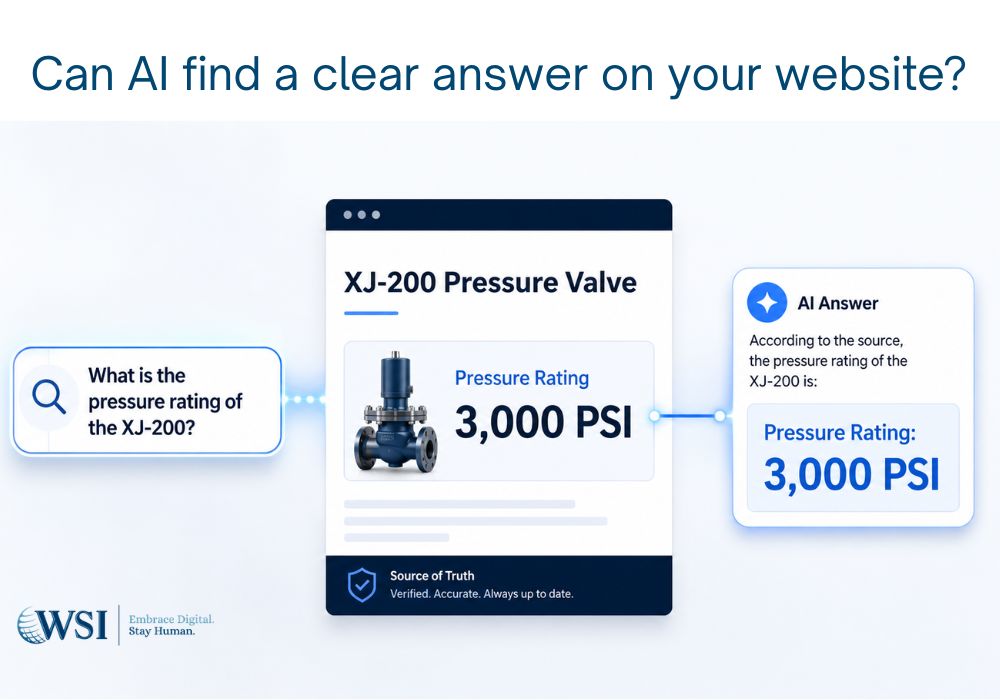
Here’s the brutal truth. AI doesn’t experience your website like a person would. It pulls your sentences apart and hunts for the one line that answers the question someone just asked. If your page can’t deliver that line, you don’t get shown. One good, clear answer can outrank a whole site full of fluff.
So, the next time you see a draft from your team or agency, stop reading it like a proud owner. Read it as if your customer would, and then double-check that AI could easily lift a clear, quotable answer from it. Ask yourself: Is there even one line here worth quoting? If not, you already know what comes next. Rewrite it. Strip out the filler. Make it so clear it’s impossible to miss.
Because AI doesn’t reward cleverness, it rewards clarity. And the businesses that figure this out first? They’re the ones people—and AI—will choose every time.
FAQs: Your Front Line for Being Found
Remember what I said about answering real questions early? Smart FAQs take that idea and put it on steroids.
Most websites treat FAQs like an afterthought—a dusty list of leftover questions tacked onto the bottom of a page. That’s wasted potential. For your business, clear Q&As on your site can be the difference between showing up in AI answers or being ignored altogether.
Smart FAQs turn your content into real questions, real answers, minus the fluff—they’re citation bait. AI systems like ChatGPT look for clear, direct answers that they can quickly grasp. FAQs do that better than anything else.
Our research shows that when you pull information out of dense paragraphs and format it as simple Q&As, your chance of being cited by AI can improve.
Picture two businesses side by side. One hides helpful answers in a 2,000-word blog post no one finishes. The other breaks the same info into clear, everyday questions people actually ask: “How much does a financial audit cost?” “What can I write off this year?”
Every clear, direct answer is a flare in the sky—something AI can lock onto. It’s not just content. It’s your signal. Your proof. And yes, the behind-the-scenes piece matters too. When your team labels things correctly on your page (it’s called schema, and in plain language, it’s like putting a sign on your site that says, “Hey AJ, the answer’s right here”), you make it even easier to get cited.
Schema doesn’t just help you; it also helps AI. It reduces the energy and computing needed to process your content, making you a faster, cheaper, and more efficient answer to surface.
AI Overviews: Be the Answer When the Click is Gone
You might be thinking your website is ready for AI. Maybe you’re telling yourself, “We’ve got FAQs. Our SEO’s in decent shape—we’ve good.” But here’s the real test.
Imagine a customer opens Google and asks a real question, the kind they’d usually call your office or store about: “How do I choose the best [insert service] for my business?” or “What should I do if I have a problem with [service/product]?”
A few years ago, they’d scroll through the search results, maybe click on your link, and read your whole page. That’s not how it works anymore.
Now they get an AI Overview—Google’s new way of answering questions before anyone clicks anything. It’s fast. It’s convenient. And it means you just lost that traffic, unless you’re the source that gets quoted.
This is what I’ve been telling you: AI doesn’t dig for buried answers. It wants the clearest line, right at the top. What your customer sees is simple: a short, clear summary pulled from sites Google’s AI trusts most. If your content provides that answer upfront, you might get picked. If it’s halfway down the page under a pile of marketing filler? Forget it.
Our research shows this clearly: most AI Overview answers come from pages with short, clear explanations right at the top. So, if you’re still burying the good stuff, AI won’t bother with you.
Even when there’s no click, there’s still the opportunity to be the information source. That mention is your new currency. It tells customers—and AlI—that this business knows what it’s talking about. And that’s worth more than a thousand empty clicks that bounce away.
So, if you want to maintain and expand your online visibility, consider viewing every page on your site through the lens of AI.
Stop asking: “Are we ranking?” Start asking: “Would our answer show up, even if no one clicks?” Because the businesses that get quoted will continue to be found.
And soon, they won’t just be found—they’ll be chosen.
More and more, that quote will come with a buy button. Whether it’s a person or an AJ agent making the call, the businesses that get cited are the ones that get acted on.
Everyone else? They’ll be wondering where their traffic went and wishing they had prepared for the asteroid sooner.
Proving Your Expertise: How AI Connects the Dots
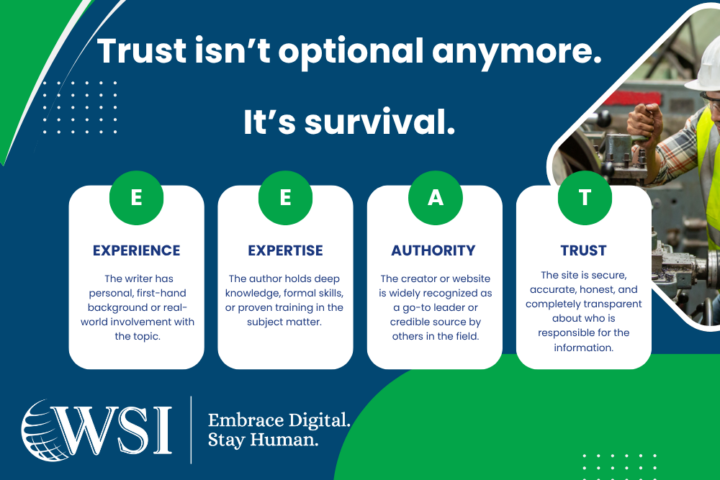
One answer can get you picked. But AI won’t trust you long-term unless you prove you own the topic.
Enter Semantic SEO. AI doesn’t operate on a page-by-page basis. It focuses on clusters. Al evaluates whether you’re covering a topic from multiple angles, using related terms, and demonstrating true depth. Post one article about home renovations, but fail to talk about permits, budgets, and timelines. AI won’t see you as an expert.
But create a series of linked blog posts exploring related pieces of the puzzle, and you start to build (and demonstrate) credibility in that area.
This is Topical Authority—one of the strongest visibility signals in the AI Search era. When you build strong topic clusters around core subjects,
Al is more likely to direct people straight to your homepage. Why? Topic clusters reduce the system’s cost to serve.
You’re not just providing an answer. You’re making it easy to extract the right one, fast. That efficiency matters. The more your content maps to a clear, comprehensive knowledge structure, the more likely AI is to surface you again.
Our research shows that when you build strong topic clusters and establish a thorough proficiency around your core topics, Al is more likely to direct people straight to your front door (i.e., your homepage), which I touched upon in our previous chapter.
Siege Media’s own study backs this up. After strengthening their clusters, they saw a nearly 30% increase in homepage traffic from AI search results, even as overall sitewide clicks declined.”
That’s the pattern you want to repeat: the more evident and more profound your expertise, the more AI trusts you—not just once, but over and over.
The Old SEO Playbook is Now a Liability
Let’s not sugarcoat it: the old SEO playbook isn’t outdated—it’s dragging your business backward. Sticking with that bloated, keyword-first content doesn’t just fail—it costs you trust.
Here’s the part too many businesses still don’t see: AI search engines are the new gatekeepers of your online visibility. They decide which business name shows up in a summary when your customer asks for help. If you don’t earn that mention, you won’t show up. No matter how much traffic you used to have.
Picture this: your competitor has a smaller site, fewer pages, less history. But every page they publish speaks like the most practical answer in the room—short, direct, unmistakably helpful. AI pulls them in because they don’t just add content; they sound like the source worth quoting.
It’s not just about the words on the page anymore. It’s about whether your words deserve to be cited and trusted enough to carry weight in the answer.
Take this as both a warning signal and an opportunity.
Cut the dead weight. Strip the filler. Replace every empty promise with an honest answer to a real question. Build your site like you’re building the best source in the room. Because you’re not just fighting for clicks. You’re fighting for your company’s right to be seen at all.
And in this new age? The ones who get found aren’t the ones who talk the most. They’re the ones who answer the best—and do it so clearly that AI can’t help but choose them.
In Summary: Key Takeaways
If you take one thing from this chapter, take this: Google and AI don’t care how many times you repeat a word. It cares whether you’re the one with the best answer. To recap:
- Search isn’t about stuffing keywords anymore. It’s about showing you understand what people are actually asking for and answering it clearly.
- AI tools choose the clearest, most helpful line they can find, not the longest pages.
- If your website hides real answers under marketing fluff, you’re invisible.
- FAQs and pages built around real questions are what get picked up now, not keyword soup.
- When clicks disappear, mentions matter. If your business name or website isn’t showing up in AI answers, you’re out of the conversation.
Old SEO was shouting in a crowded room. Today’s SEO is being the name that gets repeated—because you gave the best answer to the question everyone was asking.
Up Next: Now you know how search picks who gets seen. Next, we’ll look at why trust and real expertise decide who stays seen, and how to make sure your business isn’t just another name the AI forgets.