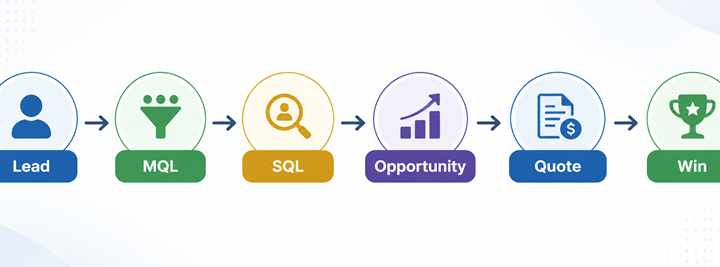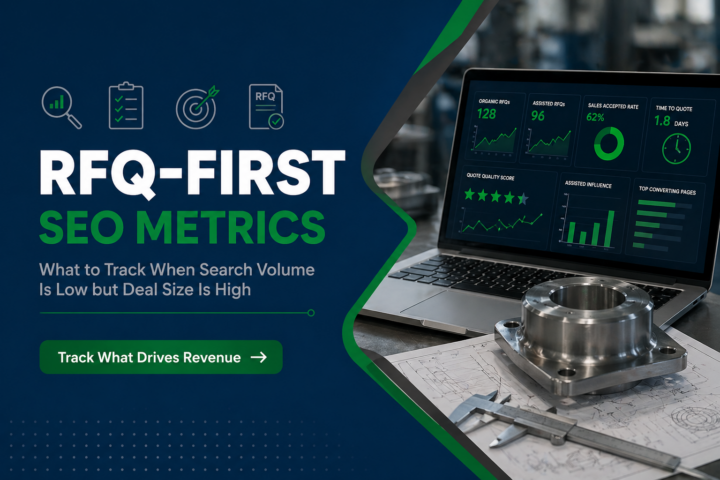
If you’re running SEO, a Content Strategy, Paid Advertising, or email marketing without clear fundamentals, you’ll get activity, but not consistent qualified leads. In industrial B2B, the “strategy layer”: Understanding your Ideal Customer Profile (ICP), segmentation of your customer base, and stakeholder journey, is the foundation that makes every tactic work together and improves measurable outcomes like RFQs, MQL quality, and pipeline velocity.
That foundation matters more than ever because buyers increasingly want to self-direct their research. Gartner reports 61% of B2B buyers prefer a rep-free buying experience, and their research notes buyers prefer doing independent research through digital channels, like Large Language Models (LLM). McKinsey’s 2024 B2B Pulse findings echo that “self-serve” expectation with a consistent rule of thirds across the journey (one-third prefer in-person, one-third remote, one-third digital self-serve).
Why Fundamentals Matter More in Complex Industrial Sales
Manufacturing buying cycles aren’t “one person, one click.” They’re committee-driven and risk-heavy: engineering needs technical validation, operations worries about uptime, procurement needs supplier confidence, and leadership needs ROI and delivery reliability.
When you skip fundamentals, you create friction everywhere:
- SEO attracts the wrong searches = high volume, low conversion quality.
- Paid Search amplifies unclear messaging = expensive clicks, weak conversion.
- Content reads “generic” = no differentiation, no proof.
- Email nurtures everyone the same way = low engagement, stalled deals.
Think of fundamentals as the foundation for your digital blueprint. They decide what gets built, what gets prioritized, and what gets measured.
What This Strategy Should Be
A B2B digital marketing strategy for manufacturers aligns four decisions:
- Ideal Customer Profile (ICP): who you’re best built to serve
- Segmentation and targeting: which markets, applications, and roles you prioritize
- Positioning: why you win (gotta have the proof)
- Buyer journey mapping: what each stakeholder needs to move forward
Once those are defined SEO, a Content Strategy, Paid Advertising or email marketing become an integrated system, not a pile of tactics operating in silos.
Step 1: Define Your ICP (Built for Specs, Not Just Firmographics)
Most industrial teams stop at “industry and company size.” That’s just not enough to develop your ICP. Your real ICP should capture technical fit and buying context, because those determine conversion rates, sales cycle length, and retention.
Here’s a practical ICP framework you can use immediately:
ICP dimensionDefine it in plain languageExamples of “fit signals”Where to pull it from
| Industry / vertical | Where they operate | Medical device OEMs; food processing plants | CRM won/loss; top accounts |
| Application / use case | What they need to accomplish | Washdown environments; high-temp sealing | Sales notes; service tickets |
| Specs / tolerances | What “meets requirements” means | ±0.001”; 316L; IP69K | Quotes; drawings; QMS |
| Certifications | What’s required to be approved | ISO 13485; IATF 16949; AS9100 | Supplier onboarding; compliance |
| Order profile | What makes the deal viable | repeat runs; MOQ reality; avg. order value | ERP; historical orders |
| Geography | Where you can deliver reliably | Midwest; NA-only; global | Shipping data; rep coverage |
| Urgency / triggers | Why they buy now | downtime; new platform launch; audit gap | Win/loss interviews |
3 anonymized industry style ICP examples
ICP Example A: Mid-market OEMs needing custom assemblies
These are OEMs launching or iterating equipment platforms. They value revision control, documentation, and repeatability. If your team is strong in DFM, validated processes, and predictable lead times, this ICP tends to produce higher-quality RFQs.
ICP Example B: Food & beverage plants with washdown-driven replacements
Here, downtime and sanitation risk drive urgency. The ICP tightens around materials, hygiene documentation, delivery speed, and install support. Your differentiator may be less about “features” and more about minimizing disruption.
ICP Example C: Specialty industrial distributors serving MRO and project work
Distributor success depends on availability, onboarding efficiency (EDI, part data, replenishment), and margin structure. If your organization supports quoting responsiveness and consistency, this ICP can scale.
Step 2: Segment Using Industrial Segmentation Targeting & Positioning
Segmentation is where “ICP clarity” becomes executable. For industrial markets, you get better precision when you segment by:
- Vertical – industry context
- Application – technical use case
- Buyer role – how value is judged
- Urgency – how fast decisions get made
Instead of one “catch-all audience”, you build a small set of high-intent segments you can market to consistently and well.
Here’s what a usable segmentation table looks like:
| Segment | Vertical | Application | Primary buyer role | Urgency trigger | Best “first offer” |
| S1 | Medical device | Tight-tolerance components | Engineering + Quality | validation deadline | DFM/feasibility consult |
| S2 | Food & beverage | Washdown replacement | Ops + Maintenance | downtime risk | “downtime prevention” checklist |
| S3 | OEM equipment | Custom assemblies | Engineering | new platform release | sample + design review |
| S4 | Industrial distribution | MRO + project | Procurement + Sales | supplier consolidation | distributor onboarding pack |
This is the point where tactics stop being generic. The rubber meets the road, so to speak. Your SEO, ads, landing pages, and nurture sequences can now be built per segment, instead of “one message for everyone.”
Step 3: Build a Positioning Statement (So You Don’t Sound Like Everyone Else)
Industrial markets are full of competitors saying the same thing: “quality,” “service,” “fast lead times.” Positioning is how you turn your strengths into a decision reason buyers can repeat internally.
Use this structure:
- For (ICP segment)
- who (need / trigger)
- we are the (category)
- that delivers (unique value)
- because (proof)
Positioning “Before / After” (example)
| Before (generic) | After (specific + defensible) |
| “We provide high-quality precision machining with fast lead times and great service.” | “For medical and instrumentation OEMs that need tight-tolerance stainless components without validation delays, we’re the precision machining partner that delivers documented process control (FAI, Cpk, traceability) and repeatable production, backed by ISO-certified quality systems and on-time performance reporting.” |
The “after” works because it names:
- who you’re for,
- the risk you remove,
- what makes you different,
- and proof that supports the claim.
Step 4: Map the Buyer Journey by Stakeholder: Engineer vs. Procurement vs. Ops
In industrial sales, you rarely “sell to a persona.” You sell to a committee where each stakeholder needs different proof at different times with different criteria.
A simple stakeholder journey map can be captured like this:
| Stakeholder | What they’re trying to prevent | What they need to see | Best content formats | Best CTA |
| Engineer | design failure / nonconformance | specs, tolerances, test data, CAD | spec sheets, CAD, app notes, DFM guides | “Talk to an engineer,” DFM review |
| Procurement | supply risk / vendor headaches | onboarding readiness, lead-time reliability | vendor pack, certifications, performance metrics | RFQ, sourcing call |
| Ops / Maintenance | downtime / slow implementation | install/troubleshoot clarity, ROI | install guides, troubleshooting, ROI tools | site assessment, retrofit consult |
With this information, you can now begin to build content intentionally: engineers get technical depth early; procurement gets confidence-building documentation before the RFQ; ops gets implementation and uptime proof.
Bonus insight: Gartner also found 69% of B2B buyers report inconsistencies between a supplier’s website and what sellers provide, which is exactly why your positioning and journey content must stay aligned across marketing and sales.
Step 5: Translate Fundamentals Into Digital Priorities (Index, Promote, Nurture, Retarget)
This is where the “strategy layer” becomes a channel plan.
What to index?
Start by indexing pages that match how industrial buyers search: application plus specs plus compliance with proof. Instead of only capability pages, build pages (sometimes it’s just improving what’s there) like:
- “Solutions for [application] in [vertical]”
- Materials and tolerance guidance
- Certification/quality system pages that reduce qualification friction
- Comparison and selection guides that help buyers shortlist
What to promote?
Paid Advertising should amplify clarity, not compensate for missing strategy. Promote assets that help buyers self-qualify and move forward:
- high-intent segment landing pages,
- role-specific offers (DFM review vs vendor pack),
- case examples tied to vertical/application.
What to nurture?
Nurture should reflect the committee, not a single funnel. A practical approach is to create role-based tracks:
- Engineering track: feasibility, validation, technical proof
- Procurement track: onboarding, reliability, compliance
- Ops track: implementation, uptime outcomes, ROI
What to retarget?
Retarget based on intent signals:
- engineering content visitors need validation proof, use technical FAQs
- RFQ visitors need credibility & confidence, leverage client testimonials
- downtime content visitors need ROI, demonstrate with case studies
If you want a quick “translation cheat sheet,” this table helps:
| Fundamental | SEO priority | Paid priority | Nurture priority |
| ICP (fit) | keywords by application/spec | targeting by industry & role | qualification-based messaging |
| Segments | segment landing pages | segment campaigns/offers | segment sequences |
| Positioning | consistent headlines/proof | ad copy & landing alignment | objection handling content |
| Journey map | role-specific content clusters | role-specific offers | role tracks & handoff cues |
Red Flags: When You’re Doing Tactics Without a Strategy
If your marketing feels busy but results feel random, fundamentals are usually the bottleneck. Here are common warning signs, and what they typically mean.
- Traffic is up, RFQs/MQLs are flat. You’re attracting the attention of the wrong people. Review your ICP and segmentation for proper alignment.
- Paid spend climbs, conversion rate doesn’t. You’re amplifying unclear messaging. Take a look at positioning.
- Sales says leads are “not qualified.” Marketing and sales are not aligned on ICP and triggers. Again look at the ICP. Is there a buyer journey issue?
- Your website reads like an org chart. Capabilities are organized internally, not by buyer problem/application. Have you mapped the buyer journey properly?
- Content is “fine” but forgettable. No distinct proof or category leadership Are you positioning the content properly?.
These are fixable, but only when you rebuild the foundation first.
A Practical Next Step: Build the Foundation Before You Scale Tactics
So, you want your digital program to produce measurable pipeline impact? Start with a simple sequence:
- Confirm ICP
- Choose 6–12 target segments (vertical, application, role or urgency)
- Write positioning (with proof you can defend)
- Map stakeholder journeys (questions to proof to content to CTA)
- Convert that map into channel priorities (SEO, paid, email, and retargeting)
That’s how fundamentals become the operating system behind every tactic.
If you want help pressure-testing your ICP, positioning, or buyer journey, and turning them into an integrated SEO/content/paid/nurture plan, schedule an SEO Discovery Call. We’ll identify what to index, what to promote, what to nurture, and what to retarget so you can drive qualified industrial opportunities instead of just clicks.
Common B2B Digital Marketing Strategy FAQ
What’s the difference between an ICP and a buyer persona?
Your ICP defines the right companies, best-fit accounts, based on factors like vertical, application, specs, certifications, order profile, and buying triggers. A buyer persona defines the people on the committee, the engineer, the procurement, the ops, the quality, the leadership and what each needs to say “yes.” Use ICP to focus your targeting; use personas to shape messaging and content by role.
How many ICPs or segments should we start with?
Start small so you can execute consistently. In most industrial organizations, 1–2 core ICPs and 6–12 segments : vertical, application, role or urgency, is enough to drive clarity and performance. Expand once you can prove conversion rates and pipeline impact by segment.
What if we serve multiple industries, do we need a different strategy for each?
You don’t need a separate strategy for every vertical. You need a shared foundation like core positioning and proof and a segmented execution layer through vertical & application pages, role-based content, and segment-specific offers. If two industries buy for different reasons , e.g., compliance-driven vs. uptime-driven, treat them as separate segments, even if the product is similar.
What makes a good industrial positioning statement?
A strong positioning statement is specific, defensible, and proof-backed. It clearly answers:
- Who you’re for (ICP/segment)
- What problem/risk you remove
- What makes you different
- What proof supports it : certifications, test data, process controls, performance metrics, or outcomes
If you can’t attach proof, it’s not positioning, it’s marketing language.
How do we map the buyer journey when multiple stakeholders are involved?
Map the journey by stakeholder and decision risk, not by generic funnel stages. Engineers need feasibility and technical proof; procurement needs supplier confidence and onboarding readiness; ops needs implementation and uptime outcomes. Then connect each role to the content that moves them forward and a CTA that makes sense for that role.
Which comes first: SEO, paid search, or content?
None of them!! Strategy comes first, then build the minimum assets required to win. In practice, that usually means:
- Segment landing pages (vertical with application with proof)
- Role-based proof content (specs/validation, supplier onboarding, implementation/ROI)
- Conversion paths (RFQ, consult, sample, assessment)
After that, use paid to validate messaging and offers while SEO compounds over time.
What should we measure so we don’t optimize for vanity metrics?
Industrial marketing performance should ladder up to the pipeline.
Track:
- Conversions by segment: RFQ, consult, sample requests
- MQL quality: fit rate, sales acceptance rate, meeting rate
- Opportunity influence: content/SEO touchpoints tied to deals
- Sales cycle velocity signals: shorter time to quote, higher win rate by segment
Traffic and impressions are diagnostic. Qualified conversions and pipeline are the goal.
Why is “self-serve research” such a big deal for manufacturers?
Because buyers are doing more evaluation before they ever talk to sales and irrelevant outreach creates resistance. Gartner found 61% of B2B buyers prefer a rep-free buying experience and 73% actively avoid suppliers who send irrelevant outreach. Don’t be noise
That puts pressure on your website, content, and proof to do the early-stage selling, accurately and consistently.
What role should AI play in this strategy (without all the hype, please)?
AI is most useful when it improves precision and efficiency, not when it replaces fundamentals.
Use it to:
- accelerate ICP/segment research and content gap analysis,
- generate first drafts of role-based content, then add real proof/spec depth,
- improve SEO optimization and internal linking at scale,
- personalize nurture paths and retargeting logic
AI performs best when your ICP, positioning, and proof points are already clear.
How long does it take to see results?
You can often see early gains quickly from better conversion paths (CRO, clearer offers, segment landing pages). SEO typically takes longer because you’re earning visibility and authority over time. A practical approach is to run a blended plan: fix the foundation and conversion first, validate with paid, and build SEO momentum in parallel.