
If you only looked at your analytics dashboard, you might think everything’s fine. A steady trickle of organic traffic. A few new backlinks. Rankings that haven’t collapsed, not yet.
But that’s the illusion.
For some businesses, the drop has already hit, sudden and sharp. A 30% nosedive in organic leads. A homepage that once ranked is now buried beneath AI-generated summaries.
For others, the decline is slower. Subtle. AImost imperceptible. Fewer inquiries. Lower-quality leads. A gut feeling that something’s off.
The outcome is the same:
Online visibility is disappearing. And business owners won’t realize it until it’s too late.
This isn’t a fad. It’s a replacement. Not by a competitor, but by AI.
That’s the shift most companies are oblivious to.
AI-generated summaries, zero-click answers, and language models trained on your content are now doing the talking. They scrape, rewrite, and respond, and they’re diverting attention and stealing the lead before your site even loads.
Not sure what that really means yet? Don’t worry. I’ll break it down.
Because understanding how these systems work and how they choose who gets seen, is the first step to staying visible.
But what does “visible” even mean now?
It used to mean showing up on the first page of Google. Page one was once the finish line. Today it’s just the starting point. Visibility now means being cited by AI, not just listed by Google. It means your content gets pulled into the response, not just buried in the links below it. It means your name gets mentioned and your solution appears and you’re visible before anyone even clicks.
If you’re not part of the answer, you’re not part of the experience. You’re invisible. Even if your site technically still exists.
The Numbers Tell the Story
In 2024, nearly 60% of searches in the United States concluded without a single click to a website, a dramatic leap from 26% in 2022. These zero-click searches mean Google (or AI) provides users with the answer without directing them to a website.
And it gets worse.
During early, controlled testing phases, Google’s AI Overviews showed up in as many as 84% of search results.” Today, they show up in nearly half, around 47%, mostly informational queries, with clear signs they’ll expand into more types of searches over time.? These full-blown AI-generated summaries, compiled from multiple sources, sometimes without credit and usually without referring traffic, dominate the top of the results page and are rewriting what it means to rank in Google.
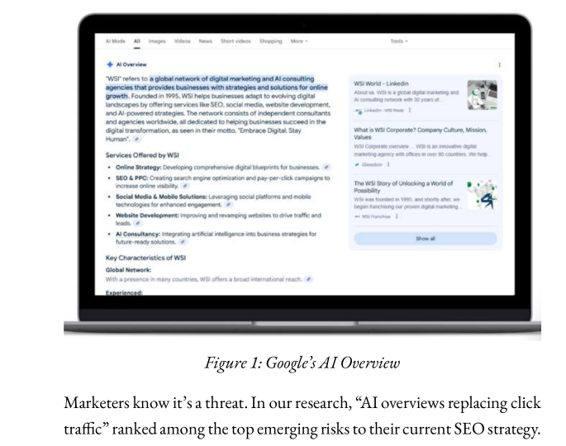
Marketers know it’s a threat. In our research, “AI overviews replacing click traffic” ranked among the top emerging risks to their current SEO strategy. They’re not wrong. In fact, Ahrefs reported a 34.5% drop in position 1 CTR when AI Overviews were displayed.* Similarly, Amsive observed an average CTR drop of 15.49%, with even larger losses, up to 37.04%, when AI Overviews were combined with featured snippets.’
In the past, people had to click on your link to discover what you offered. Now, the answer appears instantly, often without a click, with little context, and without exposing the user to your products or services.
The clicks didn’t vanish on their own, AI took over the top of the funnel.
Large language models (LLMs for short) now step in to aggregate and condense the content. Visibility now means being chosen as a source, not just a search result. These are the brains behind AI systems like ChatGPT, which are trained on vast amounts of text, enabling them to generate answers rather than just listing links.
In plain terms: if an AI mentions your business by name when answering a question, that’s a citation. And in this new world, it’s everything.
This isn’t the rise of a new competitor. It’s the rewiring of a system you’ve trusted for years.
The Google playbook, the one you’ve optimized for, invested in, maybe even built your business around , is no longer enough. Not because Google is broken. But because search itself has undergone a fundamental change at its core. Rankings, backlinks, and site health still feed the machine. But let’s be clear: on their own, they don’t make you visible anymore. What matters is how those signals combine with brand authority and citations, the proof AI actually pulls into its answers.
And most businesses are failing to recognize this decisive turning point.
They’re watching traffic slip away, blaming blog cadence, keyword targets, or backlink audits. But none of those things fix what’s really happening.
Your website traffic isn’t declining because SEO no longer works. It’s vanishing because tactics like keywords, blog schedules, and backlinks can’t carry the weight anymore.
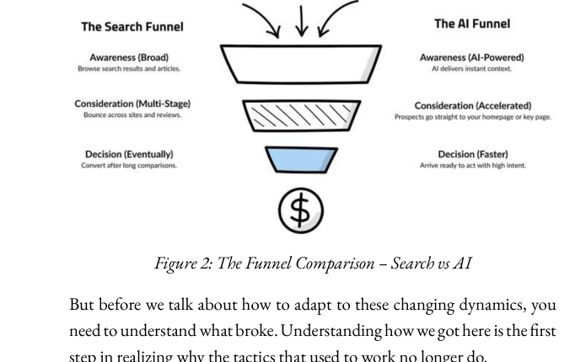
The Compressed Funnel
Enter the AI Visibility Funnel: fewer visitors, higher stakes. The top of the funnel? Gone. What’s left are high-intent users landing straight on your homepage, primed to act. These aren’t browsers, they’re buyers.
Here’s the upside. The few who do reach you are worth it.
A recent Semrush report found that AI visitors are 4.4 times more valuable than traditional search users.° Why? Because they’ve already done their homework, AI did it for them. By the time they arrive, they’ve compared options, understood your value, and made a decision.
For many industries, that makes your homepage one of the most valuable pages on your site. It’s not just the front door. It’s a conversion engine. But don’t mistake that for a single doorway. In ecommerce, real estate, local services, AI drops people straight onto product and service pages too. Every entry point now has one job: convert a visitor who arrives with their mind already made up.
But before we talk about how to adapt to these changing dynamics, you need to understand what broke. Understanding how we got here is the first step in realizing why the tactics that used to work no longer do.
The Three Waves of Search
Search has never stood still. From the beginning, it’s been evolving, refining how results are found, ranked, and presented. Over the past 25 years, we’ve seen three major waves define this evolution.
Each wave changed the game. But none of them were as cataclysmic as what we’re facing now.
To understand why your current strategy is falling short, you need to understand these waves, because they don’t just explain where we’ve been.
They reveal what’s coming.
Wave 1: Traditional Search (1998—2015)
Remember the days of keyword stuffing? When SEO was all about getting the right density of keywords on your page and building as many backlinks as possible? This was the era of traditional search, where algorithms were relatively simple. Search engines match the exact words you type to the precise words on web pages. So, if someone searches for “af- fordable running shoes,” Google fetches pages that contain those words, often over and over again.
Ranking was a recipe: pick the right keywords, place them just so, add backlinks, and publish often. The game was simple, and if you played it well, you won.
Wave 2: Intent-Based Search (2015—2022)
Next came the shift toward user intent, with Google becoming increasingly adept at understanding searchers’ actual needs. It wasn’t just about matching keywords anymore, it was about delivering the right type of content for each query. A search for “birthday dinner spots” didn’t just fetch restaurants; it inferred location, time, and intent. Results suggested local options, hours, menus, and even considering reviews from those who have celebrated a similar occasion.
It was no longer only about keywords; it was about purpose and context. Clearly labeled information, fast-loading pages, and mobile usability all played a role. Marketers had to start thinking like users, not just SEOs.
Wave 3: AI-Powered Search (2022—Present)
Now we’re in the era of AI-powered search. Search engines have evolved into AI assistants. They don’t just /ist answers; they generate them. They respond in complete sentences. The line between search and conversation is gone.
AI systems like ChatGPT, Perplexity, and Google’s AI Overviews don’t fetch content. They synthesize it. They read your content, digest it, and decide how to rewrite it as a complete response. And they often don’t link back to you.
You’re not competing just for rankings anymore. You’re competing to be cited by an AI that’s trying to answer the question without you.
Why the Old Tactics Aren’t Enough
Let’s be clear: the work you’ve done to publish quality content, earn links, and build trust still matters. Those are the very signals AI leans on. If your strategy has emphasized authority and credibility, you already hold assets AI values.
But here’s the shift. Those signals no longer guarantee visibility. The systems driving search have changed. Not just Google’s algorithm, but the very nature of visibility itself. The shortcuts that once worked? They’re collapsing.
Keywords alone won’t get you seen. A blog schedule won’t save you. Backlinks? Still useful, but no longer the magic bullet. If that’s your entire strategy, you’re building a bunker while the world moves on.
Large Language Models like ChatGPT and Claude, and platforms like Perplexity, don’t just crawl and index; they also analyze and interpret. They actively apply Natural Language Processing (the AI’s way of reading and understanding human language) to understand nuance, extract meaning, and collate comprehensive answers based on what they’ve learned from your content and everyone else’s. This means they’re not merely displaying information; they’re processing it on behalf of the user, making your raw content less necessary for direct interaction.
You might assume your SEO person has it under control. The truth: most marketers are flying blind. In our Adaptive SEO research, only 38% said they feel very confident in their current strategy. And more than half admitted that AI has made it harder to predict what will actually drive results.
If your strategy only revolves around blog schedules, keywords, and chasing rankings, you’re not just falling behind, you’re already disappearing from the systems that decide who gets found. The playing field has tilted. What worked as the whole game a decade ago is now just the starting point. Don’t get stuck playing by old rules.
The Intent Revolution
Think about how you search.
You don’t type “best pizza Chicago reviews hours.” You ask a question like a human: “Where can I get great pizza near King Street that’s open past 10?”
People don’t search the way they used to. That one behavioral shift, the rise of natural language queries, is the axis around which the entire search landscape is rotating.
Modern search isn’t transactional. It’s conversational. And that means content must do more than exist, it must understand.
Every search query, no matter how complex, falls into one of three categories:
- To learn something — “What causes sensitive teeth?”
- To find something – “Dentist near me open on Saturday”
- To do something – “Book a teeth cleaning appointment online”
This is user intent in action. And in the AI era, understanding this isn’t optional; it’s existential. If your content doesn’t match the real intent behind the query, it may not be effective. If it answers the wrong question or answers the right one in the wrong way. It will be filtered out. Not ranked lower. Filtered out entirely.
This exposes a harsh dynamic: AI systems are better at detecting intent, far surpassing most businesses’ ability to craft content tailored for it.
They understand phrasing, context, tone, and outcome. They know when someone’s looking for advice versus looking to buy. They infer urgency. They predict the next steps. And they elevate the content that aligns with those patterns.
Today’s AI-powered search doesn’t care how hard you worked on your blog post. It doesn’t care how many times you use a keyword. It cares whether your content solves the user’s problem in the format, tone, and structure that the AI system is trained to understand and prioritize.
Which is why “content strategy” is no longer about what you want to say. It’s about what your audience is trying to do, and whether your content helps them do it better than an AI-generated summary.
This is the problem Adaptive SEO was built to solve.
Why Adaptive SEO Wins
The future of search is uncertain and ruthless.
Rigid tactics are being left behind. Static content strategies and businesses that pull through this transformation will do so by moving quickly, staying human, and adapting in real-time to how people search, and how AI interprets those searches.
So let’s ask the uncomfortable question:
Are you building your SEO for the world as it was, or for the world that’s coming straight at you?
Let’s rewind.
Remember the early 2000s? You’d fire up your desktop, listen to the dial-up screech, and finally land on the Google homepage. Back then, you had to think like a robot to get results from one: “Italian restaurant New York prices hours.” It was clunky. It was awkward. But it worked.
Now jump to today.
You grab your phone and speak a complete sentence: “What’s a good Italian place near me that’s open late?” Google responds like it knows you personally. It takes into account your location, preferences, dining habits, and even your past search history. Sometimes, it finishes the sentence before you do.
This isn’t just convenient. It’s cognitive search.
Search engines haven’t stopped indexing the web. But because the technology has evolved so dramatically, they’re interpreting it on an entirely new level. Understanding nuance. Predicting intent. Surfacing answers that feel less like code and more like conversation.
That’s why old SEO, keyword-stuffed headlines, robotic page titles, and blog posts written for spiders, isn’t just ineffective. It’s invisible. Worse than that, it’s expendable. AI doesn’t need to point to you anymore. It learned from you and moved on.
Let’s look at what this transition looks like in action.
A travel company came to us with a familiar problem: decent traffic, flat conversions. Their pages were full of keyword phrases like “Cheap Holiday Packages Bahamas” and “Affordable Beach Getaways.” Technically optimized, but strategically irrelevant.
That might have worked in 2012. But now? No chance.
People don’t search like spreadsheets. They search like humans.
“Where can I take my kids for spring break that isn’t crazy expensive?”
“Best beach destinations for couples in March.”
These aren’t keywords—they’re questions. Emotional, specific, and loaded with intent.
And here’s the critical piece: they’re steeped in context.
AI has evolved beyond just scanning the words someone has typed. It interprets meaning. It understands that “crazy expensive” signals budget sensitivity. That “kids” implies family-friendly. That “March” filters for sea- sonality. This is what separates modern search from the keyword-matching days of old, an intelligent grasp of context that mirrors how humans think and speak.
When we helped reframe their content around how people actually search, and more importantly, how AI interprets that intent, the results were im- mediate. Engagement rose. Conversions followed. Not because we added more content. Because we made it more human.
Here’s another example.
Sarah, a new mom, recently searched: “Best strollers for traveling with a newborn on a plane.” She didn’t land on a blog post stuffed with “airplane stroller” 14 times. She got:
- A parent-written guide comparing top models
- A checklist on airline carry-on policies
- A video demo showing how to collapse each stroller with one hand
- And a retail site offering overnight shipping on a discounted travel system
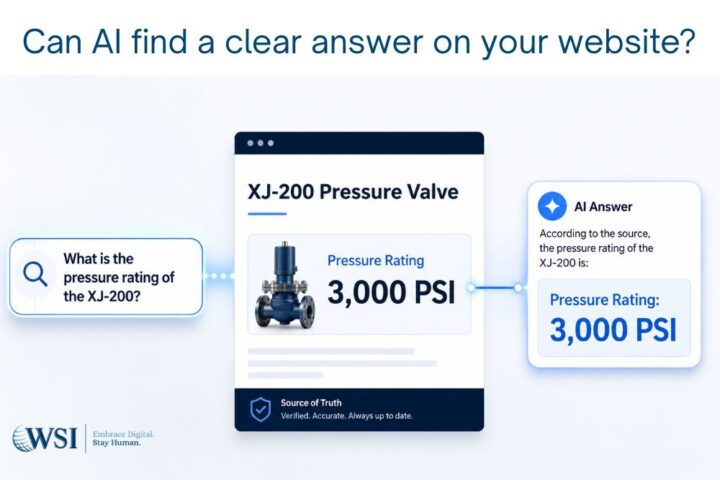
That’s not a coincidence. That’s Adaptive SEO, a strategy designed for AI and humans alike. It ensures content is not only aligned with human language but also structured and signaled in ways AI systems can understand, surface, and connect to nuanced human needs.
This is the difference between content that gets summarized and content that gets surfaced.
Modern search doesn’t reward the business that writes the most. It re- wards those who understand real users in real time, not just an ideal profile, and makes that understanding clear to the intelligent systems now guiding discovery.
It rewards intent.
Al-powered engines now read between the lines. They interpret “Jaguar diet” as an animal query, and “Jaguar top speed” as a car. That’s not keyword matching. That’s entity recognition. AI is mapping meaning, not just words, to grasp context, tone, and intent in real-time.
So what does that mean for you?
It means if your content still sounds like it was written for an algorithm from a decade ago, you’re not facing an approaching crisis, you’re already living in the aftermath of one.
Because in this new landscape, AI systems don’t just evaluate what you say. They infer what you know. They profile your authority. They judge how well your content answers real-world questions for real people, in real time.
And that’s why Adaptive SEO wins.
Not because it chases every trend, but because it understands the core of modern search:
Visibility now belongs to those who can prove relevance, intent, and trust—at scale.
That’s not a tweak. That’s a transformation.
Why Trust (and Authority) Matter More Than Ever in Search
Search has changed, but one truth has risen to the top: Trust is the new algorithm.
Not keywords. Not backlinks. Not clever tricks.
Today’s AI-powered search systems don’t reward manipulation. They punish it. They surface content that feels real, reliable, and genuinely useful.
And what they’re scanning for isn’t just relevance. It’s proof. Proof that you’ve lived the topic.
Proof that you’re cited and respected.
Proof that your voice belongs in the conversation.
In many ways, trust has become the ultimate backlink, the highest-value signal in a world where credibility outranks cleverness.
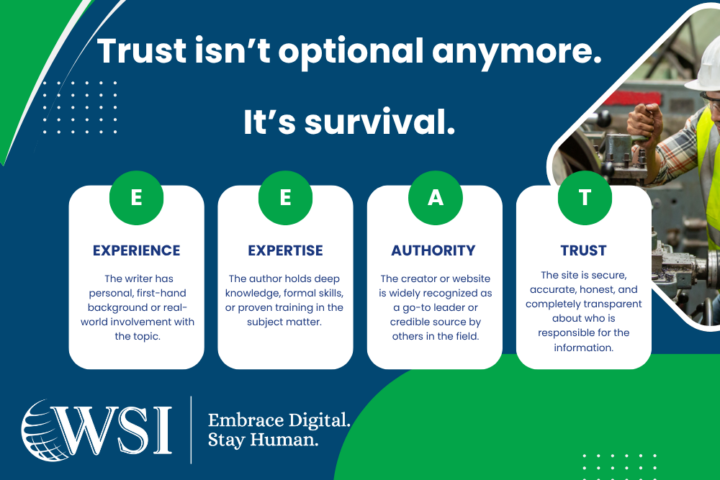
That proof has a name: E-E-A-T—Experience, Expertise, Authoritative- ness, and Trustworthiness.
It’s an existing framework introduced by Google to help its systems evaluate content credibility. Think of it as the behind-the-scenes signal that separates real sources from filler.
It stands for:
- Experience means you’ve done the thing you’re talking about, not just Googled it.
- Expertise means you bring defensible knowledge to the table.
- Authoritativeness means others reference you. Cite you. Link to you.
- Trustworthiness means users (and algorithms) feel safe listening to you.
You can’t fake any of this. Not anymore
And AI-powered systems don’t just scan your site. They analyze how the entire web responds to you, who cites you, where you’re mentioned, and how consistently your name shows up in credible, helpful, human content.
Google has even said that E-E-A-T often lives off-page. Because authority isn’t just what you say, it’s what others say about you. That’s why digital PR, brand mentions, and third-party validation now matter more than ever.
And it’s also why sites ending in .gov and .edu consistently outrank others: they have built-in trust and established credibility. User reviews, verified testimonials, and real author bios? Those are no longer nice-to-haves.
They’re signals that AI systems are actively scanning for.
This is where brand authority makes all the difference.
It’s no longer about on-page checklists or backend fixes anymore. What matters now is how well your content and company are understood, trusted, and referenced across the web.
Our research confirmed what many marketers are just beginning to realize: you’re not optimizing for clicks anymore, you’re earning your place in the machine’s worldview.
Signals of trust, authority, and usefulness shape that worldview. AI systems are learning which sources consistently deliver real answers. That doesn’t always mean the biggest brand or the highest-ranking domain. Sometimes, it’s the most recent insight or the most unique perspective that earns their trust. When AI rewrites the web into answers, it pulls in what it deems helpful. Everyone else disappears.
Let me give you a real-world example.
We worked with a brilliant nutritionist. Years of client success, speaker appearances, and real-world expertise. But online? Invisible. Her site was thin. Her credentials were buried. Her content wasn’t doing her justice.
So, we restructured everything around E-E-A-T and brand authority. Showcased her experience. Highlighted her media appearances. Earned high-quality mentions from wellness publications.
And Google took notice. So did her ideal clients.
She didn’t win by gaming the system. She won by proving she belonged.
This is the new game:
Not manipulation. Validation.
Not gimmicks. Gravitas.
And if you want to win in it, your authority can’t be confined to a single page. It has to live in every line.
Your experience should jump off the page. Say it plainly. Don’t water it down.
Your credentials? Put them front and center. Real names. Real expertise.
You need to be part of the conversation even when you’re not in the room.That means being mentioned, cited, and discussed.
Let your proof do the talking. Reviews. Testimonials. Case studies that show you’ve been there, done that.
And your site? It has to be fast, easy to trust, and feel like a real person is behind it.
In short, your entire digital presence must scream one thing. “This business belongs here.”
Because in this new reality, shallow content doesn’t just underperform, it disqualifies you. It tells AI: “This business doesn’t matter.”
So, stop chasing clicks. Start building trust. And grow your brand authority in the process.
Because in a world of AI summaries and synthesized answers, the businesses that get mentioned are the ones that earned it.
The Race for Relevance: You’re Either Training the AI Machines or Competing with Them
There’s no middle ground anymore. If you’re not adapting your content for the AI era, you’re not just falling behind, you’re feeding the machine that will soon replace you.
AI systems are being trained on your content right now. Every blog post, product description, review, and service page that explains what you do. It’s being scanned, processed, and integrated into ChatGPT and other similar platforms.
And here’s the kicker: they don’t always credit their sources.
The businesses that succeed won’t be the ones shouting the loudest. They’ll be the ones that AI trusts to speak on behalf of their category. The ones that consistently show up as reliable, valuable, and real.
This is where brand authority becomes your armor, and your leverage.
Let’s be clear: building that kind of authority isn’t simple.
Aligning your content with user intent, earning trust across platforms, integrating AI tools effectively, and keeping pace with shifting algorithms?
It’s complex. Most internal teams lack the time and expertise to manage all of this.
That’s why Adaptive SEO exists. It’s not a plug-and-play tactic, it’s a strategic response to the reality of search today.
At WSI, we’ve helped businesses move from invisible to indispensable. We don’t optimize for vanity metrics. We optimize for trust, relevance, and long-term visibility, the kind of signals AI systems reward.
And timing matters.
Search is now a winner-takes-most game. The businesses that adapt early don’t just get ahead, they stay ahead. Every day you wait is a day your competitors build more trust signals, get cited more often, and train the algorithms to recognize them instead of you.
This isn’t fear-mongering. It’s foresight.
Your content is either being found, or it’s training the systems that will answer the question without you.
So, if you want to win in this new era, don’t chase rankings.
Earn your place.
Be helpful. Be honest. Be human. That’s the only relevance that still converts.
But don’t mistake that clarity for simplicity. Even the most established businesses are vulnerable if they don’t apply these principles with urgency.
Even Trusted Businesses Can Vanish
You think being trusted protects you? Think again.
This new era of search isn’t just rewriting rankings. It’s erasing the familiar, the long-established, the once-dominant, without warning and without remorse.
I’ve watched respected companies bleed traffic they thought was locked in. Businesses that checked every SEO box in 2020 are waking up today wondering where everyone went.
Here’s what that looks like.
A regional furniture company. The local giant. Owned every search for “modern sectional sofa Toronto” and “best furniture stores near me.”
Strong domain, clean site, consistent content.
But then the shift hit.
Their organic traffic dropped. Not because they got lazy. Because AI stopped pointing people their way.
Their blog posts? Scraped and rewritten into AI answers.
Their landing pages? Once front and center, now ignored by AI.
Their SEO wasn’t bad. It was outdated. And in this new era, outdated means extinct.
Now compare that to a niche healthcare company. Decades of experience.
Certifications. Loyal audience.
Didn’t matter.
When Google’s AI Overviews launched, their visibility took a hit. Their content had value. But AI couldn’t see it because their site wasn’t struc- tured for AI. The answers were there, but buried in format, tone, and signals that systems like ChatGPT and Perplexity couldn’t parse. AI didn’t hate their business. It just didn’t see it.
That’s the game now.
Expertise is irrelevant if AI can’t recognize it.
These weren’t rookie operations. They were good businesses. They followed the rules. But the rules changed, and they didn’t.
So, let’s be clear: this isn’t some isolated dip. It’s a pattern. And it’s accelerating.
Even respected companies are losing ground because their strategies are frozen in time. Their competitors? Sharper, faster, built for AI. Structured content, clear entity signals, and human-centric language that machines understand. That’s who’s being chosen now.
And no, your business isn’t immune.
Because AI doesn’t care how long you’ve been around. It doesn’t owe you traffic. It doesn’t reward effort. It responds to how well you align with its systems. Unless you adapt to this new digital environment, your presence is already becoming less visible.
This isn’t just a Fortune 500 problem. It’s an SMB extinction event.
And if you’re not adapting, you’re in the blast zone.
Here’s the upside: this moment is your edge, if you move. SEO is no longer a task. It’s a survival system.
Done right, it’s not just how people find you. It’s how AI remembers you. How trust gets earned. How your voice becomes the answer in a world of instant AI decisions.
If you’re still checking SEO boxes, you’ve already lost.
Adaptive SEO is the only way forward, not to keep up, but to lead. Because in this world, visibility isn’t granted. It’s claimed.
In Summary: Key Takeaways
- Search is fundamentally changing. AI systems now generate answers directly, often without linking back to your content.
- AI is not just redirecting traffic; it’s replacing it. Your best-performing content is now being scraped, summarized, and served to users without a click, cutting you out of the journey entirely.
- Traditional SEO tactics aren’t enough. Keywords, back- links, and content schedules alone can’t win anymore. What sur- vives,and actually gets amplified by AI, are the fundamentals: authority, trust signals, and credible, helpful content. If you’ve invested in those, you’re already ahead. Now it’s time to adapt them for AI.
- The new currency is trust and brand authority. If your content isn’t credible, helpful, or cited, you’re being excluded from the conversation altogether.
Up Next: You’ve just read about how search has shifted. Now it’s time to meet the force behind the shift. In Chapter 2, we’ll unpack how large language models (LLMs) like ChatGPT, Gemini, Claude, and Google’s AI Overviews have redefined the role of AI, shifting it from assistant to arbiter.
These systems aren’t helping people find you—they’re deciding whether you’re visible at all.