It’s The New Gatekeeper Of Visibility
AI isn’t here to assist you. It’s here to judge, and even worse, replace you.
Most people still talk about Al as if it’s just a productivity hack. A helpful assistant. Something to speed up content creation or clean up copy. That framing is not just outdated. It’s dangerous.
AI isn’t just a tool anymore; it’s the filter. The bouncer. The new gatekeeper standing between your business and your audience. And it’s already deciding who gets seen and who disappears.
The Fall of the Search Engine, The Rise of the Answer Machine
Google hasn’t disappeared, but its power has fractured. Its traditional ranking model is being eaten from the inside by the very AI it helped build.
Google’s AI Mode is turning search into a conversation. Instead of just showing a link or a snippet, it handles multi-step reasoning, builds visual comparisons, and delivers personalized answers, all inside a full-screen experience that often never sends users to a website at all. It’s not a search engine. It’s an assistant. And it’s redefining what it means to be found.
You’re not just competing to rank. You’re competing to be remembered, referenced, and reasoned with inside an evolving AI interface.
You’ve already seen the signs. The metrics from Chapter 1 told the story loud and clear. Clicks are vanishing, traffic is thinning, and AI Overviews are steamrolling your carefully optimized rankings. Today, 60% of searches now end without a click, and Al-generated summaries appear in over 80% of Google queries. And the visitors who do reach you? They’re not browsers, they’re pre-sold, high-intent buyers worth 4.4 times more than the average organic visitor. And by early 2028, AI search traffic is expected to eclipse traditional search entirely.
A critical detail, those numbers don’t show you? How AI decides who makes the cut.
How AI Decides Who Gets Seen
Large language models don’t crawl like Google. They synthesize. They compare. They decide. Instead of scanning the entire web in real time, they work off a combination of what they’ve already learned and what they can retrieve when asked.
Some answers come from their core training data, massive snapshots of the internet. Others come from live sources, like active websites, forums, product pages, or media mentions. And in many cases, it’s a blend of both: stored knowledge layered with fresh context.
Reality check: they don’t start from scratch.
They reach for what’s known. What’s trusted. What’s already been seen enough to stand out.
If your business wasn’t part of what they learned and isn’t showing up in what they see now, you’re not part of the answer.
Think of AI like an obsessive librarian. Instead of remembering every book, it constantly scans the shelves for the ones most read, most quoted, and most trusted, tagging the passages it can pull quickly. When it needs to answer a question, it grabs from those reliable references and stitches them into a response.
The shelves are updated over time, and what’s “visible” on them is influenced by how well that book (your content) performs in the wider ecosystem: how often it’s cited, linked, clicked, and surfaced.
High rankings, backlinks, and mentions still matter, not because AI cares about your search position, but because they amplify the very patterns AI learns to trust.
Memory, in this context, isn’t nostalgia. It’s pattern recognition. AI doesn’t “remember” you because you once ranked high. It references you because your content, name, and insights keep showing up, in rankings, in mentions, in citations, and in live sources it draws from.
Visibility used to be only about position on a page. Now it’s also about being referenced in the response. Rankings still feed the patterns, but they’re no longer the whole story.
So, if you’re not part of that broader pattern, you’re not just bypassed. You’re invisible.
If You’re Not Mentioned, You Don’t Matter
Clicks are no longer the prize. Relevance is.
And in Al-driven systems, relevance is often surfaced through citations, direct mentions or quotes of your content, company, or perspective.
AI doesn’t rank sites. It builds answers. To do that, it pulls from the sources that most clearly, confidently, and concisely match the user’s question. Those mentions aren’t handed out for effort. They’re earned through clarity, consistency, and trust signals embedded in your content and online presence.
The reality is this: search engine ranking is no longer your target. You’re optimizing to be included in the answer.
So, the question isn’t “Are we ranking?” anymore. It’s “Are we being mentioned?”
Research shows tools like ChatGPT frequently pull from sources beyond the top 20 results. Because AI cites what’s relevant, that means your buried blog post might earn you more visibility than your homepage, if it delivers a clear, confident answer. This is the strategic pivot.
SEO is no longer about what you publish. It’s about what gets pulled.
When Citation Beats Ranking: A Scenario Playing Out in Real Time
Picture a mid-sized SaaS company focused on compliance automation for financial services. They’ve invested heavily in SEO. The team is publishing two blogs a week. They’ve optimized every headline, every page description. They’ve even secured a few backlinks through partnerships and syndication deals.
And yet, nothing’s happening. Traffic is flat. Leads from organic search are drying up. Their top-ranking blog post for “best compliance automation tools” used to bring in 500+ visits a month. Now? It’s barely cracking double digits.
Meanwhile, a smaller competitor with less traffic, fewer pages, and no backlinks to speak of starts appearing in ChatGPT’s answers. Not once. Not twice. Repeatedly.
What happened?
They didn’t rank higher. They got mentioned.
A journalist covering AI in RegTech included them in a quote in TechCrunch, a thread on Reddit discussing compliance tools linked to their product demo. A consultant mentioned them in a webinar transcript posted on YouTube.
That’s it! No SEO wizardry. Just being mentioned in the right places like, editorial media, user forums, and high-trust platforms AI pulls from during training.
Within weeks, this competitor starts showing up in Al-generated responses for queries like:
- “What tools help with financial compliance automation?”
- “Best software for Reg Tech startups?”
- “Affordable Al-based audit reporting platforms?”
‘Traffic to their homepage triples. Their leads spike.
But guess what? Most of that traffic isn’t coming from Google at all. It’s coming from Perplexity, from ChatGPT’s browsing function, from AI Overview links, and from curious users manually typing in the company name they just saw quoted by AI. They didn’t earn clicks.
They earned visibility.
The fine print?
When AI systems like ChatGPT answer a question, they do not rank websites. They do not remember sources over time. They pull what they can reach and what they already know, then write the answer that best fits the question.
First, they retrieve pages they can access; fresh, relevant, and high-quality. Then they generate an answer, blending that with what they’ve already learned from prior training.
Inside that process, attention helps the model focus on the most relevant parts of the retrieved text. Attention doesn’t pick the source, retrieval does.
So, if your name appears in credible places AI can reach, media articles, respected forums, transcripts, and the language around it matches the intent of the question, you’re far more likely to be referenced in an AI search. Not because of a backlink, but because you’re a clear, high-signal
match.
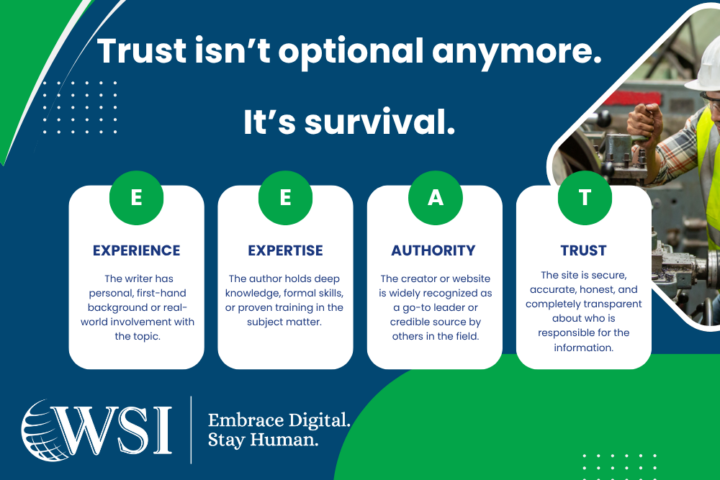
This is the new SEO reality. Not rankings. Citations. Not clicks. Credibility. In this world, E-E-A-T: Experience, Expertise, Authoritativeness, Trustworthiness, is your visibility signature. Being helpful is table stakes. Being statistically believable is what gets you chosen.
GEO: The New Way to Get Found by AI
Google crawls your site. AI rewrites it.
This isn’t just a new set of rules, it redefines your entire content mission. You’re no longer creating content to be found in search. You’re creating content designed to be quoted, summarized, and referenced by systems trained to decide what matters. This is called Generative Engine Optimization, or GEO for short.
It’s not about keywords. It’s about being remembered.
I’ll break down how to operationalize GEO in Chapter 5, when I explore how AI reshapes your content, often without your input, and never with your permission.
But here’s what you need to understand now: GEO content is built differently. It leads with strong, self-contained answers. It includes quotable insights, expert-backed claims, and crisp language that AI can easily extract and repurpose for use.
It’s not just helpful, it’s harvestable.
To thrive, your content must read like a source, not a suggestion. It must signal authority, structure, and clarity at a glance. Because if you want to be cited, your content needs to sound like something worth quoting, even when no one clicks.
And that’s the reality now.
The AI summary is the story.
Let’s be real: even your best content won’t help you if you’re still writing for algorithms instead of intelligence.
Owned Media Is Your AI Advantage
You don’t have to wait for Wired or The Verge to name-drop your company. You can still influence AI visibility from platforms you control, you do it right.
Our deep research into AI search behavior found that approximately 44% of mentions cited by AI tools came from owned media, such as your blog, your YouTube channel, your newsletter, and other content you publish directly.
The tricky part? It only works if your owned content behaves like something AI should trust. This means publishing content that sounds like it belongs in the answer, not just on the internet.
Authorship must be real, not hidden in a footer. Your expertise should speak in plain language, not corporate fluff. Summaries must hit hard. Takeaways should land like headlines. And your tone? It has to lead. Not follow.
It’s not about posting more.
It’s about showing up as a name worth remembering.
Every piece of content you publish, every blog, every transcript, every downloadable guide, is a chance to shape the data AI learns from. If it’s coherent, credible, and consistent, it builds recognition. If it’s generic, bloated, or buried, it tends to disappear.
So stop waiting to get quoted.
Start teaching AI what your brand should sound like.
You still need to be discovered.
Owned media builds your authority, earned media amplifies it. AI remembers what it sees often, across places it trusts.
Ensure your voice is represented on your site, in the press, so it gets pulled into the next AI training cycle. You’re already a publisher.
Time to act like one.
Don’t Think in Keywords. Think in Prompts.
People don’t search like robots anymore. They ask like humans. You no longer win visibility online by matching search volume. You win it by matching how people think. A traditional SEO mindset might target: “best CRM software 2025” An Al-driven prompt might look like: “What’s a good CRM for a 5-person startup that hates sales calls and doesn’t use Outlook?”
See the difference? One is generic and robotic. The other is specific, human, and personal. Now apply that across industries. A law firm might chase “employment lawyer near me.” But the AI is getting asked: “Can I get fired for taking medical leave in New York?”
A fitness business might target “workout plan for beginners.” But people are asking: “What’s a good 20-minute strength workout I can do in my apartment without weights?”
A mid-sized parts supplier might target “OEM parts distributor.” But the prompts sound more like: “Who can supply custom-machined parts with short lead times for aerospace?”
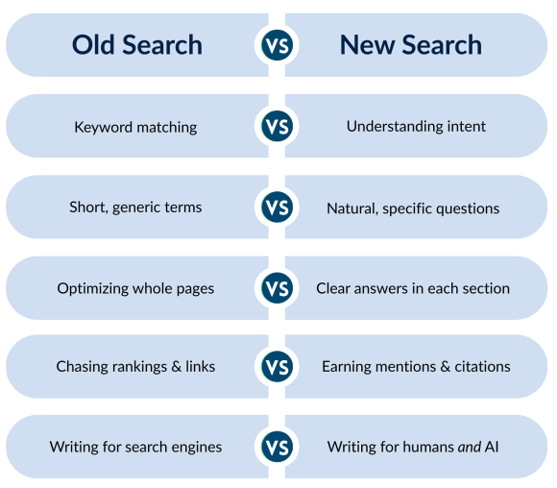
The difference isn’t just technical. It’s philosophical. Old SEO matched words. Modern AI interprets meaning. It doesn’t look for the phrase “marketing automation tools.” It seeks the clearest, most human answer to real-world questions, like “What’s a simple tool for a small team that hates follow-up emails?”
Keywords used to be short and robotic. “Jax software.” Two words, no context. But that’s not how people search anymore. Instead, they ask: “What’s the best tool to file quarterly taxes for a side business in California?” The more natural the language, the more likely it is to match how AI interprets the question.
Entire pages used to matter. Now, it can come down to a single paragraph. One well-written section that answers the question clearly is enough to get pulled. Every word counts. Every block of copy is a chance to be quoted.
Rankings used to be the holy grail. But ranking without being mentioned is a dead end. Today, visibility comes from being named by others, by AI, by reputation.
You’re no longer writing for search engines. You’re writing for systems that think. That means clarity beats cleverness. Usefulness comes first, but structure still matters when it helps the machine understand what you’re saying. Your content shouldn’t just lead to the answer. It should be the answer.
In Chapter 3, we’ll dig deeper into this shift, from keywords to prompts. But for now, remember this: AI doesn’t care how optimized your headings are.
It cares whether you sound like someone who understands the problem and deserves to be part of the answer.
This is why traditional keyword research tools are increasingly falling short. Sure, they still offer some signal. But tools like AnswerThePublic, Reddit, YouTube comments, and even TikTok search are now your best sources for prompt research. They show you how people talk, not just how they search.
AI systems are trained on human phrasing, not sanitized keyword variations. The more your content mirrors how people actually think and ask, the more likely it is to be included, because AI selects answers based on alignment, not just accuracy.
Is AI Trained to Remember Your Business?
This might be the most important (and most misunderstood) concept in the age of AI.
Search engines like Google continuously crawl the web, scanning for new posts and updates. AI doesn’t operate that way. It trains on snapshots of the internet, massive slices of information, frozen in time. But here’s where it gets more complex: modern tools combine that learned data with real-time search, user prompts, and even past interactions.
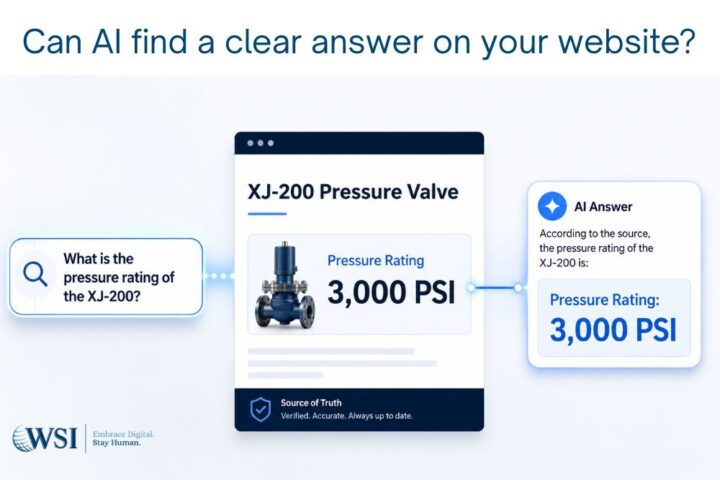
So, when someone asks, “What’s the best software for X?” AI isn’t just searching. It’s generating. It blends what it was trained on with what it can retrieve, synthesizing an answer on the spot.
And if your business wasn’t part of what it learned? And isn’t showing up in what it sees now? You’re simply not part of the answer.
That’s the trap countless businesses fall into. I call it the crawl-time illusion—the belief that because your content is live, it’s being seen. That used to be true with Google. But for AI? Visibility depends on what it has been trained to recognize and what it can reliably retrieve, not just what’s new.
Al systems don’t browse like users. They don’t scroll. They don’t compare. They generate responses based on entities and sources that are consistently visible and credible across the web.
If your name didn’t make that list? You’re not being overlooked. You’re absent.
Now, there’s nuance here. Leading AI platforms can access live web pages. But even then, they tend to favor sources that are already recognized, structured for summary, and credible. That’s why it matters where your name appears.
That’s why being quoted on trusted sites (media publications and directories) carries more weight than just publishing to your blog.
Visibility today isn’t about ranking. It’s about being recognizable by humans and machines.
Waiting to get discovered is no longer a strategy. If you’re not building recognition now, the next generation of AI models will be trained, and you won’t be in them.
To be seen tomorrow, you must be recognizable today.
Want to Show Up in AI? Be Someone It Recognizes.
When it comes to AI, it doesn’t just remember words; it remembers who said them.
In Al terms, that’s called entity recognition. It’s how a model distinguishes between a fruit and a trillion-dollar tech company when it sees the word
“Apple.” It learns from context, consistency, and repetition. Once it recognizes something as a distinct entity, a person, a company, or product, it pins that to its internal map of “known things.” That map enables it to reference, quote, and confidently include those entities in its answers. And that’s where the stakes come in.
Suppose your business isn’t consistently showing up with a clear identity on your website, on third-party platforms, or in citations from others. In that case, you’re not just under the radar. You’re out of the model.
That means it won’t mention you. Won’t suggest you. Won’t pull you into its answers, no matter how good your content is. And that’s not an exaggeration.
AI doesn’t work like a human researcher. It doesn’t fact-check across tabs. It doesn’t follow a trail of breadcrumbs. It makes decisions based on patterns, associations, and signals—all of which are inferred during its training process.
So, if your name appears once on your homepage but not again across the ecosystem… If your author bio doesn’t match your LinkedIn presence… If your business isn’t listed on platforms like Wikidata, Crunchbase, or relevant directories… If your business isn’t being cited by others in your industry… You’re not an entity. You’re a ghost.
And ghosts don’t get quoted.
To become visible, you need to exist where AI is trained to look. That means structured data. That means platforms like Crunchbase, Wikidata, industry directories, and yes, the systems behind the systems, like Google’s Knowledge Graph.
The Knowledge Graph isn’t just for showing up in a sidebar. It’s the map AI uses to understand who you are, what you do, and how you’re connected to the world. It links entities, people, businesses, and topics into a web of meaning. And if you’re not part of that web, AI can’t place you.
Can’t trust you. Can’t choose you.
Entity recognition is how you stop being just another website and start becoming a name that AI remembers. It’s how you become visible before someone even asks the question. And in the AI era, being remembered is everything. So, what does it take to become a known business in the eyes of AI?
You can’t fake it. You have to send clear signals over and over in the places AI has learned to trust.
Our research at WSI shows that AI tends to favor businesses with consistent mentions across multiple trusted platforms, especially on respected websites.
The Visibility Test: Are You Remembered?
Forget rankings for a moment. Ask yourself this: If ChatGPT is trained on everything your industry has published in the last two years, would your business stand out? Would your name appear in the datasets it digests?
Would your insights be quoted in the articles it deems credible?
Would your content sound like a source or like a footnote? That’s the test now. Not “Are you optimized?”
But “Are you recognizable to a machine that doesn’t crawl the web like Google, doesn’t click links, and doesn’t care about your latest post?” The reality is: AI doesn’t remember you. It predicts you.
Recognition isn’t granted. It’s computed based on how well your content fits the question at hand.
AI visibility is built upstream, from valuable mentions, brand consistency, and trust signals embedded across the open web. If you’re not recognized, you’re not retrieved. If you don’t match the context, you’re not relevant.
And if you’re not relevant, you’re done.
Your Homepage Has One Job Now: Convert
In the age of AI search, visitors who land on your homepage aren’t just browsing. They’re arriving with intent, because something, somewhere, already pointed them to you. Your homepage used to be a welcome mat.
Now it’s a decision point.
When a user sees your name in an AI Overview, a ChatGPT answer, or a Perplexity result, they often want to learn more. And while some clicks go to specific articles or product pages, a growing share lands directly on the homepage, either because AI cited your company name rather than a single piece of content, or because the mention sparked a direct search for your business.
One study found that 22% of Al-generated search traffic lands directly on a company’s homepage, more than double the 10% seen from traditional Google search. For companies with strong visibility in LLMs and AI Overviews, that number can jump to nearly 30%.
These aren’t casual browsers. They’re intent-driven visitors, coming in with context and expectations. AI gave them a reason to trust you. Now they want to see if you live up to it.
Your homepage isn’t the start of the journey anymore. It’s become a moment of validation, the handoff from AI to action. So don’t treat it like a welcome tour. Treat it like a conversion engine.
And ask yourself: Is there a clear, compelling offer above the fold? Does the page deliver social proof that reinforces what the AI implied? Is your credibility obvious through testimonials, case studies, trust badges, or media mentions? And most importantly: Is it clear what to do next?
Because when a visitor lands on your homepage straight from an AI suggestion, they’re not a cold lead. They’re a warm opportunity. They don’t need a backstory. They need a reason to believe and a next step to take.
The Compounding Cost of Invisibility
The businesses that win in this new world aren’t just lucky. They’re early. AI systems don’t just reflect the present; they reinforce what’s already been seen. If your business was mentioned once, it’s more likely to be mentioned again. If you’ve earned trust before, you’re more likely to be recognized in future responses.
AI doesn’t create brands. AI doesn’t create winners. It amplifies the ones that already exist. It reinforces the ones already showing up in the right places. If your business wasn’t being talked about before, AI won’t suddenly make you visible now.
But that doesn’t mean the door is closed. Today’s AI systems combine what they’ve learned with what they can find now. They’re constantly evaluating which businesses are showing up across trusted websites, expert content, public directories, and industry conversations.
You’ve moved past chasing the top spot in Google rankings. You’re shaping the digital footprint that AI tools rely on to decide who to include.
So, the real question isn’t: “Did we publish content?”
It’s: “Have we built enough trust, consistency, and relevance to be included when AI assembles an answer?”
Because if the signals aren’t there, your business won’t be either.
In Summary: Key Takeaways
The tectonic shift is already happening. You can’t stop it—but you can still adapt. The businesses that move now won’t just get through; they’ll shape what comes next. So, what does adaptation look like? What actually matters now?
Here’s what I want you to remember:
- Al isn’t a tool; it’s the new gatekeeper. It determines who gets noticed, who gets cited, and who gets overlooked.
- Mentions matter more than clicks. If AI doesn’t quote your company, your content, or your name, you don’t exist in the answer.
- You’re not writing for Google anymore. You’re creating content designed to be remembered and reused by AI.
- People search conversationally now. If your content doesn’t match how real people talk, AI won’t find you.
- Publishing content isn’t enough. If your business isn’t showing up in trusted places, like media articles, industry platforms, or public data, AI won’t recognize you.
Up Next: You’ve just read how AI systems filter who gets seen. In Chapter 3, I’ll dive deeper into how AI interprets human intent and why understanding how it reads queries is now just as important as how you write content.