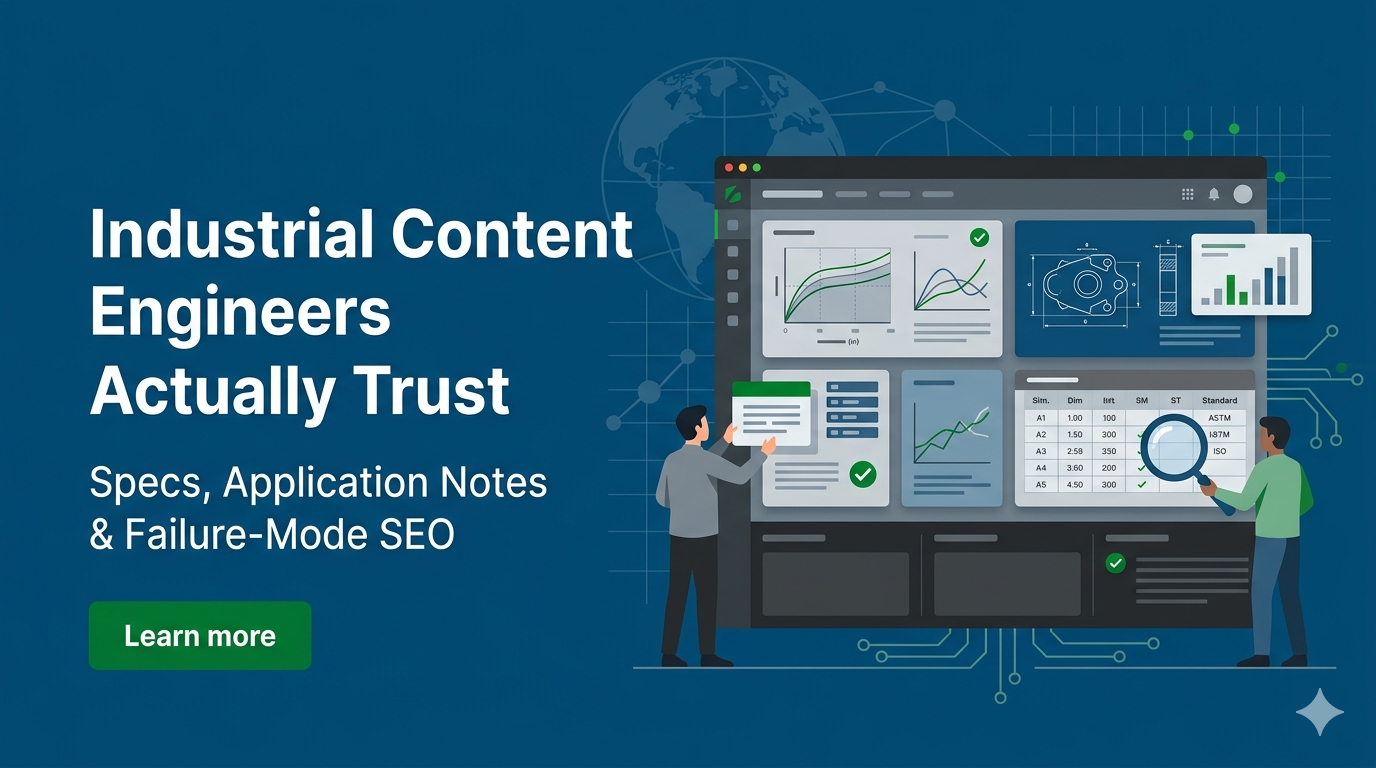
Industrial buyers are not looking for generic marketing posts. Engineers, procurement teams, and quality stakeholders look for technical evidence: specs, constraints, test methods, and application guidance grounded in real use cases. If your content does not help them evaluate fit and reduce supplier risk, it will struggle to rank for niche searches and even more so to convert into RFQs.
The industrial buyer content ladder
Industrial content performs best when it follows the actual buying process, especially in long sales cycles with multiple reviewers.
1) Early research: framing the problem
At this stage, the buyer is defining requirements and figuring out what a viable solution looks like.
Common questions:
- “What material works in high heat and corrosive conditions?”
- “What causes cracking, delamination, or pitting?”
- “What process can hold this tolerance?”
Best content types:
- selection guides
- failure-mode explainers
- introductory application notes
2) Validation: confirming technical fit
Now the buyer is checking whether a process, material, or supplier can meet the requirement.
Common questions:
- “What tolerance is realistic for this process?”
- “How is this tested or inspected?”
- “What does ASTM or ISO require in practice?”
Best content types:
- specs and tolerance guidance
- standards explainers
- test method and inspection documentation
3) Supplier shortlist: commercial and operational review
At this point, the team is narrowing suppliers and preparing RFQs.
Common questions:
- lead times, traceability, and documentation
- certifications and quality systems
- support for the required environment or application
Best content types:
- capability pages
- compliance and documentation pages
- RFQ checklists
- application-specific proof
Content types that rank for niche industrial queries
Application notes and design considerations
Application notes work because they answer real engineering questions in context.
What to include:
- the use case and operating environment
- design constraints, including material, geometry, tolerance, and surface finish
- tradeoffs and alternatives
- clear “fits” and “doesn’t fit” guidance
- the data needed to make a recommendation or provide a quote
SEO benefit: application notes naturally include the modifiers engineers search for, including materials, temperatures, standards, and tolerances.
Selection guides
Selection guides help buyers make decisions they can defend internally.
Examples:
- “How to choose coatings for salt spray environments”
- “Selecting plastics for cleanroom applications”
- “Choosing stainless grades for chemical exposure”
- “Material selection for vacuum and outgassing constraints”
What makes them credible:
- a decision table that maps conditions to recommended options
- failure risks tied to poor selection
- references to test methods or standards
- a clear next step, such as “Send us your requirements” or “Talk to an engineer”
Failure-mode troubleshooting content
Failure-mode content often signals an active problem, and active problems lead to supplier evaluation.
Examples:
- “Why does anodizing peel on [alloy]?”
- “What causes cracking after heat treatment?”
- “Galvanic corrosion between dissimilar metals”
- “Coating delamination root causes”
- “Warping after machining: prevention”
A structure that works:
- symptoms, or what the buyer is seeing
- likely root causes, starting with the most common
- diagnostic checks, including what to inspect or measure
- fixes, whether material, process, or design-related
- prevention steps, including DFM and quality controls
CTA: “Share your specs or drawings for review.”
Standards explainers
Engineers usually do not want a dictionary definition. They want to know what a standard changes in practice.
A strong standards explainer should cover:
- what the standard governs
- what it does not govern
- implications for material choice, testing, and documentation
- common misinterpretations
- what buyers should include in an RFQ
SEO benefit: standards terms such as ASTM, ISO, and ASME often act as intent-narrowing modifiers.
Test methods, inspection, and compliance documentation
This is trust-building content, and it often plays a major role in making the shortlist.
Examples:
- inspection methods you use, such as CMM, vision systems, surface roughness testing, or NDT
- traceability and documentation, including CoC, material certs, FAI, and PPAP where relevant
- calibration and quality-process overviews
- cleanliness handling, packaging standards, or controlled-process documentation
Conversion tip: place this content close to RFQ CTAs and capability pages so buyers can validate fit without digging.
How to operationalize SME content without slowing engineers down
The difference between “we should create technical content” and publishing it consistently usually comes down to process.
Engineer interview outlines that are repeatable and fast
Use a consistent interview structure so SMEs can contribute in 30 to 45 minutes.
SME interview outline
- What problem does this solve, and for whom?
- Which requirements matter most, such as environment, performance, or standards?
- Where do projects fail most often?
- What design or process choices prevent those failures?
- What tolerances and materials are typical, and which are edge cases?
- What inspection or testing proves success?
- What information do you need in an RFQ to quote quickly?
- What are the best-fit and not-a-fit guardrails?
- What misconceptions do buyers commonly have?
Output: one publishable draft and one checklist that can be reused elsewhere.
Review and approval workflow
Industrial content needs accuracy, but it also needs to move.
A workable process:
- marketing drafts from the SME interview using a structured template
- engineering reviews technical accuracy within a defined scope and time window
- quality or compliance reviews only where standards or claims require it
- final proof, publication, measurement, and iteration
One useful step is defining approved claim language for certifications, tolerances, and materials. That makes future reviews faster.
Repurposing: from article to sales asset
Technical content should support more than SEO.
One topic can become:
- an SEO article, such as an application note, selection guide, or failure-mode post
- a downloadable PDF checklist for procurement
- a one-page sales sheet
- three to five nurture emails matched to buyer stage
- sales enablement snippets for objections or engineer handoffs
This is how teams scale technical content without starting from scratch every month.
Where to gate content and where not to
Gating can support lead capture, but it can also reduce discoverability if overused.
Keep these pages open and indexable
- standards explainers
- failure-mode articles
- core application notes
- capability specs at a typical-range level
- FAQs that answer common buyer questions
Consider gating these assets
- deeper calculators
- large spec libraries
- extensive CAD packs
- detailed design guides that warrant sales follow-up
- high-value templates such as RFQ checklists or qualification matrices
A useful rule: gate supporting assets, not the core pages you want to rank.
Proof points you can include
Example editorial calendar for one product line
This sample eight-week plan maps content to the buyer ladder.
Weeks 1-2: Early research
- Selection guide: “How to choose ___ for ___ environment”
- Failure-mode article: “Why does ___ fail under ___?”
Weeks 3-4: Validation
- Standards explainer: “What ___ standard means in practice”
- Inspection or test-method page: “How we verify ___ and what to specify”
Weeks 5-6: Shortlist
- Application note: “___ in ___ application: design considerations”
- Capability support page: “Typical tolerances, materials, and finishes for ___”
Weeks 7-8: RFQ enablement
- RFQ checklist PDF: “What to include for faster quoting”
- FAQ hub for procurement and quality questions
“SME interview to publishable draft” workflow diagram
This can easily be turned into a simple visual.
- SME interview, with recording and notes
- draft template populated with sections and tables
- engineering review for accuracy and constraints
- quality or compliance review for claims and documentation
- publish in HTML and create a supporting PDF
- repurpose for sales and nurture
- measure with Search Console and conversion data, then refine
Book an AI + Content Strategy Discovery Call
If you want steady technical content without overloading your SMEs, the next step is to align topics, workflow, and measurement.
Book an AI + Content Strategy Discovery Call to build:
- a spec-driven content roadmap built around application notes, selection guides, and failure modes
- an SME interview and approval workflow that keeps content moving
- a repurposing plan that supports SEO, sales enablement, and nurture, tied back to RFQs