
If you sell engineered products or services, the right SEO agency should do more than increase traffic. It should help you show up for high-intent, spec-driven searches and turn that visibility into RFQs, quote requests, and pipeline. This guide gives you a practical checklist for telling true industrial SEO specialists apart from generalists.
Why niche industrial SEO is different
Industrial search demand is often low in volume and high in value. Buyers are usually engineers, procurement teams, quality leaders, and operations stakeholders who need to confirm fit, tolerances, standards, materials, lead times, and compliance before they contact a supplier. That changes how SEO needs to work.
- Long buying cycles and multiple stakeholders mean content has to support technical evaluation and internal approval.
- Standards and specs such as ASTM, ISO, ASME, DIN, part numbers, and material grades often signal real intent.
- A small number of qualified accounts can matter more than a large amount of irrelevant traffic.
- Trust signals such as certifications, quality systems, testing, traceability, and documentation affect conversion just as much as rankings.
The goal is not vanity metrics. The goal is to capture qualified demand and move it toward an RFQ.
What is niche industrial SEO?
Niche industrial SEO is the process of optimizing your site for searches that include technical modifiers such as standards, specs, part numbers, tolerances, materials, processes, and applications, then converting that traffic into qualified inquiries like RFQs and MQLs.
Think in terms of “material grade + process + tolerance + industry,” not broad terms like “manufacturer near me.”
The 7 capabilities that matter most
1) Technical SEO for complex industrial sites
If your site includes product catalogs, PDFs, CAD files, faceted navigation, or multiple product variants, technical SEO is essential. The agency should be comfortable with:
What to look for
- Crawlability and index control, including robots.txt, canonicals, noindex rules, and XML sitemaps
- Faceted navigation and duplicate-content management for filters and parameter URLs
- Product variant strategy, including when to consolidate pages and when to separate them
- Internal linking from category to subcategory to product to application
- Site speed and Core Web Vitals, especially on pages with heavy media or PDF content
- Structured data where relevant, including Organization, Product, FAQ, and Breadcrumb schema
RFQ-first litmus test
Can they explain how they will keep filter pages, duplicate spec pages, and PDFs from competing with each other in search results without making important content harder to find?
2) Keyword research built from specs, standards, and part numbers
General keyword tools rarely tell the whole story in manufacturing. Strong industrial SEO agencies start with your technical language.
What specialists do
- Build keyword lists from:
- Standards and specs such as ASTM, ISO, ASME, SAE, and MIL-Spec
- Material grades such as 17-4 PH, 316L, A36, and PEEK
- Tolerance and performance modifiers such as surface finish, hardness, pressure rating, and dimensional tolerances
- Part numbers, SKUs, and legacy naming conventions
- Process terms such as 5-axis machining, EDM, extrusion, injection molding, and anodizing
- Compliance terms such as ITAR, DFARS, ISO 13485, and AS9100
- Map keywords to:
- Product families
- Industries served
- Applications and failure modes
- Buyer stage, from research to shortlist to RFQ
RFQ-first litmus test
When they talk about search intent, do they include technical validation and buying readiness, or do they stop at basic labels like informational and transactional?
3) SME-driven content process
Industrial content works when it is technically sound and easy to understand. The agency should have a repeatable process for turning subject matter expertise into publishable content.
A practical SME-to-content workflow
- A 30 to 45 minute interview with an engineer or SME, guided by a clear outline
- Discussion points should include:
- Selection criteria such as materials, tolerance tradeoffs, and design constraints
- Common failure modes and how to avoid them
- Testing and inspection steps
- Acceptance criteria
- Questions buyers ask before they submit an RFQ
- The agency then produces:
- An SEO page or technical article
- Optional visuals such as diagrams or images
- A downloadable spec sheet or checklist if that supports lead generation
- Final review and approval follow a defined process
RFQ-first litmus test
Can they show technical content that would hold up under review by an engineer?
4) Content-to-RFQ mapping
Industrial SEO content should connect to revenue intent. That means building pages around questions that often lead to quote activity, such as:
- Which material grade fits a specific operating environment?
- What tolerance range can a given process hold?
- What ASTM or ISO requirements apply to a specific component?
- What drives cost, and what design-for-manufacturing choices affect it?
- What lead time constraints exist, and what alternatives are available?
What to look for
- A plan that covers core money pages such as capability, product, and application pages, not just blog posts
- Clear conversion paths from each page, including RFQ forms, quote requests, spec downloads, and consultation calls
- Supporting assets that reduce friction, such as RFQ checklists, design guides, and material selection charts
RFQ-first litmus test
Ask how they decide whether a topic should become a landing page, application page, FAQ, or blog post, and what CTA fits each one.
5) Measurement tied to quotes
Rankings are not the end goal. A strong agency should be able to connect organic visibility to sales outcomes, especially in long buying cycles where the first visit rarely converts.
A strong measurement approach includes
- Google Search Console data for queries, pages, click-through rate, and visibility trends
- Analytics data for engagement by page type, conversion actions, and assisted conversions
- CRM alignment in platforms such as HubSpot, Salesforce, or Dynamics:
- Lead source and campaign tracking
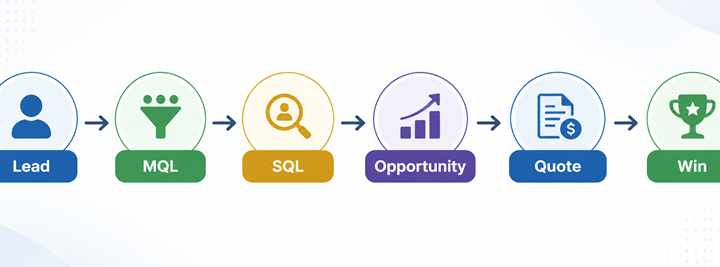
- Lifecycle stage movement from lead to MQL to SQL to RFQ to quote to closed-won
- Reporting that answers:
- Which pages and topics influence RFQs?
- Which keywords bring in quote-ready traffic?
- Where do buyers drop off before submitting an RFQ?
RFQ-first litmus test
If the agency cannot discuss attribution beyond last-click reporting, it is probably not equipped for industrial buying cycles.
6) Sales enablement integration
Industrial SEO works better when sales and marketing use the same content. Your agency should build assets that sales can use in active opportunities.
What good looks like
- Content sales can send to procurement, such as documentation, traceability, compliance, and certification pages
- Content sales can send to engineering, such as tolerance, DFM, and material tradeoff pages
- One-pagers and capability briefs developed from SEO content
- Quote-support assets such as FAQs, inspection-process pages, and lead-time policy pages
- Feedback loops from sales:
- Repeated objections become new content topics
- Lost-deal reasons inform content and page improvements
RFQ-first litmus test
Ask how often they meet with sales and what kind of sales feedback changes the SEO plan.
7) Governance
Manufacturing content often needs review for technical accuracy, regulatory wording, brand claims, export controls, or safety language. A specialist agency should be able to manage that without slowing production to a crawl.
Governance elements to look for
- Defined reviewers across engineering, quality, legal or compliance, and marketing
- Version control and clear ownership for updates
- Rules for substantiating claims around certifications, tolerances, and performance language
- A publishing cadence that accounts for review realities
- A process for updating pages when standards or specs change
RFQ-first litmus test
Can they keep work moving through real review cycles without defaulting to generic content?
RFQ-First Checklist
Use this to compare agencies side by side. Score each item from 0 to 2:
- 0 = no evidence
- 1 = partial evidence
- 2 = strong proof
A true specialist will usually score 22 or higher.
- Technical SEO for complex catalogs, including facets, duplication, and canonicals
- Keyword methodology based on specs, standards, and part numbers
- SME interview-to-asset process, with examples
- Content strategy focused on money pages and conversion paths
- CRO basics for RFQ flows, including form friction and trust signals
- Measurement tied to CRM and quotes, including assisted conversions
- Sales enablement integration and feedback loop
- Governance and review workflow experience
- Proof in similar industrial verticals, such as case studies or work samples
- A clear roadmap from discovery to strategy to implementation to measurement to optimization
Red flags in generic SEO pitches
Watch for signs that the agency is applying a standard B2B playbook to a specialized industrial problem:
- “We’ll write X blogs per month” with no discussion of money pages, RFQ paths, or SME input
- No mention of standards, specs, or modifiers in keyword research
- Overpromises such as guaranteed rankings or page-one results in 30 days
- Generic link building with no explanation of placement quality
- Reporting limited to traffic and rankings
- No plan for duplication or faceted navigation in industrial catalogs
- No interest in speaking with your engineers
- No governance plan for regulated or compliance-heavy industries
RFP questions that separate specialists from generalists
Use these questions in your RFP or agency interviews.
Technical SEO
- How do you manage faceted navigation and URL parameters without creating index bloat?
- How do you prevent keyword cannibalization across product variants and spec pages?
- What does your technical SEO audit include for industrial sites?
Keyword and content strategy
- Show your process for building keyword targets from standards, specs, and part numbers.
- How do you decide whether a keyword should map to a landing page, blog post, or FAQ?
- How do you capture hidden intent around tolerances, coatings, certifications, and inspection terms?
SME process and governance
- Describe your SME interview workflow. Who runs it, and how does it become publishable content?
- How do you manage approvals across engineering, quality, and marketing without slowing output?
Conversion and revenue measurement
- What is your plan for mapping content to RFQs instead of traffic alone?
- How do you report assisted conversions and connect SEO performance to CRM stages and quotes?
Sales enablement
- How do you build SEO content that sales can use during active deals?
- How do you gather sales feedback, and how often does it change the roadmap?
Common agency types
Most agencies fall into one of these groups:
Industrial SEO specialist
Best when you need the full system: technical SEO, content, conversion, and measurement.
Technical SEO specialist
Best when site architecture is the main blocker and you already have strong internal content resources.
Content studio
Best when your technical foundation is solid and you need scalable, SME-driven content production.
Full-service digital agency
Best when you need SEO, paid media, automation, and CRO together, but only if they understand industrial search intent and long sales cycles.
Proof points and examples to request
When an agency says it does industrial SEO, ask for proof you can verify.
Ask for before-and-after examples of
- Technical fixes such as index-bloat reduction and crawl improvements
- Content tied to lead outcomes, not traffic alone
- Growth in rankings for spec-modified terms
Ask for sample deliverables
- A keyword map tied to capability pages
- An SME interview outline and the resulting content piece
- Reporting that shows the path from SEO to CRM stages to RFQs and quotes
Sample RFQ-first KPI dashboard
The point of the dashboard is to connect leading indicators such as visibility to lagging indicators such as quotes and revenue.
| Funnel stage | KPI | System/source | Why it matters |
|---|---|---|---|
| Visibility | Impressions for spec-modified queries | Google Search Console | Shows demand capture in your niche beyond branded search |
| Visibility | CTR on top pages | Search Console | Shows whether titles and descriptions match intent |
| Engagement | Organic sessions to capability and application pages | GA4 or equivalent | Shows whether the right pages are attracting traffic |
| Engagement | CTA interaction rate, such as RFQ clicks, downloads, or contact actions | GA4 events | Early sign of quote intent |
| Lead | Form fills or RFQs from organic | CRM and form tracking | Core conversion metric |
| Lead quality | MQL rate from organic | CRM | Separates low-fit leads from real opportunities |
| Sales | Quote requests influenced by organic | CRM attribution model | Reflects the role of SEO in longer buying cycles |
| Revenue | Quote-to-win rate for organic-sourced or organic-influenced deals | CRM | Helps validate lead quality |
| Revenue | Pipeline and revenue from organic-influenced deals | CRM | Connects SEO to business impact |
Even a basic attribution setup is better than none. The goal is to build enough visibility to make better decisions and improve over time.
Neutral validation sources
Third-party review platforms can be useful as one input, but they should not decide the choice on their own. For example, Clutch presents itself as a marketplace for business service providers with verified reviews and a published methodology.
How to use reviews well
- Filter for industrial or manufacturing experience
- Look for detailed outcomes tied to leads, pipeline, CTR, or rankings connected to business goals
- Ask the agency to explain which deliverables and processes led to those results
What specialists do differently
- manufacturing SEO services -> “SEO agency for manufacturing” or “Digital Marketing for Manufacturers”
- digital marketing for manufacturers -> “Marketing for Manufacturing Companies” (Services)
- turn traffic into qualified leads -> “Conversion Optimization Strategies for B2B Industrial Websites”
Next step: request a Free Website Competitor Analysis
A practical starting point is a Free Website Competitor Analysis focused on:
- Technical SEO risks such as crawlability, duplication, and index bloat
- Spec-driven keyword gaps across standards, grades, and tolerances
- Content-to-RFQ opportunities with the strongest potential pipeline impact
FAQs
• How long does industrial SEO take to produce RFQs?
It depends on your current site, your niche, and your competition. The fastest gains usually come from technical fixes and high-intent capability or application pages, not from top-of-funnel blogging alone.
• Should we prioritize standards pages or capability pages?
In most cases, start with capability and application pages because they are closer to conversion. Standards and spec pages can then support validation and capture longer-tail search demand.
• Do we need engineers involved?
Yes. For niche industrial keywords, engineer input is usually essential, even if it is limited to structured interviews and review.
• What if our search volume is low?
That is normal in industrial niches. Focus on qualified actions and quote influence, not raw traffic.
• Can an agency do this without CRM access?
They can make progress, but it is much harder to connect SEO work to quotes and revenue without at least some CRM alignment and lifecycle reporting.